
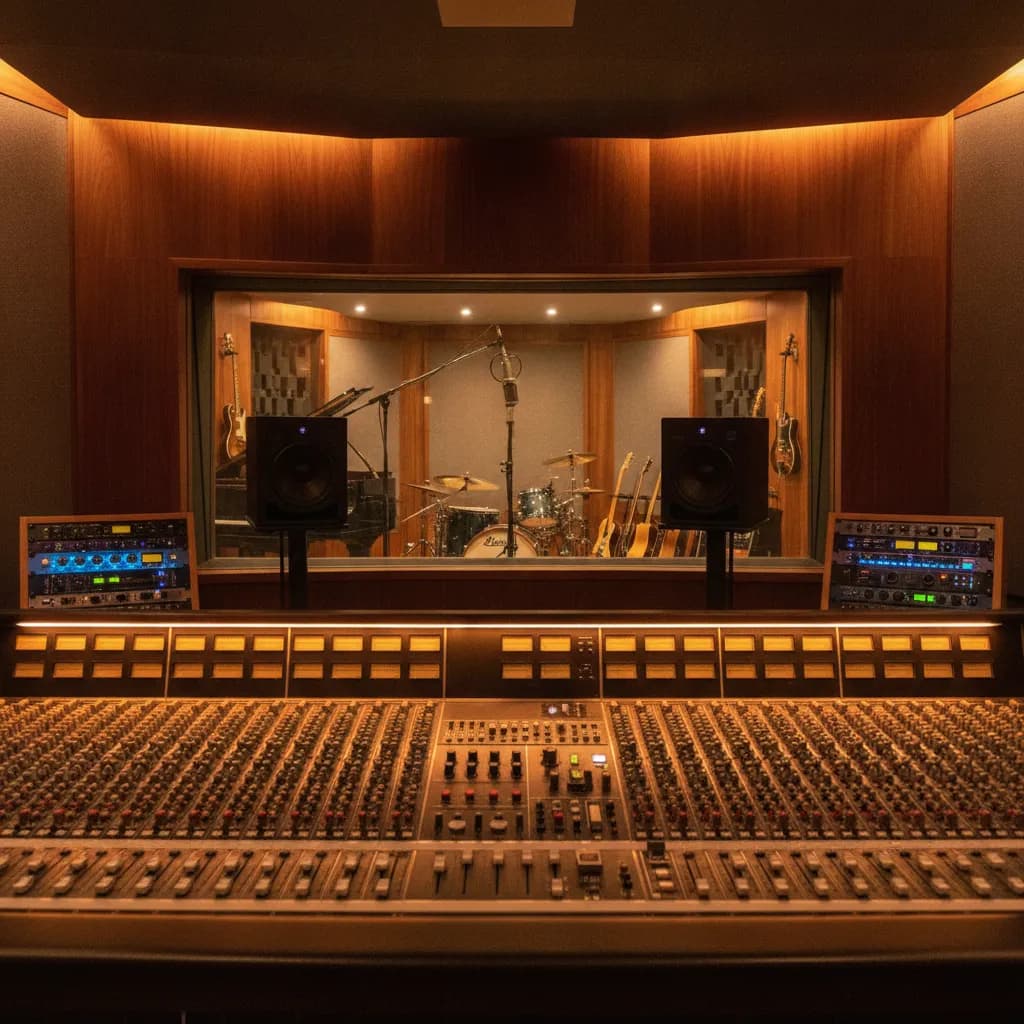
The right studio for your project is the one whose room matches your source, has a posted rate you can verify, and includes an engineer in that rate. In Los Angeles, recording studio time runs anywhere from $50 to over $300 per hour, so the spread is wide — but hourly rate is rarely the most important number. A cheap rate is not the same as a good value.
The five things that actually matter
1. Does the room fit your source?
A vocal booth and a live room are different tools. A singer-songwriter or podcaster needs a dead, controlled space — parallel walls and kit drums would ruin the take. A band tracking live needs square footage, a real drum kit, and ideally a baby grand if keys are on the record. Confirm physical fit before you look at anything else. See the Rainforest Room (vocals, voiceover, podcasts) and the Rock Room (full band, drum kit, baby grand) for how Paradise splits this.
2. Is an engineer included — and at what price?
This is the single question most artists forget to ask. Studio time in Los Angeles typically ranges from $35–$150 per hour, depending on the studio, equipment, and whether an engineer is included. Some studios quote a room-only rate and add the engineer as a separate line item. Rates usually include a staff engineer, though some studios charge separately for engineering. Always ask: "Is an engineer in the room for the full session at this price?" If the answer involves a separate hourly fee, recalculate your total before you book. Read more in our guide to do recording studios provide an engineer?
3. Are the rates posted and complete?
Transparent pricing is a green flag. Many artists focus only on the hourly price, yet the total cost of recording a finished, releasable song comes from a combination of studio time, production complexity, and session efficiency. If a studio won't publish its rates, expect surprises. Look for block rates (4 hr, 6 hr, 8 hr, 12 hr) because the per-hour cost usually drops meaningfully as you book longer — and a 6-hour session almost always produces more than two back-to-back 3-hour sessions. See the full LA cost breakdown for tier-by-tier numbers.
4. What are the cancellation and deposit terms?
Across the industry, a 50% non-refundable deposit to hold your slot is standard. A 50% deposit is required to book your first session; the deposit will be applied to your session or refunded if you cancel more than 48 hours before your session time. The 48-hour window is the most common grace period — some studios are stricter. If you arrive late, your session may be shortened to accommodate others; depending on how late you arrive, your engineer will determine if there is enough time remaining to start the session, and regardless of the length of the session you will be responsible to pay for the entire session. Know the policy before you sign. Our guide on recording studio deposit and cancellation policy covers what's normal in LA specifically.
5. Can you actually get there — and load in?
Aside from choosing a studio near enough to travel to, it's important to make sure there aren't any practical headaches on the day — look for a studio with vehicular access for unloading and loading equipment and easy parking. For a solo vocalist this is minor; for a band hauling a 4×12 cabinet it can define your whole morning.
The checklist table: what to ask, what to look for
| Question to ask | Green flag | Red flag |
|---|---|---|
| Is an engineer included at this rate? | Yes, in the room the whole session | Engineer is extra, or "available on request" |
| Are full rates published on the website? | Block rates clearly listed for 2 hr, 4 hr, 6 hr, 8 hr, 12 hr | "Contact us for pricing" only |
| Does the room fit my source? | Separate vocal and live rooms with specs listed | One room described as good for "everything" |
| What gear is in the room? | Named consoles, mics, and outboard listed | Vague ("professional equipment") |
| What are the deposit and cancellation terms? | 50% deposit, 48-hour cancellation window, policy in writing | No written policy, or full session charged on any cancellation |
| What are the hours? | Open late (e.g., 9 am–2 am daily) | Limited hours that force early wrap |
| Is parking or load-in practical? | Public parking nearby, ground-floor access for gear | Street-only parking, elevator-only load-in for heavy kit |
| Can I hear work from this room? | Portfolio or SoundCloud with genre-relevant examples | No audio samples anywhere |
The cheapest hourly rate is often not the cheapest session
This deserves its own heading because it trips up first-timers every time. A more experienced engineer will do a better job faster than a less experienced engineer — your engineer will have a greater impact on the sound and cost of your recording than any other variable. A $75/hr room with a sharp engineer who knows your genre can finish a track in four hours. A $40/hr room where you spend two hours troubleshooting a signal chain issue costs more in the end.
The same logic applies to block rates. The most common model for mid-range studios and commercial facilities is hourly billing, where you pay for each hour you use the studio, typically with a minimum booking requirement of two to four hours. Booking a 6-hour block instead of two separate 3-hour sessions almost always saves money per hour and gives you the runway to actually finish something. See how many hours it takes to record a song before you pick a block size.
Gear that matters vs. gear that is theater
A long gear list on a studio website is not automatically a good sign. What matters is whether the specific gear in the room serves your project:
- Vocals/podcasts: A quality large-diaphragm condenser, clean preamps, and a well-treated booth matter more than a vintage console in the next room.
- Drums: The room size and acoustic treatment are the gear. A kit in a dead 10×10 space sounds worse than a modest kit in a properly sized live room.
- Mixing/mastering: Accurate monitors and a treated mix room matter more than any single piece of outboard. See mixing and mastering services cost for what to expect post-session.
What LA rates actually look like in 2026
Recording studios in Los Angeles average $110 per hour to rent, but that number flattens a very wide range. Typical listings on booking platforms run between $65 and $110 per hour for mid-tier rooms. Premium rooms at established facilities run higher. Budget and overnight rooms can run lower. The table below shows typical LA market ranges alongside Paradise's posted block rates for direct comparison.
| Session length | Typical LA range (mid-tier, engineer included) | Paradise — Rainforest Room | Paradise — Rock Room |
|---|---|---|---|
| 2 hours | $130–$250 | $200 | $250 |
| 4 hours | $260–$480 | $295 | $395 |
| 6 hours | $390–$700 | $450 | $595 |
| 8 hours | $520–$950 | $595 | $795 |
| 12 hours | $780–$1,400 | $850 | $995 |
Typical LA ranges are estimates based on publicly listed mid-tier studio data as of mid-2026. Engineer included in all Paradise rates.
Getting to the studio: a practical note
If you're coming from the Westside, logistics are easier than most LA sessions. The Metro E Line's Downtown Santa Monica station is located near the intersection of 4th Street and Colorado Avenue and is the E Line's western terminus — a five-minute walk from the studio at 1505 4th St, Ste 219. Big Blue Bus lines stop within a couple of blocks. If you're driving, Santa Monica's downtown public parking structures on 4th and 5th Street start with free hours, so a short session often costs nothing to park. For bands loading in heavier gear, the structure access beats street parking by a wide margin.
Nearby: Harvelle's (the Westside's oldest live-music room, directly across 4th St, open since 1931) and McCabe's Guitar Shop on Pico Blvd for strings or a last-minute repair before your session.
An honest word about home studios
If you're recording a single acoustic guitar and a vocal for a demo, a well-treated home setup with a decent interface can get you 80% of the way there. The case for a professional room is strongest when: (1) you need a drum kit tracked properly, (2) you want an experienced engineer's ears in real time, (3) you're cutting something for release and the mix environment matters. Our guide on home studio vs. professional recording studio lays out the honest comparison.
Frequently asked questions
How do I know if a studio engineer is any good?
Ask for recent work in your genre — any credible studio will have a portfolio or SoundCloud. Get to know the people behind the studio; if you are not working with your own audio engineer, get to know the studio engineer and find out if you're a good fit — talk about music, experiences, and figure out how they align. A 15-minute phone call before booking tells you more than any gear list.
Is a 2-hour session ever enough?
For a single vocal overdub or a podcast episode with one host, yes. For tracking a full song from scratch, plan for at least 4–6 hours. Read how many hours it takes to record a song for realistic estimates by project type.
What's a normal deposit to hold a session?
A 50% deposit is required to book and schedule studio time, with the remaining balance due in full the day of your session. This is the near-universal standard. If a studio asks for 100% upfront with no cancellation window, that's worth questioning.
Does the cheapest hourly rate mean the cheapest session?
Rarely. Studio quality, engineer experience, preparation, and workflow efficiency all affect the final investment. A slower workflow or an engineer unfamiliar with your genre can easily double your hours. Budget for the total session cost, not just the hourly rate.
What should I bring to my first session?
Tuned instruments, charted arrangements, and a reference track of the sound you're going for. Anything you can decide before you walk in saves expensive clock time inside. See our how to prepare for your first recording session checklist.
What's the difference between a tracking room and a mix room?
A tracking room is optimized for capturing performances — isolation, live sound, booth separation. A mix room is optimized for playback accuracy — flat response, treated walls, precise monitors. Some studios have both; others specialize. If you need both, ask whether the same engineer handles both stages or whether you'll hand off to someone new.
Next steps
- Book a session — open 9 am–2 am daily, engineer included
- Explore our studios — Rainforest Room and Rock Room specs, photos, and gear
- Mixing and mastering — post-session services
- Membership options — better value if you record regularly
- Best recording studios in Santa Monica (2026) — how we compare to nearby options
- Best recording studios in Los Angeles (2026) — full Westside overview
- How much does it cost to record a song in Los Angeles?
Facts and prices on this page last verified 2026-08-03 by the Paradise Recording team.