
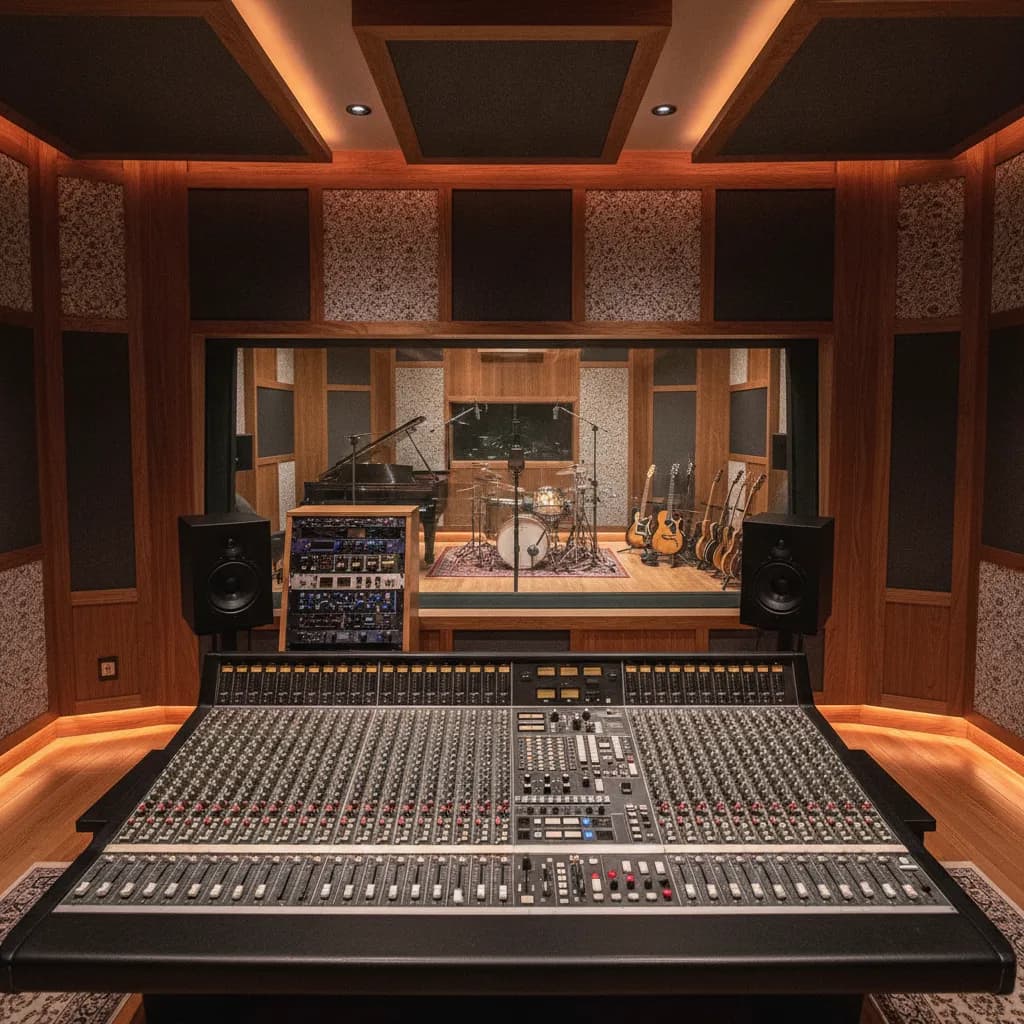
The honest answer to the home studio vs professional recording studio question is: both, at different moments. Home setups have become genuinely capable — you can write, demo, produce beats, track scratch vocals, and do a lot of pre-production work at a quality level that would have cost thousands per day in a commercial room fifteen years ago. But there are specific tasks — live drums, final vocals, critical monitoring, and the objectivity that comes from a neutral room and a fresh set of ears — where the physics of a purpose-built space still matter, and where a few targeted pro hours pay for themselves.
This guide is for LA-area artists, bands, and podcasters trying to figure out where their budget actually belongs. We'll cover what home setups do well (and the real cost to get there), where they reliably hit a wall, what the hybrid workflow looks like in practice, and what a few hours in a pro room can realistically add to a track you've already built at home. No hype in either direction — just the practical math and the honest trade-offs.
Quick takeaways
- Home studios are genuinely good for production, demos, and iteration. A home studio provides immediate access to recording tools without scheduling constraints — a freedom that benefits artists who rely on frequent practice, quick iterations, and flexible deadlines. Lower costs also make experimentation less stressful.
- A functional home setup costs $500–$1,800 all-in. A fully functional home studio runs $500–$1,200 depending on gear choices — mic, interface, headphones, monitors, DAW — plus $200–$600 for basic acoustic treatment.
- Room acoustics matter more than gear. Many home studios go wrong by spending thousands on fancy equipment while ignoring the room itself. A $5,000 microphone in an untreated spare bedroom will sound worse than a $200 mic in a well-treated space.
- LA pro studio rates span a wide range. Studio time in Los Angeles typically ranges from $35–$150 per hour, depending on the studio, equipment, and whether an engineer is included. Boutique rooms with included engineers sit in the mid-range of that band.
- The hybrid workflow is the real-world standard. Many creators ultimately use both: home setups for drafting and experimentation, and professional environments for final recordings where precision matters most.
- Targeted pro sessions — drums, final vocals, mixing — are where the investment makes the most sense. You don't have to choose one or the other permanently; most working indie artists in LA use both strategically.
What home studios genuinely do well
Let's be fair here, because the home studio has earned its place. Advancements in technology have made it easier and more affordable than ever to create high-quality audio from the comfort of your own home.
Production and beat-making are the clearest wins. If you're working entirely in the box — programming drums, layering synths, editing samples — you can produce commercially competitive work from a bedroom. The DAW gap between home and pro has essentially closed. Digital audio workstations give us immense power to easily edit, comp, shift, and adjust music, and it's now common for many producers and engineers to work entirely on laptops.
Demos and pre-production are another genuine strength. Being able to record a rough vocal idea at 11pm without booking a session — and without a clock running at $75/hr — is genuinely valuable. A DIY recording studio is excellent for experimentation. You can find your sound, get comfortable hearing your voice, and practice playing to a click track. Arriving at a pro session with your arrangements locked, your tempos decided, and your scratch vocals done means you spend studio dollars on takes that matter — not on figuring out the song.
Podcasting and voiceover (in a treated room) can also work well at home, particularly for solo formats where the consistency of your own space is an asset.
The key phrase in all of this is in a treated room. Most home studios need acoustic treatment — controlling sound inside the room — not soundproofing, which blocks outside noise. Treatment costs $200–$600 in DIY panels. That's manageable. What's not manageable in most apartments or houses is the low-end: at home, you're dealing with reverberations from untreated walls, and phase issues that standing waves in the room can cause. This is the silent killer of home mixes — you think the low end sounds right because you've been listening in that room for months, but it doesn't translate on other speakers.
Where home studios hit a wall
Drums
This is the clearest case. You cannot track a live drum kit in a standard home or apartment — not legally, not acoustically, not practically. High-end recording studios that accommodate live drums typically range from $50,000 to $250,000+ depending on space requirements, custom room construction, and analog outboard equipment choices. These facilities accommodate larger ensembles and include custom-built acoustically treated rooms. That investment exists because drums require it. The bleed, the room sound, the low-frequency energy — none of it can be faked with foam panels on bedroom walls.
Drum samples and programmed kits are a legitimate creative choice for many genres. But if your music calls for the real thing — rock, jazz, Americana, R&B with a live feel — you need a room built for it. That's a targeted use case for a pro studio, not a full album commitment.
Vocals — the subtler problem
Home vocal recording is possible, but it's harder than it looks, and the gap between "usable demo" and "release-ready" is real. A professional recording studio's controlled environment minimizes background noise, such as the AC running or a dog barking. In addition to the room acoustics, high-quality studio microphones also help capture the best sound.
Beyond noise, there's the microphone and preamp chain. High-end microphones, preamps, converters, and monitoring systems capture voices with clarity and depth that are difficult to replicate at home. A Manley Reference mic through a Tube-Tech CL 1B compressor and API preamps — the kind of signal chain in a well-equipped boutique room — simply captures more of what makes a voice interesting. That's not snobbery; it's physics.
Monitoring — the invisible problem
This is the one most home recordists underestimate. Achieving professional-grade audio quality at home can be challenging. External noises, echoes, and ambient sounds may interfere with recordings. But more insidiously, an untreated room gives you a false picture of your own mix. You EQ for a room that doesn't exist anywhere else. You make decisions on a bass response that's being colored by your walls. The result is a mix that sounds great in your bedroom and falls apart on headphones, in a car, or on a club system.
Professional studios invest heavily in calibrated monitoring environments precisely because the room is the tool. A professional studio is built around accuracy and reliability. Acoustically engineered rooms minimize unwanted resonance and ensure that recordings translate consistently across platforms.
Objectivity
There's a less technical but equally real problem with recording entirely at home: you lose perspective. When you've been staring at the same session in the same room for three weeks, you stop hearing it. A good engineer in a neutral room hears your track fresh. Experienced engineers also play a key role: they correct issues in real time, guide performance nuances, and optimize workflow so talent can focus entirely on delivery. That outside perspective — someone who isn't emotionally attached to take seven of the second verse — is worth something that gear can't replace.
The hybrid workflow most indie LA artists actually use
The practical answer in 2026 isn't "home or pro" — it's a deliberate split. Underground indie artists often benefit from a hybrid approach: record the core live feel — drums, bass, guide guitar/vocals — to capture energy, then overdub guitars, textures, and lead vocals for clarity.
Here's what that typically looks like in practice:
At home:
- Write and arrange the song fully
- Program or sketch drums to lock the tempo and structure
- Record scratch vocals to guide the arrangement
- Build out production elements (synths, samples, DI guitars)
- Do rough mixing passes to understand the track's needs
In the pro room:
- Track live drums (often a half-day or full day)
- Cut final lead vocals with a proper mic chain and a fresh engineer's ear
- Track any acoustic instruments that need the room (piano, acoustic guitar, strings)
- Do a final mix pass on calibrated monitors, or send to mixing and mastering
This approach means your studio budget is concentrated on the sessions where the room genuinely changes the outcome. You're not paying $100/hr to record scratch guitar that you'll replace anyway.
For bands tracking everything live together, the calculus shifts — you probably need the pro room for the full tracking session. See our band recording studio guide for how that math works in LA. For solo artists and producers, the hybrid approach is often the most efficient path.
What a few pro hours actually add to a home-produced track
Let's be concrete about this, because "professional quality" is a phrase that gets thrown around without much meaning.
A 2-hour vocal session in an acoustically treated room with a quality large-diaphragm condenser, a real compressor in the hardware chain, and an engineer who can coach the performance typically yields:
- Cleaner noise floor (no HVAC hum, no street noise, no neighbor's TV)
- More dynamic range captured before limiting — the mic and preamp capture the full character of the voice
- Better takes, because the artist is focused on performing rather than managing gear
- A file that sits in a mix without needing heavy corrective EQ
A 2-4 hour drum tracking session adds the one thing you genuinely cannot fake: a real room. The transients, the bleed between mics, the low-end thump of a kick in a live room — these are what make a record feel physical rather than constructed.
A mix session on calibrated monitors — or sending your stems to a professional mix engineer — is often the highest-ROI move of all. If you're preparing music for Spotify, Apple Music, YouTube Music, radio, sync licensing, or commercial release, a professional recording environment often delivers better sound quality, greater efficiency, and a smoother creative experience. A mix done in a room you can trust translates. One done in an untreated bedroom often doesn't.
None of this requires a week in a $500/hr room. Recording a song at an LA recording studio in 2026 can cost anywhere from $50 to over $300 per hour. Boutique studios — the mid-tier rooms with real gear and an included engineer — sit in the middle of that range and offer the best value for targeted sessions. LA recording studio rates typically range from $30–$100/hour for project studios to $500/hour for world-class facilities, and most studios offer block booking discounts and package deals.
At Paradise Recording in Santa Monica, the Rainforest Room (vocals, voiceover, podcasts) starts from $200 per 2-hour block with an in-house engineer included — that's a full vocal session with professional gear and engineering guidance for roughly what you'd spend on a decent condenser microphone. The Rock Room — with a full drum kit, baby grand piano, and live-band setup — starts from $250 per 2-hour block. Both rooms are a five-minute walk from the Metro E Line's Downtown Santa Monica terminus at 4th & Colorado, and the downtown parking structures on 4th and 5th start with free hours, so a short session often costs nothing to park.
For a deeper look at what pro sessions cost across LA, see our honest pricing guide and the how many hours to record a song guide.
Making the call: a simple decision framework
Here's a plain-language decision tree:
Lean toward home recording if:
- You're writing, demoing, or in pre-production
- You're producing electronic or hip-hop music that doesn't require live acoustic tracking
- You need unlimited time to experiment without a financial clock running
- You already have a treated room and a decent signal chain
Lean toward a pro session if:
- You're tracking live drums — full stop
- You're cutting final lead vocals for a release (especially if your room is untreated)
- You need your mix to translate across systems and you don't trust your monitoring
- You want an experienced engineer's ear on the performance in real time
- You're recording for sync licensing, broadcast, or commercial release where technical standards matter
Use the hybrid if:
- You have both a home setup and a recording budget (most working indie artists)
- You want to minimize studio hours while maximizing what those hours produce
- You're building an EP or album over multiple months
The hybrid approach is also where a studio membership can make a lot of sense — a predictable monthly cost for access to a pro room when you need it, without paying full day rates for every session.
Frequently asked questions
Can I record a full album at home?
Yes, for certain genres and formats — electronic, hip-hop, lo-fi, and heavily produced pop tracks have all been made commercially at home. But if your album includes live drums, acoustic instruments that need a room sound, or vocals where you need the best possible capture, you'll likely want at least some pro sessions in the mix. The question isn't whether it's possible — it's whether the result is what the music needs.
How much does a decent home studio cost to set up in 2026?
A fully functional home studio runs $500–$1,200 depending on gear choices — mic, interface, headphones, monitors, DAW — plus $200–$600 for basic acoustic treatment. You can get started for under $1,000 if you're disciplined about priorities. Spending more than that without treating the room first is a common mistake.
Is the engineer included when I book a pro studio?
It depends on the studio. Studio time in Los Angeles typically ranges from $35–$150 per hour, depending on the studio, equipment, and whether an engineer is included. Some studios charge the engineer separately; others include one in the room rate. At Paradise Recording, an in-house engineer is included in every session — no add-on fee. See our full guide on whether recording studios provide an engineer for what to ask before you book.
What's the most common mistake home recordists make?
Ignoring the room. Proper acoustic treatment often provides better return on investment than expensive equipment in poorly treated rooms. Before buying a better microphone, address your monitoring environment. Bass traps in corners, absorption at first reflection points, and a calibrated reference are worth more than upgrading your interface.
How do I know when my home recording is "good enough" to release?
Test it on multiple playback systems: your phone speaker, earbuds, a car stereo, a Bluetooth speaker, and a decent pair of headphones. If it sounds consistent — not perfect, but coherent — across all of them, it's translating. If it sounds great at home and thin or muddy everywhere else, the room is lying to you and you need either better treatment or a mixing session on calibrated monitors.
How far in advance should I book a pro studio in LA?
Book 2–4 weeks ahead for most LA studios, especially during peak times (evenings and weekends). High-end studios may require 1–2 months' notice. Boutique studios are often more flexible. Paradise Recording is open 9am–2am daily and takes bookings at /book — checking availability a week or two out is usually enough for weekday sessions.
What's a deposit policy like at a typical LA studio?
Policies vary, but most professional studios require a deposit at booking — commonly 50% — and have a cancellation window (often 24–48 hours) after which the deposit is forfeited. Read the full breakdown in our guide on recording studio deposit and cancellation policies before you book anywhere.
Should I mix and master at home or send it out?
If you have a well-treated room and strong mixing chops, home mixing is viable. If you're unsure about your monitoring environment, sending stems to a professional mixer is often the highest-ROI move in your whole production budget. Check our mixing and mastering services cost guide for what to expect to pay and what you actually get. Paradise Recording also offers mixing and mastering services if you want to keep it all in one place.
Next steps
- Book a session — Rainforest Room from $200/2hr, Rock Room from $250/2hr, engineer always included
- Explore our studios — see both rooms, gear lists, and what each is built for
- View the Rainforest Room — vocals, voiceover, podcasts
- View the Rock Room — full-band tracking, drums, baby grand piano
- Learn about membership — a monthly option if you're recording regularly
- Mixing and mastering services — send us your home-produced stems
- How much does it cost to record a song in LA? — full pricing context
- How to prepare for your first recording session — get the most out of your pro hours
- Best recording studios in Santa Monica (2026) — broader local context if you're still shopping around