
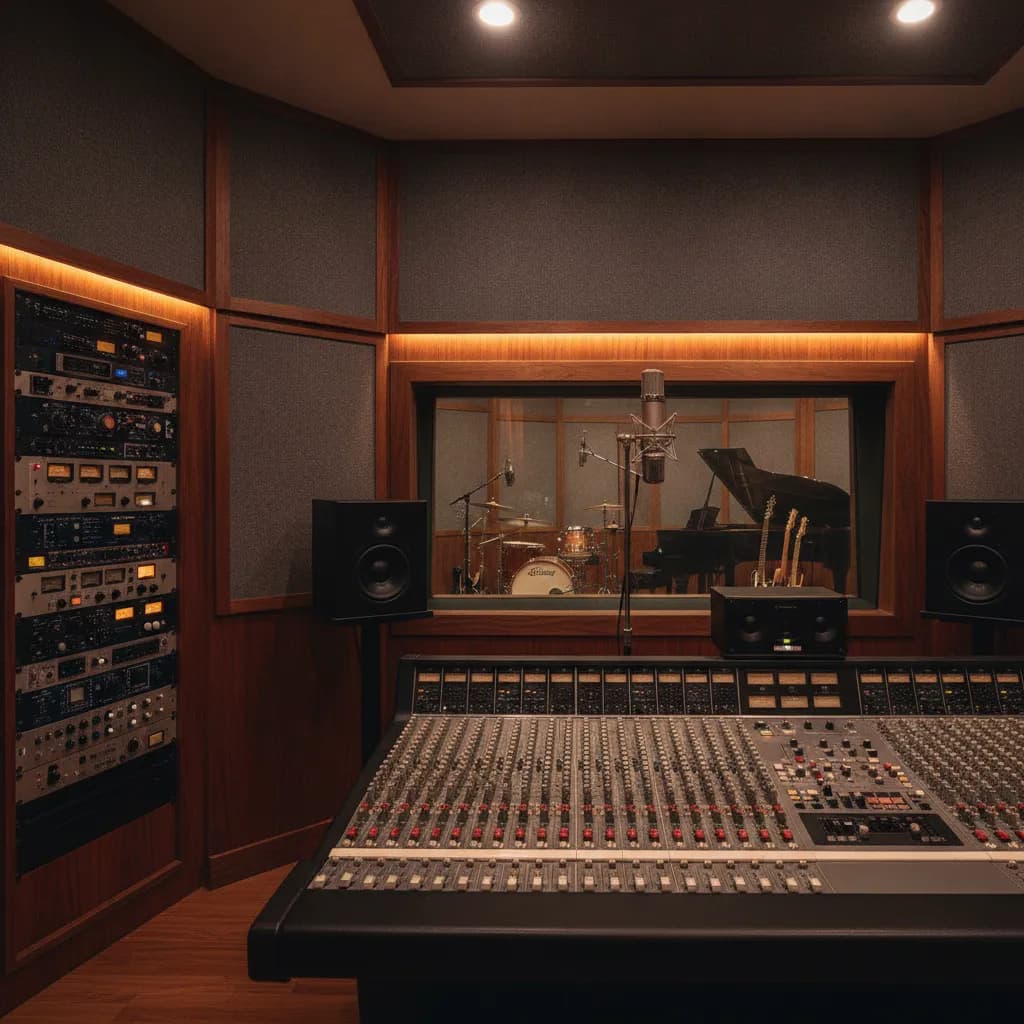
Tracking a full band in a Los Angeles studio is a fundamentally different undertaking from a solo vocal session or a producer building a beat in the box. You're coordinating multiple musicians, multiple signal chains, and a room big enough to hold a drum kit — all at the same time. The short answer: it's absolutely doable on a working-band budget in 2026, but only if you go in with a clear plan for your recording approach, your room requirements, and your rehearsal prep.
This guide covers the real decisions you'll face when booking a band recording studio in Los Angeles: the live-off-the-floor vs. overdub question, what isolation and drum rooms actually do for your sound, what the LA market charges for full-band sessions, how to get the most out of the hours you pay for, and what to look for in a room. If you're weighing your options on the Westside, we'll also explain how Paradise Recording's Rock Room fits into that picture — honestly, without the sales pitch.
Quick takeaways
- LA band studio rates span a wide range. Recording at an LA studio in 2026 can cost anywhere from $50 to over $300 per hour, with the spread driven by room size, gear quality, and whether an engineer is included. Budget at least $100–$150/hr for a room that can properly handle a full kit.
- Live-off-the-floor captures energy; overdubs give you control. Perhaps the biggest plus for recording live is that you'll capture the full, glorious power of a band performance, with musicians reacting to each other consciously and subconsciously. Overdubs let you fix things; live recordings let you feel things.
- Bleed is the central trade-off. If all the band members are in the same room playing fully amplified, you'll inevitably capture a lot of microphone bleed across tracks, which can be a real headache at the mixing stage.
- Rehearsal is not optional. Rehearsal is crucial if you track live. Tiny mistakes and inconsistencies come through loud and clear on a record, so you need to be tight.
- Deposits and cancellation windows are industry standard. Across the industry, a 50% deposit to hold the date is the norm, with most studios requiring 48 hours' notice or more to cancel without penalty.
- A pre-mic'd drum kit saves you real money. Setup time is billable time. A room with a permanently installed, well-tuned kit and pre-run mic lines can shave 30–60 minutes off a session before you play a single note.
Live-off-the-floor vs. overdubs: which approach is right for your band?
This is the first decision to make, and it shapes everything else — room choice, session length, budget, and how tight you need to be before you walk in.
Recording live off the floor
Recording a band live means putting everyone in a room, pointing microphones at them, and capturing what happens when they play together — the drums, the guitars, the bass, the vocals, all bleeding into each other's microphones to varying degrees, all responding to each other in real time. That mutual response is the whole point. A tightly rehearsed band sounds more lifelike, spontaneous, and human when recorded this way.
The practical upside: instead of scheduling multiple sessions for different instruments, everything is captured in one go, which can save costs and provide a cohesive sound that reflects the unity of the band.
The practical downside: live recording is more accident-prone. Your entire song is being captured in a single moment, and fixing mistakes is much harder. If your drummer flams the snare on bar 12 of an otherwise perfect take, you may need to re-cut the whole thing.
Best for: punk, garage rock, country, jazz, folk — any style where the live-room feel is a feature, not a bug. Also great for bands that have played these songs 50 times already.
The overdub approach
Overdubbing means piecing a track together by recording each element on its own, over the top of those already recorded. You might first record the drums, then have the bassist record their part over the drum track, followed by the guitars, then the vocals.
Overdubbing allows for the careful layering of sounds. You can record each instrument or vocal track separately, which gives you control over the mix and the chance to fine-tune each element — and that can elevate the overall sound quality of the final product.
The trade-off is time and feel. Building a song part by part takes more session hours and can produce a technically clean but emotionally stiff result if the players aren't experienced working to a click track in isolation.
Best for: pop, modern rock, metal, hip-hop-influenced bands, or any project where sonic precision matters more than live-room energy.
The hybrid: the smart middle ground
These days you can use both approaches together. You can record a few takes with your band present, knowing you can overdub and edit later thanks to multitrack recording. You still get the organic "live in the room" feel, but any mistakes are no longer permanent.
In practice, this often means: drums and bass (and sometimes scratch guitar) tracked live together as the foundation, then guitars, keys, and vocals overdubbed cleanly. The intention in initial tracking sessions is to play together as a band, but the focus in the control room is capturing the main foundation — drums, bass, guitar, and piano. The vocalist sings, everyone does their part, but the main focus is to get the foundation right.
What isolation and drum rooms actually do for your sound
If you're tracking a full kit, the room is not a nice-to-have — it's a technical requirement.
Why the drum room matters
Professional studios usually have a dedicated booth in which the drums and drummer are placed. This serves several purposes. The walls of the booth may be made of brick or stone to give a hard, bright, reflective sound that often suits rock drumming, or it may be well-damped and absorptive so it adds no character at all. The choice of room character is a production decision as much as an acoustic one — a live, reflective kit room gives you that vintage rock sound; a dead room gives you modern punch you shape entirely in the mix.
Isolation for amps and other instruments
Isolation booths for instruments are usually not used to create a particularly dry sound but for separation. When the whole band is recorded at the same time, it's often better to place the bass and guitar amps in isolation booths to avoid spill in the drum microphones.
If you're recording a band that plays really loudly, sticking the amps in iso booths is the right call. Likewise, isolation makes sense if the band or producer specifically wants a modern, slick sound, regardless of volume.
The practical takeaway: if you want to play live but still have the ability to re-amp a guitar or punch in a bass line without ruining the drum tracks, you need at least some degree of source separation. A room with gobos, baffles, or a dedicated iso space gives you that flexibility.
What about bleed — is it always bad?
Not necessarily. In rooms with good mic technique and portable panels placed strategically between instruments, you can produce an astonishing amount of isolation — and you can capture bleed separately with room mics to control exactly how much "room" ends up in the recording. Experienced engineers use bleed intentionally; it's only a problem when it's uncontrolled.
What a full-band session costs in Los Angeles in 2026
Let's be direct about numbers, because the market is genuinely wide.
The LA rate landscape
Studio time in Los Angeles typically ranges from $35–$150 per hour, depending on the studio, equipment, and whether an engineer is included. At the top end, LA studios in 2026 can run over $300 per hour. That's a huge range, and the right tier depends on what you actually need.
For a full-band session with a real drum room, professional mic pre's, and an engineer who knows how to track a kit, you're realistically looking at the middle to upper portion of that range. Budget-tier rooms at the low end of the market often lack the acoustic treatment, mic inventory, or room size to handle a full band properly. Studio quality, engineer experience, preparation, and workflow efficiency all affect the final investment.
What changes the number
- Engineer included or not. Some studios charge the room rate and then bill the engineer separately. Always ask up front. Rates usually include a staff engineer, though some studios charge separately for engineering.
- Session length and block rates. You typically book with a minimum booking requirement of two to four hours. Longer blocks usually come at a lower effective hourly rate than single-hour bookings.
- Setup time. All production setup time is part of the session time booked and charged at most studios. A room with a permanently installed, pre-mic'd drum kit eliminates the 45–60 minutes you'd otherwise spend placing and cabling mics before you ever hit record.
- Mixing and mastering. Tracking is just the beginning. Budget separately for post-production — see our guide to mixing and mastering services costs for honest 2026 numbers.
At Paradise Recording
The Rock Room starts at $250 per 2-hour block, with an in-house engineer included in every session. The room is built for bands: full drum kit, baby grand piano, and a selection of amps — all in the room and ready to track. No extra engineer fee, no surprise add-ons. Because the kit is permanently installed and pre-mic'd, you're not burning your first hour on setup. You can see the full pricing structure and book directly with no phone tag.
For a realistic EP budget, think in terms of 4–6 hour blocks per song (tracking day) plus separate mixing time. That math changes significantly based on how well-rehearsed you are — more on that below.
Rehearsal prep: the single biggest variable in your studio bill
No amount of great gear compensates for a band that doesn't know its parts. This is not a criticism — it's arithmetic. Studio time costs money per minute. Every moment spent working out an arrangement, debating a tempo, or waiting for someone to learn a chord change is money spent on something you could have settled in a rehearsal room for a fraction of the price.
Here's a practical pre-session checklist for bands:
- Demo the songs. Even a phone recording in your rehearsal space tells you where the problem spots are. Fix them before you pay studio rates.
- Agree on tempos and click track settings. Know your BPMs. If you're tracking to a click, practice to one. Playing to a consistent tempo reference can be crucial for editing takes together or making fixes later.
- Tune your instruments — and your drum heads. A poorly tuned kit is one of the most common session-killers. New heads, properly tensioned, make a dramatic difference. McCabe's Guitar Shop on Pico Blvd is a short drive for strings and any last-minute repairs before a session.
- Decide your approach in advance. Live-off-the-floor, hybrid, or full overdubs? Know before you walk in so the engineer can set up the room appropriately.
- Assign a band spokesperson. One person communicates with the engineer. Competing instructions slow everything down.
- Arrive on time — or early. The billing of a recording session begins at the start time agreed upon during the booking. Arriving 10 minutes early costs you nothing. Arriving 15 minutes late costs you 15 minutes of session time.
For a deeper checklist, see our guide on how to prepare for your first recording session.
Booking logistics: deposits, cancellations, and scheduling norms
Deposits
A 50% deposit to hold your date is the industry standard across LA studios. A 50% deposit is required to book your first session, and it will be applied to your session or refunded if you cancel more than 48 hours before your session time. Some studios are stricter — for all cancellations, the initial 50% deposit is typically forfeited and non-refundable. Read the policy before you sign, especially for longer band sessions where the deposit amount is significant.
Cancellation windows
Same-day booking is genuinely rare at professional studios in LA. Most rooms require 24 to 48 hours' notice. For a full-band session where the engineer needs to prep the room and kit, give as much lead time as you can — a week or more is courteous and ensures you get the slot you want.
How many hours to book
There's no universal answer, but a rough guide for a four-piece band:
- 2-hour block: Good for tracking one tight, well-rehearsed song live-off-the-floor, or for laying down drum and bass foundations for two songs.
- 4-hour block: A realistic tracking day for one song with overdubs, or two songs live.
- Full-day / lockout: For bands recording an EP or album in a concentrated push. Ask about day rates — many studios discount longer bookings.
See our guide on how many hours it takes to record a song for a more detailed breakdown by session type.
The Rock Room at Paradise Recording: an honest look
The Rock Room is Paradise Recording's full-band tracking space, located in Santa Monica at 1505 4th St, Ste 219. Here's what's actually in the room and why it matters for a band session:
- Full drum kit, pre-mic'd. You walk in and play. No setup clock ticking on your session budget.
- Baby grand piano. Available in the room for sessions that need it — useful for bands with keys or for piano-driven arrangements.
- Amplifiers. Guitar and bass amp options in-room, so you're not hauling a half-stack across the 10 Freeway.
- Pro signal chain. Manley Reference microphone, Tube-Tech CL 1B compressor, API preamps, and Focal Twin6 monitors in the control room. These are the tools that make drum tracking sound like a record, not a demo.
- In-house engineer, always included. Every session at Paradise comes with an engineer — no surprise add-on fees. If you want to know more about what that means in practice, our guide on whether recording studios provide an engineer explains the industry norm.
- Hours: 9am–2am daily, which gives bands flexibility around day jobs, rehearsals, and travel. See our late-night studio guide if you're looking for evening sessions specifically.
Getting there: The Metro E Line's Downtown Santa Monica terminus at 4th & Colorado is about a five-minute walk. Big Blue Bus lines stop within a couple of blocks. If you're driving, Santa Monica's downtown parking structures on 4th and 5th Street start with free hours — a short session often costs nothing to park. Coming from Venice, you're about 10 minutes via Lincoln; from Culver City, roughly 15 minutes via Washington; from Hollywood, allow 25–35 minutes on the 10 depending on traffic.
The studio is directly across 4th Street from Harvelle's, the Westside's oldest live-music room (open since 1931) — a good sign for the neighborhood's commitment to working musicians.
For a broader look at Westside options, see our guides to recording studios in Santa Monica and recording studios in Venice.
Frequently asked questions
How much does it cost to record a full band in Los Angeles?
Recording at an LA studio in 2026 can cost anywhere from $50 to over $300 per hour, and the true cost depends on factors beyond just the hourly rate. For a full-band session with a proper drum room and included engineer, budget realistically in the $100–$200/hr range for a mid-tier professional facility. The Rock Room at Paradise Recording starts at $250 per 2-hour block with engineer included. For more context, see our full LA studio pricing guide.
Do I need a studio with a separate drum room?
For most full-band electric sessions, yes. Drums are the loudest acoustic source in the room, and without proper isolation or acoustic treatment, drum bleed will compromise your other tracks. Professional studios usually have a dedicated booth in which the drums and drummer are placed. If you're an acoustic ensemble or a very quiet band, you have more flexibility.
Is live-off-the-floor faster than overdubbing?
Generally, yes — if the band is tight. Building a song with live recording is much quicker than overdubbing, assuming you can get a good take in the time you have booked. The catch is that "assuming you get a good take" is doing a lot of work in that sentence. Rehearse thoroughly before you commit to a live-only approach.
Should we use a click track?
For most modern recordings, yes. Playing to a consistent tempo reference can be crucial for editing takes together or making fixes later. If your music intentionally breathes and fluctuates in tempo (jazz, folk, certain blues), a click may work against you — discuss it with your engineer in advance.
What's a normal deposit to hold a band session?
A 50% deposit is the industry standard. Most studios require a 50% deposit to book, which is applied to your session or refunded if you cancel more than 48 hours in advance. Policies vary — some studios are non-refundable under any circumstance. Always read the cancellation terms before paying. Our recording studio deposit and cancellation policy guide covers what's normal in LA.
How many sessions does it take to record an EP?
It depends heavily on the number of songs, your approach (live vs. overdubs), and how rehearsed you are. A realistic estimate for a 4-song EP with a tight, well-rehearsed four-piece: 2–3 tracking days plus separate mixing sessions. The time it takes to record in a studio depends on your situation — it may take an hour, half a day, a full day, or several days.
Can a home studio handle full-band recording instead?
For drums, almost certainly not without significant acoustic investment. Very few home studios have the luxury of dedicated drum facilities, but it may be possible to improvise something similar if you have a large multi-room venue at your disposal. For bands on a tight budget, a common hybrid approach is to track drums professionally and handle overdubs at home — a legitimate strategy worth discussing with your engineer.
What happens after we track — who handles mixing?
Mixing and mastering are separate from the tracking session and should be budgeted for separately. Paradise Recording offers mixing and mastering services if you want to keep the project in one place. For a breakdown of what that costs and how long it takes, see our guides on mixing and mastering costs and how long mixing and mastering takes.
Next steps
- Book a session — check real-time availability for the Rock Room
- Explore the Rock Room — gear list, photos, and what's included
- View all studios — compare the Rock Room and Rainforest Room side by side
- See membership options — if you're planning multiple sessions, a membership may cut your per-session cost significantly
- Read: How to prepare for your first recording session — a practical pre-session checklist
- Read: How much does it cost to record a song in Los Angeles? — full 2026 pricing context
- Read: Best recording studios in Santa Monica (2026) — how to evaluate your Westside options