
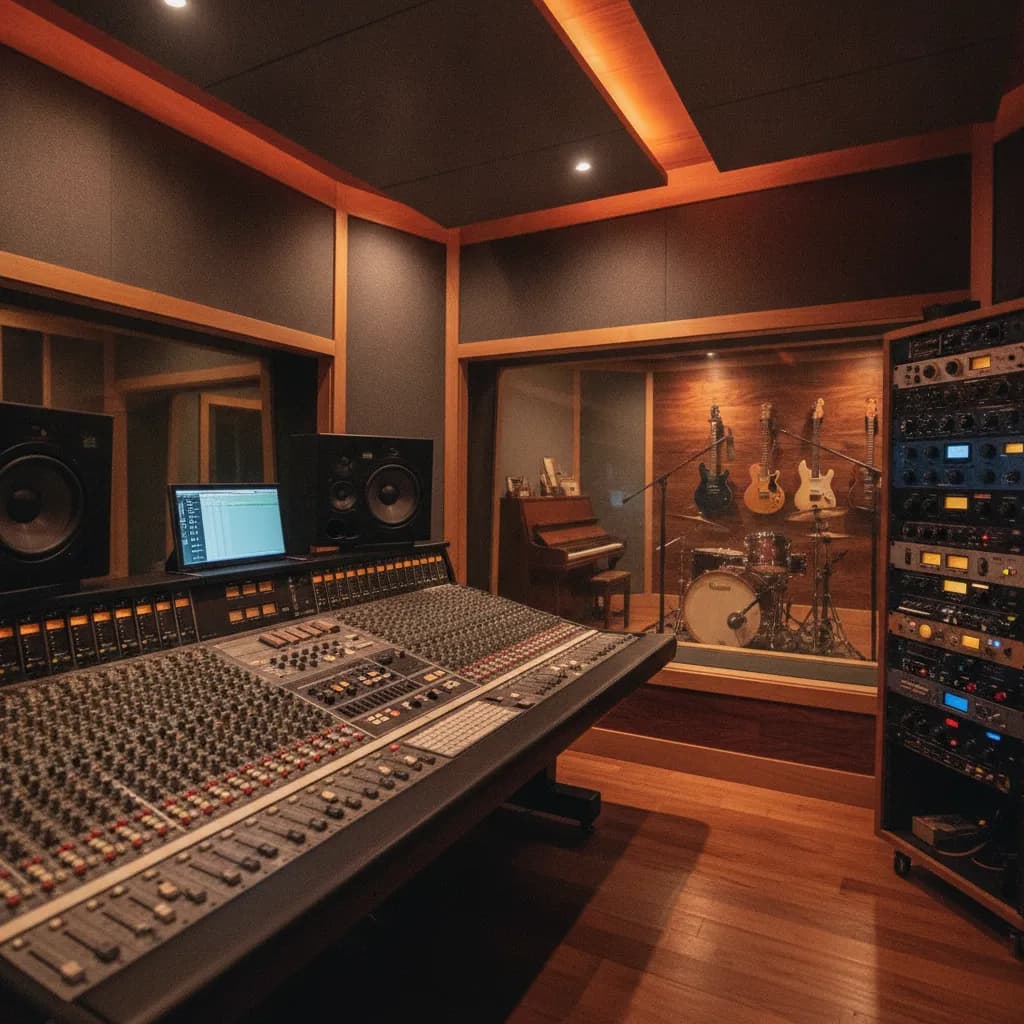
Every finished song crosses the same bridge: the recording is done, and now it has to become the polished, loud, translated-everywhere track people hear on streaming. That bridge is mixing and mastering — and the market for those services in 2026 runs from $5 AI masters to four-figure A-list mixes, with very little honest guidance about what the differences actually buy you.
This guide is written by Paradise Recording in Santa Monica. We sell mixing and mastering services with posted prices, and we'd rather explain the whole market honestly — including the tiers where we're not the right answer — than pretend the options don't exist. Here's what mixing and mastering actually are, what each tier of service costs, what you need to deliver, and how to pick the right level for your project.
Quick takeaways
- Mixing and mastering are different jobs. Mixing balances and shapes the individual tracks of a session; mastering polishes the finished stereo mix for loudness and translation across playback systems.
- The 2026 market has real tiers: AI/automated mastering ($5–$25/track), budget online services ($30–$150/song), independent professionals ($150–$800/song), and name engineers ($1,000+/song). Each tier is legitimately right for someone.
- Paradise's posted rates: mix + master for $800 per song ($600/song for two or more), mastering only for $250 per track — three revision rounds included, real engineers, upload from anywhere.
- Labeled stems are half the battle. Clean, consistently named WAV exports from bar 1 save your engineer an hour of detective work per song — time that goes into the actual mix.
- Revisions have etiquette: gather all your notes into one list per round, reference specific timestamps, and compare against a reference track rather than a feeling.
- Turnaround is typically days to weeks — 3–7 days is common for a single at independent services; Paradise runs 2–3 weeks standard for mix + master or 3–5 days rush.
Mixing vs. mastering: the two jobs, in plain English
Mixing takes the individual recorded tracks — every vocal take, drum mic, bass DI, synth layer — and turns them into one cohesive stereo file. Balance, EQ, compression, panning, effects, automation: the mixer makes hundreds of decisions so the song feels intentional and the vocal sits exactly where it should. A mix can rescue an average recording or elevate a great one; it's where most of the sonic character of a finished record comes from.
Mastering takes that finished stereo mix and prepares it for the world: final EQ and dynamics, loudness to competitive streaming levels, sequencing and spacing (for EPs and albums), and quality-control across playback systems — car, earbuds, club PA, phone speaker. Mastering is a smaller intervention than mixing, which is why it costs less, but it's the difference between a mix that sounds good in one room and a record that translates everywhere.
If your track was produced and mixed as you went (common in electronic and hip-hop production), you may only need mastering. If you're handing over raw multitracks, you need both.
What mixing and mastering services cost in 2026
Here's the honest market map. Prices are per song, USD, and reflect what independent artists actually encounter — every tier exists for a reason.
| Tier | Mixing | Mastering | What you're really getting |
|---|---|---|---|
| AI / automated (LANDR, eMastered, etc.) | — | $5–$25 | An algorithm applies genre-typical EQ, compression, and loudness in minutes. No taste, no revisions that mean anything, but fast and cheap for demos. |
| Budget online marketplaces | $30–$150 | $20–$50 | A human, often early-career, working fast at volume. Quality varies wildly — listen to their portfolio, not their reviews. |
| Independent professionals | $150–$800 | $50–$200 | An experienced engineer who asks for references, works your revisions seriously, and delivers streaming-ready files. Where most serious independent releases should live. |
| Name / A-list engineers | $1,000–$5,000+ | $200–$500+ | Grammy-credit ears, major-label polish, and scheduling measured in weeks. Worth it when the budget and stakes justify it. |
Two pricing details to always check, at any tier:
What's included per song. Revision rounds (two to three is standard — unlimited usually means slow), alternate versions (instrumental, a cappella, clean edits — often $25–$75 each if not included), and stem masters if you need them.
Rush fees. Faster-than-standard delivery commonly adds 25–50% or a flat fee.
Where Paradise sits
Our mix and master service is posted publicly, like everything else we price:
- Mix & Master: $800 per song, or $600/song when you send two or more. You send labeled stems and a rough demo; we mix from scratch — balance, EQ, compression, effects, automation — then master for streaming loudness and clarity.
- Master only: $250 per track. You send a finished stereo mix; we master to your reference, loud-and-forward or dynamic-and-spacious.
- Three revision rounds included on both. Standard turnaround is 2–3 weeks for mix & master (rush: 3–5 days, +$150 flat) and 5–7 days for mastering (rush: 24–48 hours, +$100 flat).
- Everything runs through a private project portal — pay, upload stems, track revisions, download masters. You never need to set foot in Santa Monica, though if you tracked at our studio, the same engineers who know your session can finish it.
What to send: stems, references, and notes
The quality of what you deliver directly affects the quality — and speed — of what comes back.
Stems, labeled properly. Export every track as a WAV from bar 1 of the session (so everything lines up on import), at the session's sample rate (usually 44.1 or 48 kHz), 24-bit, with your artist name and the instrument in every filename: ArtistName_Vocal_Lead.wav, ArtistName_Kick.wav, ArtistName_Bass_DI.wav. Consistent naming saves your engineer 20–60 minutes of detective work per song — time that goes into the mix instead.
A rough demo. Your own rough mix, however imperfect, tells the engineer what you've been hearing. Balance decisions you've lived with for months are information.
One to three reference tracks. Commercial songs whose vocal level, low end, brightness, or space you're chasing. "Make the chorus hit like this reference at 1:02" beats a paragraph of adjectives every time.
Honest notes. Tuning preferences, a lyric that must stay audible, anything you already know bothers you. And decide upfront how much creative license you're giving: at Paradise the intake form literally asks whether to keep the vibe or take liberties — every engineer wishes every client answered that question.
Revision etiquette (how to get a better mix, faster)
Revisions are where good projects either converge or spiral. The habits that make engineers love working with you also get you a better record:
- Listen on at least three systems — good headphones, car, phone speaker — before writing notes. Half of first-listen concerns disappear or clarify by the third system.
- One consolidated list per round. Ten notes in one message is one revision; ten messages over three days burns your included rounds and everyone's patience.
- Timestamp everything. "Vocal feels buried at 1:14 in the second verse" is actionable. "More vibes" is not.
- Compare against your reference, not your memory. A/B the revision against the reference track at matched volume before deciding something's wrong.
- Know when it's done. If round three sounds like the record you imagined, resist inventing a fourth opinion. Fresh ears run out before revision rounds do.
Do you even need paid mastering?
Honest answer: not always. If you're releasing a rough demo, testing songs on SoundCloud, or the track will be remixed later, an automated master — or simply a well-limited mix — is fine. Streaming services normalize loudness anyway, so "louder master" alone is not the advantage it was a decade ago.
Paid, human mastering earns its fee when the release matters: a single going to playlist pitching, an EP that needs consistent tone across five songs, sync licensing submissions, or any record you'll be promoting with money. Translation, tonal balance, and sequencing are judgment calls an algorithm still can't make.
And if the mix itself is the weak link — vocals fighting the beat, low end that only works in one room — mastering can't fix that. That's a mixing problem, and it's why the mix + master combination is usually the right buy for home-produced records.
Frequently asked questions
What's the difference between mixing and mastering?
Mixing blends and shapes all the individual tracks of a session into one stereo file — balance, EQ, compression, effects, automation. Mastering polishes that finished stereo file for release: final tone, competitive loudness, and translation across playback systems. Mixing is the bigger intervention; mastering is the final quality gate.
How much do mixing and mastering services cost?
In 2026: automated mastering runs $5–$25 per track, budget online services $30–$150 per song for mixing, independent professionals roughly $150–$800 per song for mixing and $50–$200 for mastering, and A-list engineers $1,000+ per mix. Paradise Recording charges a posted $800 per song for mix + master ($600/song for two or more) and $250 for mastering only, with three revision rounds included.
How long does mixing and mastering take?
Typical independent-service turnaround is 3–7 days for a single with revisions; complex projects and busy engineers run longer. Paradise's standard turnaround is 2–3 weeks for mix + master (3–5 days rush) and 5–7 days for master-only (24–48 hours rush).
What are stems and how should I export them?
Stems are the individual track exports of your session — each vocal, drum, bass, and instrument part as its own WAV. Export all of them from bar 1 at the session sample rate, 24-bit, named like ArtistName_Vocal_Lead.wav, so the engineer can rebuild your session accurately in minutes.
How many revisions should be included?
Two to three rounds is industry standard and genuinely enough when notes are consolidated and timestamped. Be wary of "unlimited revisions" — it usually signals a service that plans to get it almost-right slowly. Paradise includes three rounds on every project.
Are AI mastering services like LANDR good enough?
For demos, drafts, and low-stakes uploads, yes — they're fast, cheap, and consistent. For releases you're promoting, human mastering still wins on judgment: tonal decisions in context, sequencing an EP, catching problems an algorithm normalizes over. Many artists use AI masters for demos and a human engineer for the actual release.
Can you master a song that was mixed somewhere else?
Yes — that's exactly what a master-only service is for. Send the finished stereo mix (ideally with 3–6 dB of headroom and no limiter on the mix bus) plus a reference track, and the mastering engineer takes it from there.
Is it worth mixing and mastering at the same place?
Usually, yes, for independent projects: one engineer (or team) carries the intent from mix through master, revisions stay coherent, and bundled pricing is better — Paradise drops from $800 to $600 per song at two-plus songs. The traditional argument for a separate mastering engineer — fresh ears — matters most on big-budget records.
Next steps
- Start a mix or master project — posted pricing, private portal, 3 revision rounds
- What a recording studio costs in LA
- Where to record vocals in Los Angeles
- Book tracking time first — the whole studio (Rainforest and Rock Rooms), engineer included