
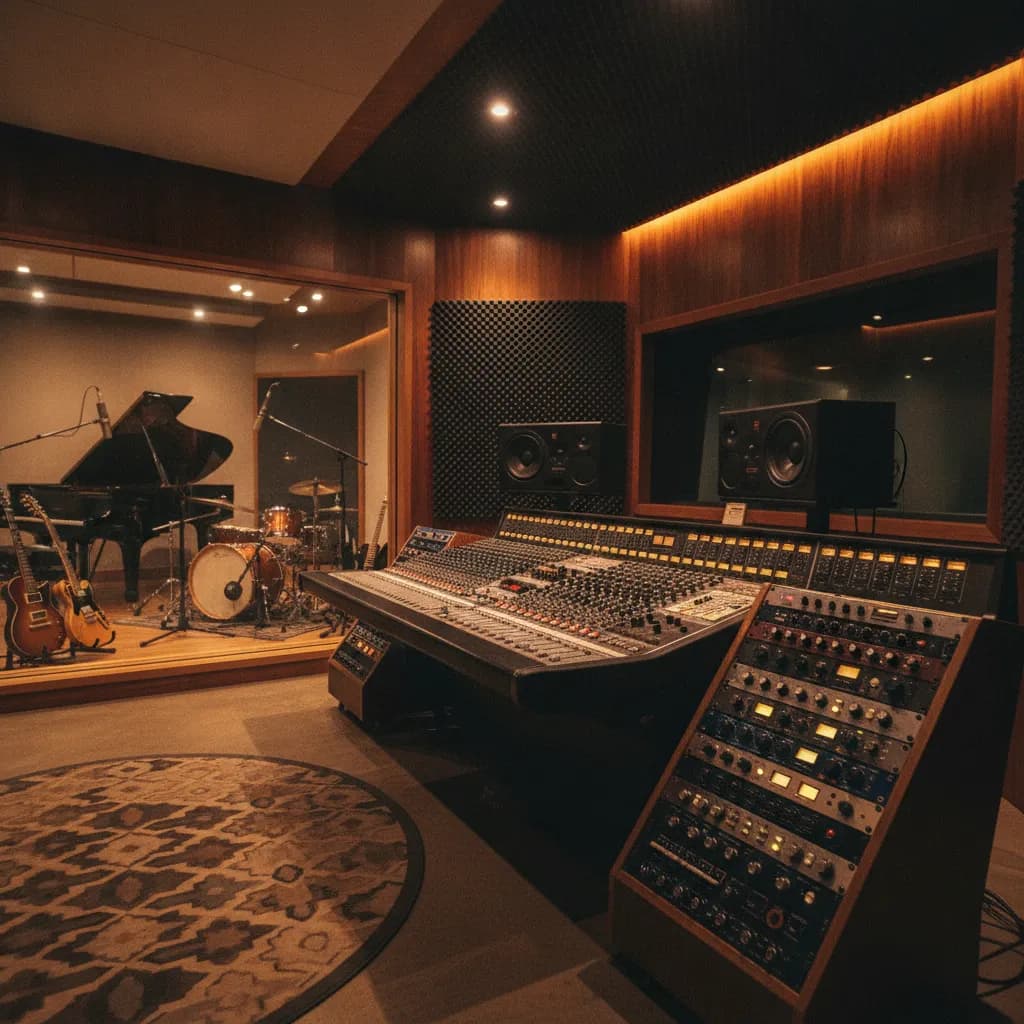
Vocals are the one part of a record listeners judge instantly. A slightly dull drum sound gets forgiven; a thin, harsh, or boxy vocal never does. That's why "where should I record my vocals?" is the highest-stakes booking decision most independent artists make — and why the answer matters more than any plugin you'll ever buy.
This guide is written by Paradise Recording, a boutique vocal-and-band studio in Santa Monica. We'll be upfront: we built a room specifically for voices, and we think it's very good. But most of this guide applies to any vocal session anywhere in Los Angeles — what a proper vocal room actually is, why home recordings so often disappoint, what a professional vocal session costs, and how to get the most out of the hours you book.
Quick takeaways
- The room matters more than the mic. An untreated bedroom puts comb-filtering and box-tone on every take, and no plugin fully removes it. A treated vocal room is the single biggest upgrade most singers ever hear.
- The classic pro vocal chain is simple: a great large-diaphragm condenser, a clean or gently colored preamp, and an opto compressor catching peaks on the way in. At Paradise that's a Manley Reference Gold into API/Neve preamps and a Tube-Tech CL 1B.
- An engineer changes your performance, not just your sound. When someone else handles gain staging, punch-ins, and comping, you sing instead of operating software between takes.
- A pro vocal session in LA typically costs $150–$400 for a 2–4 hour block at boutique rooms with an engineer included. At Paradise it's $160 for 2 hours or $300 for 4, whole studio and engineer included.
- Two to four hours covers most single-song vocal sessions — leads, doubles, harmonies, and ad-libs — if you show up warmed up and rehearsed.
- Hybrid workflows win. Plenty of artists produce at home and book studio time only for the vocal. It's the highest-leverage few hundred dollars in independent music.
Why home vocal recordings sound thin
If you've recorded vocals at home and felt like they never sit right in the mix, the causes are almost always the same three things.
The room is fighting you. Parallel drywall, a low ceiling, and a hard desk surface reflect your voice back into the mic a few milliseconds late. Those reflections comb-filter with the direct signal — thinning the low mids, hyping the harshness around 2–5 kHz, and adding that unmistakable "recorded in a room" box tone. EQ can't fix it, because the problem is baked into the recording itself.
The signal chain is working at the edge. Budget interfaces and USB mics are genuinely impressive for what they cost, but they run out of headroom fast. Singers clip the loud notes, so they back the gain off, then the quiet passages sit near the noise floor. The result reads as "thin" and "small" even when the performance was big.
Nobody's driving. Recording yourself means engineering yourself: setting levels, punching in, judging takes, fighting the software. Every minute spent in the DAW is a minute out of performance headspace, and it shows in the takes.
None of this means home recording is useless — it's ideal for writing, demos, and rough comps. But when a song is finished and deserves its final vocal, the fix for all three problems is the same booking.
What actually makes a great vocal room
When you're comparing vocal recording studios in Los Angeles, these are the things that genuinely change what ends up on the recording — roughly in order of importance.
Acoustic treatment built for voices
A vocal room should be controlled but not dead — enough absorption and diffusion that the mic hears your voice, not the walls, while keeping the take alive. Ask any studio how their vocal space is treated. A confident, specific answer ("broadband absorption at the first reflection points, bass trapping in the corners") is a good sign; "it sounds great, trust us" is not. The Rainforest Room at Paradise is a treated, plant-filled room built specifically for lead vocals, voiceover, and podcasts — intimate enough for a whisper, controlled enough for a belt.
A signal chain chosen for voices
The classic professional vocal chain has three links, and studios that care will name theirs:
| Link | What it does | In the Rainforest Room |
|---|---|---|
| Microphone | Captures detail and flatters the top end | Manley Reference Gold tube condenser (plus a Shure SM7B for rap, podcasts, and darker voices) |
| Preamp | Adds clean gain and character | API 512c (punch) and Neve 1073 (silk) |
| Compressor | Catches peaks so every word stays present | Tube-Tech CL 1B opto compressor |
You don't need to memorize gear names. The point is that a mic-preamp-compressor chain in this tier records vocals that need less fixing later — which also lowers your mixing bill.
An engineer who runs vocal sessions every week
A good vocal engineer sets the level once and rides it invisibly, punches in without breaking your flow, keeps a comp sheet so the best phrases are already flagged, and tells you honestly when take three beat take nine. At Paradise the in-house engineer is included in every session — you never pay extra for the person who makes the session work. If you're comparing studios, always ask whether the engineer is included; across LA a freelance engineer adds roughly $50–$150 per hour when they're not. Our studio cost guide breaks down that math in detail.
Headphone mix and monitoring
Underrated but decisive: if you can't hear yourself comfortably, you sing sharp, push too hard, and tire early. A studio should be able to dial your headphone blend — more of you, less of you, a touch of reverb for confidence — in seconds. It's also fair to ask what they monitor on; we use Focal Twin6 Be near-fields, so playback tells the truth.
What a vocal session costs in Los Angeles
For a straightforward vocal session at a boutique LA studio — you, an engineer, and a produced instrumental — expect $150–$400 for a 2–4 hour block with the engineer included. Larger commercial rooms bill more, and rooms that quote a lower rate often add the engineer separately.
Paradise's posted rates for the whole studio, Rainforest Room included: $160 for 2 hours, $300 for 4, $450 for 6, $600 for 8, and $850 for 12 — engineer, gear, and room all included, no setup fees (every rate). Booking is online with live availability, no email back-and-forth: book a session.
How much time do you need? Honest rules of thumb:
- One song, rehearsed, vocals over a finished beat: 2 hours covers lead, doubles, and a first pass of harmonies.
- One song with layered production — stacked harmonies, ad-libs, comping as you go: 4 hours is comfortable.
- An EP's worth of leads (3–5 songs): book 6–8 hours, or split across two sessions to protect your voice.
- Voiceover and podcast sessions: most single episodes or scripts fit inside 2 hours.
If you're recording regularly, membership drops the effective hourly rate further.
How to get your money's worth from the session
Preparation is the difference between leaving with a record and leaving with a plan to come back. The short version: know the song cold, warm up before you arrive, bring your instrumental as a high-quality WAV (not a YouTube rip), bring lyric sheets, and drink water like it's your job. We wrote a full checklist in how to prepare for your first recording session — it applies to your tenth session too.
One more habit worth stealing from professionals: record more doubles and harmony passes than you think you need while your voice is warm. Extra takes cost minutes in the session; recreating a vocal sound at a later session costs a lot more.
After the vocal: mixing and finishing
A great raw vocal still needs a mix — tuning where taste demands it, compression, EQ, effects, and a master that holds up next to your references. You can take your session files anywhere (we hand off multitracks at the end of every session), or use Paradise's in-house mixing and mastering service with posted per-song pricing and three revision rounds included.
Frequently asked questions
What is the best studio for recording vocals in Los Angeles?
The best vocal studio is a controlled, treated room with a professional signal chain and an engineer who runs vocal sessions constantly — not necessarily the biggest or most famous facility. On the Westside, Paradise Recording's Rainforest Room was purpose-built for vocals with a Manley Reference Gold, Tube-Tech CL 1B, and an included engineer. For big-room legacy studios, our Los Angeles studio guide covers the whole landscape honestly.
How much does it cost to record vocals at a studio?
At boutique LA studios, plan on roughly $150–$400 for a 2–4 hour vocal session with an engineer included. Paradise posts its rates publicly: $160 for 2 hours or $300 for 4, whole studio and engineer included. Mixing and mastering are separate at virtually every studio.
How many hours do I need to record vocals for one song?
Two hours is enough for a rehearsed lead vocal plus doubles and basic harmonies. Book four if the song has heavy vocal production or you want to comp carefully as you go. Under-rehearsed songs eat studio time faster than any other factor.
Can I record voiceover, ADR, or a podcast in a vocal studio?
Yes — the same treated room and chain that flatter a singer serve spoken word even better. The Rainforest Room handles voiceover, ADR, narration, and podcast sessions regularly, with the SM7B on hand for broadcast-style voices and an engineer managing levels and editing markers.
Do I really need an engineer for a vocal session?
If you want your best performance, yes. Self-engineering splits your attention between singing and software, and it shows in the takes. An included engineer also means gain staging, punch-ins, and comping are handled by someone who does it every day — at Paradise that's part of every posted rate, not an add-on.
Should I record vocals at home or in a studio?
Do both, strategically. Write and demo at home where iteration is free, then book a studio block for final vocals once the song is finished. A 2-hour pro vocal session is the cheapest big upgrade available to a home-produced track.