
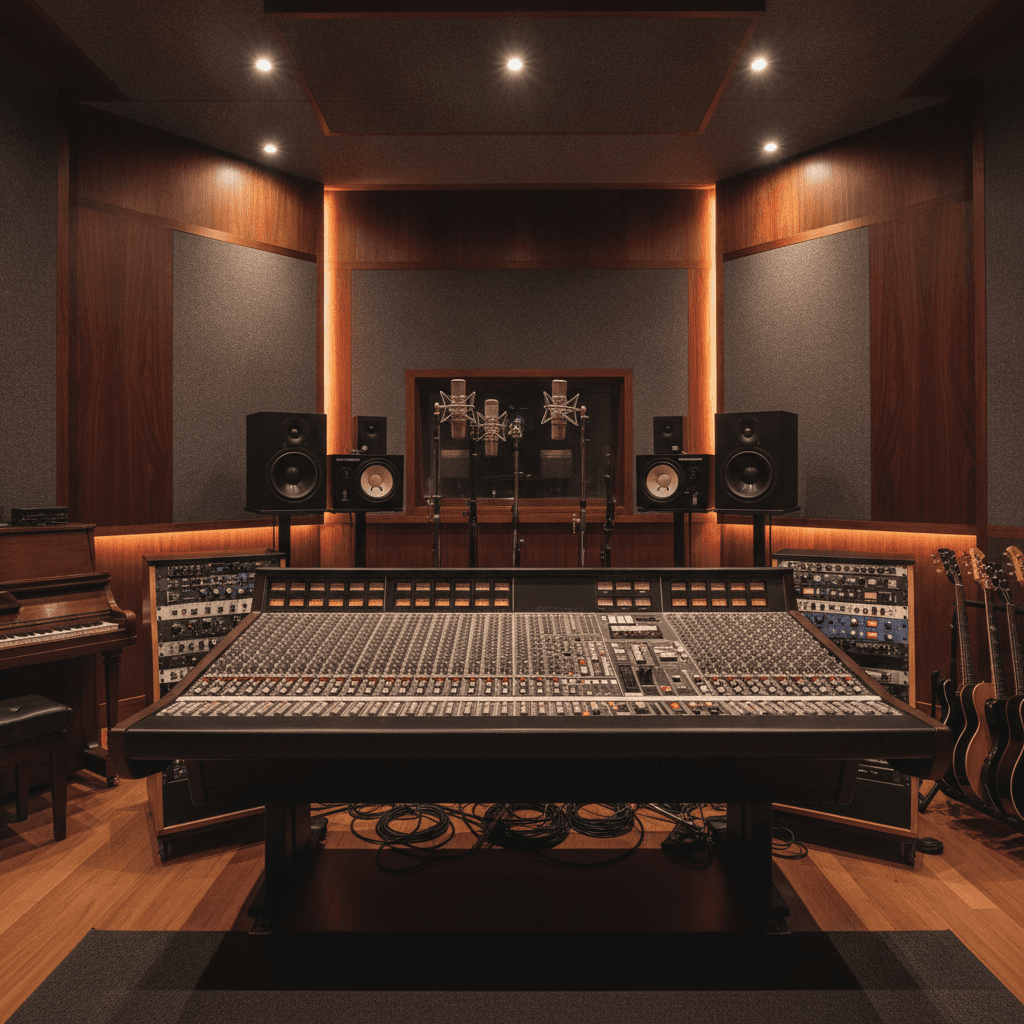
If you've tried to figure out how much a recording studio costs in Los Angeles, you've probably run into a wall of vague answers, "contact us for pricing," or rates that look affordable until you read the fine print. So here's the short answer: LA studio time runs anywhere from roughly $50 to $500+ per hour, depending on the room, the gear, the location, and whether an engineer is included. That range is real and wide, and what sits inside it matters enormously.
This guide is written by Paradise Recording — a boutique studio in Santa Monica that actually posts its prices publicly. We think transparent pricing is a basic courtesy to working musicians, so we're going to apply that same standard to recording studio prices across the whole LA market. We'll cover every pricing structure you'll encounter (hourly, block, day/lockout), explain what "engineer included" really means in practice, flag the hidden fees that quietly inflate your bill, and give you honest ranges so you can budget before you ever set foot in a studio.
Whether you're a solo artist cutting your first EP, a band tracking a full record, or a podcaster shopping for a vocal booth, this is the pricing breakdown you actually need.
Quick takeaways
- LA studio rates span $50–$500+/hr, and that range reflects real differences in room quality, gear, and staff — not just prestige markup.
- Block rates (2–4 hours) are almost always a better deal than straight hourly, and they're how most boutique studios structure their pricing.
- "Engineer included" can mean very different things — from a seasoned pro who shapes your sound to someone who presses record and stays out of the way. Ask before you book.
- Hidden fees are common: parking, file transfers, instrument rentals, and overtime charges can add 20–40% to a session if you're not watching for them.
- Day/lockout rates make sense for bands tracking full arrangements; they typically run $800–$2,500+ in LA depending on the room.
- Paradise Recording posts its real rates — sessions from $160 per 2-hr block for the whole studio, engineer always included (every rate) — so you can compare apples to apples.
Hourly vs. block vs. day rates: which structure are you actually paying for?
Recording studios in LA use three main pricing structures, and understanding the difference before you book will save you real money.
Hourly rates
Hourly pricing is common at larger commercial facilities and at studios that cater to professional clients with unpredictable schedules. You pay for exactly the time you use, billed in hourly (or sometimes half-hourly) increments. In LA, hourly rates at reputable studios run roughly $75–$250/hr for mid-tier rooms and $300–$500+/hr at major commercial facilities with large live rooms, vintage consoles, and A-list clientele.
The problem with hourly billing for most artists: setup, teardown, and the inevitable "let's try one more take" moments eat into your time fast. If your session runs 15 minutes over, you're paying for another hour.
Block rates
Block pricing — typically 2, 4, or 8-hour chunks — is the most common structure at boutique studios, and it's almost always a better deal per hour than straight hourly. You book a defined block, you know your cost upfront, and there's usually a small buffer built in for setup.
At Paradise Recording, for example, sessions start at $160 for a 2-hour block, and every booking is the whole studio — the Rainforest Room (vocals, voiceover, podcasts) and the Rock Room (full band tracking, drum kit, baby grand piano) — with an engineer included. Those are the real posted rates, not a teaser that disappears when you call.
Across the broader LA market, 2-hour block rates at comparable boutique studios typically run $150–$400, with the spread driven by location, room size, and gear quality.
Day rates and lockout sessions
A "lockout" means you rent the entire studio for a full day — usually 10–12 hours — and no one else comes in. You can leave your gear set up, take breaks without the clock anxiety, and work at a human pace. For bands tracking live, this is often the most economical structure per hour.
In LA, day/lockout rates at boutique and mid-tier studios generally run $800–$2,500+. Major commercial rooms — the kind with a 96-channel SSL and a 2,000 sq ft live room — can run considerably higher. If you're comparing day rates, always confirm what's included: engineer time, assistant engineer, tape (if applicable), and whether you get the full 10–12 hours or something shorter.
What "engineer included" actually means
This is one of the most misunderstood line items in studio pricing. When a studio says an engineer is included, it could mean any of the following:
- A senior engineer who co-produces on the fly, helps with arrangement decisions, coaches performances, and delivers a mix-ready session at the end
- A competent tracking engineer who sets levels, manages signal flow, and keeps the session moving — solid, professional, not a creative collaborator
- A studio assistant who handles the technical basics but defers all creative decisions to you
None of those is inherently wrong — they serve different needs. But you should know which one you're getting before you book.
At Paradise Recording, every session includes an in-house engineer who runs the room and the gear. If you want to bring your own producer or engineer, that's a conversation worth having upfront with any studio.
The reason this matters financially: if a studio quotes you a low hourly rate but doesn't include an engineer, you'll need to hire one separately. Freelance engineers in LA typically charge $50–$150/hr on their own, sometimes more for experienced pros. That "cheap" studio rate can get expensive fast.
When you're comparing studio costs, always ask: Is an engineer included? What is their role? Can I hear examples of their work?
Hidden fees that inflate your final bill
This is where a lot of artists get surprised. Here are the most common add-ons to watch for when evaluating how much a recording studio will actually cost you:
Parking. In Santa Monica, Hollywood, and most of central LA, parking near a studio can run $15–$40 per session, per car. For a full band, that's real money. Always ask if the studio validates or has a lot.
File transfers and session exports. Some studios charge $25–$75 to export and deliver your session files, stems, or rough mixes. This should be included as a standard courtesy — but it isn't everywhere.
Instrument and backline rentals. The studio listing says "drum kit available" — but is it included in your rate, or is there a rental fee? Same question applies to amps, keyboards, and DI boxes. Always confirm.
Overtime charges. If your session runs long and you're on an hourly or block rate, overtime is often billed at a premium — sometimes 1.5x the standard rate. Know the policy before you start.
Assistant engineer fees. Some larger studios include an assistant engineer in their rate; others bill them separately at $25–$75/hr. For complex tracking sessions with a full band, an assistant is often essential.
Studio musician fees. If you need a session musician — keys, bass, strings, whatever — that's a separate negotiation. Rates vary widely, from roughly $100–$500+ for a session depending on the musician's experience and the complexity of the part. This is not a studio fee, but it's part of your total session cost.
Mixing and mastering. Tracking time is not mixing time. If you want your files mixed and mastered after the session, that's a separate service. At Paradise Recording, mixing and mastering is a distinct offering with its own pricing. This is true at virtually every studio — budget for it separately.
What drives the price difference between LA studios?
Why does one studio charge $75/hr and another charge $400/hr? Here's what's actually behind that spread:
Room acoustics and size. A properly treated room with a large live space costs serious money to build and maintain. You're paying for that infrastructure.
Gear quality. A Neve 8078 console, a Studer tape machine, a collection of vintage outboard — these cost hundreds of thousands of dollars and require maintenance. Studios with elite gear charge for it. At Paradise Recording, the signal chain includes a Manley Reference microphone, Tube-Tech CL 1B compressor, API preamps, and Focal Twin6 monitors — professional tools that affect what your recording actually sounds like.
Location. Studios in Beverly Hills or West Hollywood often carry higher overhead than those in Santa Monica or Culver City, and that overhead shows up in the rate. That said, location alone doesn't determine quality — some of the best rooms in LA are in less obvious neighborhoods.
Engineer experience. A studio with a staff engineer who has major-label credits will charge more than one with a recent grad behind the board. Both can be the right choice depending on your project and budget.
Demand and clientele. Some studios price to their market. A room that books solid six days a week doesn't need to compete on price.
If you're exploring options across the city, our guide to recording studios in Los Angeles covers the landscape honestly, and we also have more focused looks at studios in Santa Monica and studios in West Hollywood if you're trying to narrow down by neighborhood.
When a home studio or cheaper option is the honest answer
Not every project needs a commercial studio. Here's a plain-English breakdown of when you might not need to spend the money:
You're demoing, not recording finals. If you're working out arrangements or getting a rough idea down, a home setup or a low-cost rehearsal room recording may be entirely sufficient.
Your project is voice-only and your room is quiet. A good USB condenser microphone and basic acoustic treatment can produce a podcast or voiceover that sounds professional. The jump to a professional vocal booth makes sense when you need consistent, controlled sound across many sessions — or when clients are paying for broadcast-quality audio.
Your budget is genuinely tight. A session where you're watching the clock every five minutes because you can't afford another hour is a bad creative environment. If a cheaper room with less gear lets you relax and work, that's the right call for that project.
You need ongoing access, not one session. If you're recording frequently, a membership or recurring booking arrangement at a studio you trust often works out to significantly less per session than one-off bookings.
The honest truth is that the right studio is the one that fits your project, your budget, and your working style — not the most expensive one you can justify.
Frequently asked questions
How much is a studio session?
For most independent artists, a studio session means a 2–4 hour block, and at boutique LA rooms that runs roughly $150–$400 with an engineer included. At Paradise Recording a 2-hour session is $160 and a 4-hour session is $300 — whole studio (Rainforest vocal room and Rock live room), engineer always included. Big commercial rooms and full-day lockouts cost more; see the day-rate section above.
How much does studio time cost per hour?
Across Los Angeles, studio time at reputable rooms works out to roughly $75–$250 per hour at mid-tier and boutique studios and $300–$500+ at major commercial facilities. Block pricing usually beats the sticker hourly rate: Paradise's posted blocks work out to $70.83–$80 per hour depending on block length, with the whole studio, the engineer and all gear included.
How much does it cost to record a song in Los Angeles?
A single song tracked at a boutique LA studio typically costs $200–$600 for the session itself, depending on the room, how long tracking takes, and whether the engineer is included. Add mixing ($150–$500+) and mastering ($50–$200+) if you want a finished, release-ready track. Total cost for one professional-quality song: roughly $400–$1,300 is a realistic range for most independent artists.
Is it cheaper to record by the hour or book a block?
Block rates almost always work out to a lower effective hourly rate, and they give you a fixed cost upfront. If you know you need at least 2 hours, a block is the smarter buy at most studios.
What does a recording studio day rate cost in LA?
Day/lockout rates at boutique and mid-tier LA studios typically run $800–$2,500 for a 10–12 hour session. Major commercial rooms can run higher. Always confirm what's included — engineer time, assistants, and amenities vary.
Do I need to hire my own engineer, or is one included?
It depends on the studio. Many boutique studios, including Paradise Recording, include an in-house engineer in every session. Larger commercial facilities sometimes charge the engineer separately. Always ask, because a freelance engineer in LA typically adds $50–$150/hr to your cost.
What hidden fees should I watch for when booking a studio?
The most common ones: parking, session file exports, instrument rentals, overtime charges, and assistant engineer fees. Ask for a written breakdown of what's included before you commit to a booking.
Is a more expensive studio always better?
No. Expensive rooms have expensive gear and experienced staff, but if your project is a demo, a podcast, or a straightforward vocal session, you may not need — or hear — the difference. Match the studio to the project, not the other way around.
How much does mixing and mastering cost on top of studio time?
Mixing in LA typically runs $100–$500+ per song depending on the engineer's experience and the complexity of the session. Mastering runs roughly $50–$200 per song at most independent facilities. Paradise Recording offers mixing and mastering services with transparent pricing if you want a one-stop option after tracking.
How do I know if a studio's pricing is fair?
The clearest signal is whether the studio posts its prices publicly. If you have to call or email to find out what a session costs, that's not inherently a red flag — but it does make comparison shopping harder. Studios that post transparent rates are easier to evaluate honestly.
Next steps
- Book a session at Paradise Recording
- See our studio rooms and gear
- Explore the Rainforest Room (vocals, voiceover, podcasts)
- Explore the Rock Room (bands, full-kit tracking, piano)
- Learn about membership options for frequent bookings
- Mixing and mastering services
- Recording studios in Los Angeles — an honest overview
- Recording studios in Santa Monica
- Recording studios in West Hollywood