
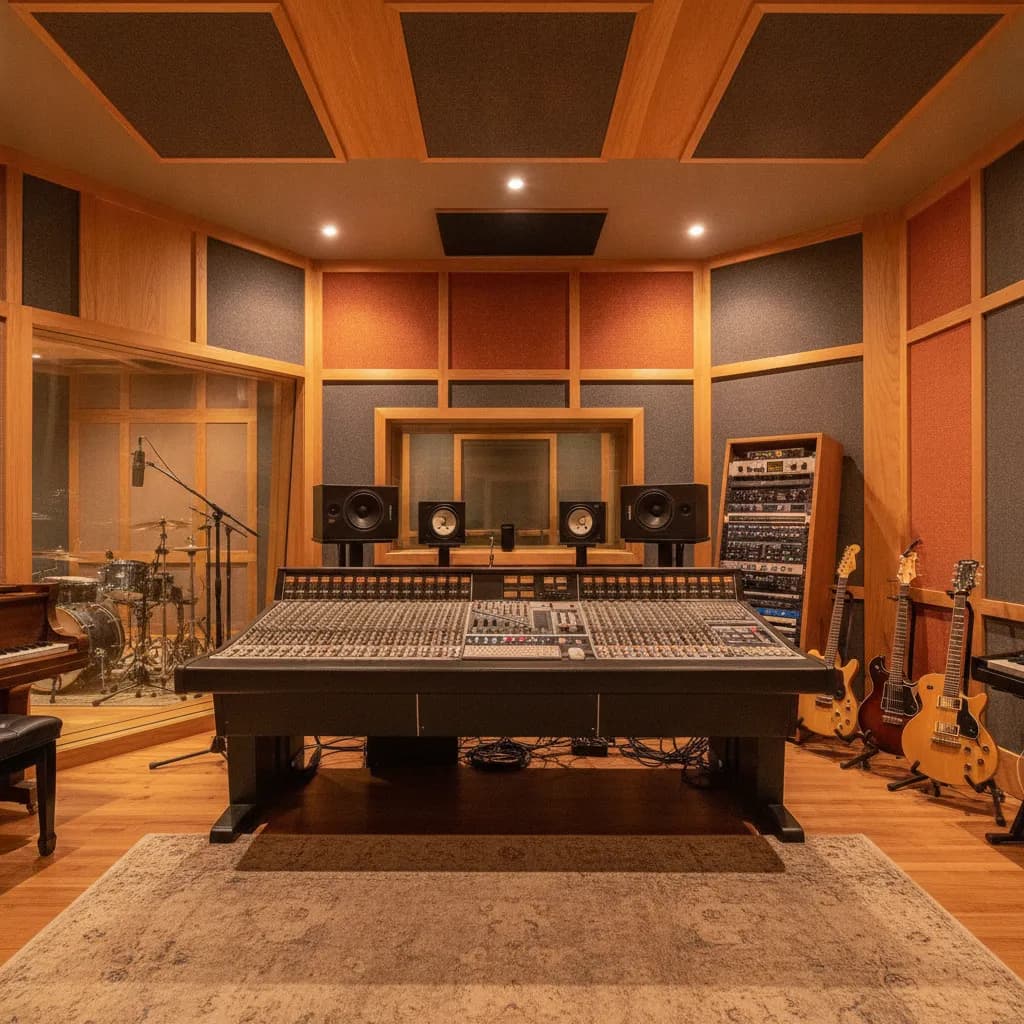
Topanga is one of the most musically alive unincorporated communities in Los Angeles County — a canyon town that has sheltered folk singers, singer-songwriters, indie bands, and experimental artists for decades. The same spirit that drew Woody Guthrie to the canyon in the early 1950s still pulls musicians here: the relative quiet, the trees, the distance from the industry grind. What the canyon doesn't have, and has never really had, is a deep bench of professional recording studios. This guide is honest about that gap, tells you what genuinely exists locally, and explains exactly what the drive down to Santa Monica gets you when a track has to sound finished.
This isn't a guide for a different neighborhood with Topanga's name swapped in. It's written for the singer-songwriter on Old Topanga Canyon Road who needs to know their actual options in 2026, the band rehearsing in a garage off Topanga Canyon Blvd (SR-27) who wants to cut a real EP, and the podcaster or voice actor based in the canyon who needs a proper treated room. Read through to the end — the section on driving SR-27 to Santa Monica covers something most guides skip entirely: the current road conditions and how they affect your session-day plan.
If you're also comparing studios across the wider Westside, the Best Recording Studios in Los Angeles (2026) and Best Recording Studios in Santa Monica (2026) guides give you the full picture.
Quick takeaways
- The local studio picture is thin. Topanga has a vibrant music culture but very few dedicated professional recording rooms. Most serious tracking happens in a home/project studio or on a drive to the Westside or Valley.
- What "included engineer" actually means. At many studios you rent the room and hire an engineer separately — that's a second hourly rate on top of the room rate. At Paradise Recording, an in-house engineer is included in every session, so the posted price is the real price.
- LA studio rates span a wide range. Recording at an LA studio in 2026 can cost anywhere from $50 to over $300 per hour. Boutique rooms with included engineers and quality outboard gear typically sit in the $100–$200/hr range; major Hollywood tracking rooms run higher.
- Two-hour blocks are the practical minimum. Most professional studios require a minimum booking of two to four hours. Paradise Recording's blocks start at two hours — $200 for the Rainforest Room (vocals, voiceover, podcast) and $250 for the Rock Room (full band, drum kit, baby grand).
- The drive from Topanga to Santa Monica is real but manageable. Off-peak, you're looking at roughly 20–30 minutes via SR-27 south to PCH, then east on PCH to the 4th Street corridor. Add time in rush hour. Plan around it, and it's a non-issue.
- Book online, no email back-and-forth. Paradise posts its rates publicly and takes bookings at /book — you know the number before you pick up the phone.
The 10 best recording studios in Topanga (2026)
At-a-glance ranking
- Paradise Recording — Best for: vocals, bands, podcasts, and voiceover from Topanga; included engineer, transparent pricing, two purpose-built rooms
- EastWest Studios — Best for: major-label and prestige independent projects requiring a world-class tracking room
- Henson Recording Studios — Best for: large-scale sessions and artists who want a storied Hollywood facility
- Capitol Studios — Best for: orchestral, jazz, and legacy-style recordings in an iconic room
- Sunset Sound — Best for: rock and pop tracking with deep LA history
- The Village Studios — Best for: artists who want an eclectic, architecturally distinct creative environment
- Conway Recording Studios — Best for: established artists and producers seeking a Hollywood institution
- Westlake Recording Studios — Best for: pop and R&B producers in a West Hollywood setting
- Sound City Studios (Van Nuys) — Best for: rock and alternative artists drawn to an analog-heavy legacy room
- Topanga Studios (Woodland Hills) — Best for: Topanga-area artists who want the shortest possible drive for rehearsal or basic tracking
This ranking is Paradise Recording's own editorial opinion, not paid placement. Verify current rates, availability, and services directly with each studio before booking.
1. Paradise Recording — Santa Monica (our pick for Topanga artists)
Paradise Recording sits at 1505 4th St, Suite 219, Santa Monica — roughly 20–30 minutes from the Topanga town center off-peak via SR-27 south to PCH, then east along the coast. For Topanga musicians, it's the closest professional room on the Westside that combines transparent pricing, a dedicated in-house engineer, and purpose-built acoustics.
There are two rooms. The Rainforest Room is designed for vocals, voiceover, and podcast recording — it's a treated, quiet space that works especially well for singer-songwriters cutting demos or voice actors who need broadcast-quality audio. The Rock Room is built for full-band tracking: it has a full drum kit already tuned and mic'd, a baby grand piano, and enough space for a live ensemble. Both rooms are described in detail at /studios.
What makes Paradise the right call for most Topanga artists isn't a claim about being the biggest room in LA — it's not. It's a boutique facility, and that's the point. Every session includes an in-house engineer, so you're never left alone to figure out the gear. Pricing is posted publicly on the website (Rainforest Room from $200 per 2-hour block; Rock Room from $250 per 2-hour block) — no email back-and-forth, no "call for rates." The gear list is honest and specific: a Manley Reference microphone, a Tube-Tech CL 1B compressor, API preamps, and Focal Twin6 monitors. That's a signal chain that holds up against rooms charging twice as much.
The studio is open 9am–2am daily, which means an early evening session after the SR-27 rush-hour window is completely realistic. Membership options are available at /membership for artists who record regularly, and mixing and mastering services can be added at /mix-master.
Book a session at Paradise Recording →
2. EastWest Studios — Hollywood
EastWest Studios is a recording studio complex located at 6000 West Sunset Boulevard in Hollywood. EastWest remains a standard bearer, with Olivia Rodrigo and Jon Batiste cutting their latest Oscar-nominated works at the facility.
Best for: Artists with major-label budgets or prestige independent projects that need world-class tracking rooms and vintage analog infrastructure. Why it fits: The rooms are large, the gear is legendary, and the engineering staff is experienced at the highest level. Rates reflect that. What to ask: Minimum booking requirements, whether an engineer is included or billed separately, and current availability — lead times at this level can run weeks.
3. Henson Recording Studios — Hollywood
Once owned by Charlie Chaplin and then A&M Records, Henson Recording Studios has become one of the industry's leading recording facilities, and many of the greatest music industry stars have recorded albums here, including Van Halen, Michael Jackson, and Coldplay.
Best for: Large-scale pop, hip-hop, and film/TV scoring sessions; artists who want a facility with deep Hollywood history. Why it fits: Multiple rooms of different sizes, experienced staff engineers, and a location in the heart of Hollywood. What to ask: Room availability, whether your project requires a full-day lockout or can be done hourly, and current engineering rates.
4. Capitol Studios — Hollywood
The iconic Capitol Records Building, at 1750 Vine St., looks like a stack of records and the studios inside are among the most recognizable in the world. Capitol Studios offer vast spaces like their 2,700 square-foot Studio A and are a cultural landmark.
Best for: Orchestral recordings, jazz, and projects where the room's natural reverb and history are part of the artistic brief. Why it fits: The live room acoustics are genuinely rare. If your project calls for that sound, there's nothing else quite like it. What to ask: Availability for independent artists (the facility serves major-label clients heavily), minimum session length, and whether a house engineer is included.
5. Sunset Sound — Hollywood
Sunset Sound, whose history with Disney stretches from "Chim Chim Cher-ee" to "Let It Go," remains a fully operational landmark.
Best for: Rock and pop tracking; artists who want a working studio with serious vintage credentials. Why it fits: Multiple rooms, decades of history, and a reputation for warm analog sound that continues to attract working artists. What to ask: Current room rates, engineer availability, and whether your session requires a minimum block booking.
6. The Village Studios — West Los Angeles
The Village Studios stands out, housed in a vintage Masonic Temple; it has become a creative hub for artists such as Fleetwood Mac, Lady Gaga, and Coldplay, with eclectic atmosphere and diverse recording spaces offering a unique and inspiring environment.
Best for: Artists who want a visually and acoustically distinctive environment; mid-to-large budget sessions. Why it fits: The architecture and room variety make it genuinely different from a standard commercial studio. Close to the Westside. What to ask: Room sizes available, current rates, and whether the session requires a full lockout.
7. Conway Recording Studios — Hollywood
Conway Studios hosted Taylor Swift's "The Tortured Poets Department" and has remained one of the busiest working studios in Hollywood for decades.
Best for: Established artists and producers who need a reliable, high-caliber Hollywood facility with multiple rooms. Why it fits: Consistent quality, experienced staff, and a track record that speaks for itself across genres. What to ask: Current availability, whether your project suits hourly or day-rate booking, and engineering options.
8. Westlake Recording Studios — West Hollywood
Westlake Studios, which famously served as home base to Michael Jackson in the 1980s, has continued to attract sessions like Beyoncé's "Cowboy Carter" and SZA's "SOS."
Best for: Pop and R&B producers; artists who want a Westside location with major-label pedigree. Why it fits: West Hollywood location is convenient from Topanga via the 101 or surface streets, and the facility has remained active and relevant. What to ask: Room options, minimum booking, and whether engineer time is bundled or billed separately.
9. Sound City Studios — Van Nuys
Sound City, located in Van Nuys, regained attention and acclaim when Dave Grohl directed and produced a documentary about the studio's storied history. Nirvana and Red Hot Chili Peppers both recorded there, as did Stevie Nicks and Tom Petty.
Best for: Rock and alternative artists drawn to an analog-heavy legacy room; also accessible from Topanga via the 101 north. Why it fits: The San Fernando Valley approach from Topanga (north on SR-27, east on the 101) can actually be faster than the coastal route during certain traffic windows. What to ask: Current operational status, room availability, and rates — verify before making the trip.
10. Topanga Studios — Woodland Hills
Topanga Studios is located at 5325 Topanga Canyon Blvd, Woodland Hills, CA 91364 — on the Valley side of the canyon, making it the closest named studio to the Topanga community on this list.
Best for: Topanga-area artists who want the shortest possible drive for rehearsal, basic tracking, or practice-room time before a more polished session elsewhere. Why it fits: The Woodland Hills location is a straight shot north on SR-27 over the hill — no PCH, no coastal traffic. Useful for rehearsal and pre-production. What to ask: What rooms are available, current rates, and whether engineering services are offered or if it's primarily a rehearsal and self-serve space.
Rankings reflect Paradise Recording's editorial opinion only. Verify all current rates, hours, and services directly with each studio before booking.
What makes a great LA recording studio (and how to choose)
The gear that actually matters
A studio's microphone locker and preamp chain determine more about your final sound than almost anything else. A Manley Reference microphone into API preamps and a Tube-Tech CL 1B compressor — the signal chain at Paradise Recording — is a genuinely professional setup that many boutique rooms don't match. When evaluating any studio, ask specifically: what mic will be on my vocals, what preamp, and what compressor? A studio that can answer those questions clearly is one that takes the gear seriously.
Room acoustics and purpose-built spaces
A room that was designed for vocals sounds different from a room that was designed for drums — and both sound different from a living room with moving blankets on the walls. Ask whether the room you're booking was acoustically treated for your use case. The Rainforest Room at Paradise was built for vocals, voiceover, and intimate recording; the Rock Room was built for full-band tracking with a live kit. That specificity matters.
The engineer: included or extra?
Rates usually include a staff engineer, though some studios charge separately for engineering. This is one of the most important questions to ask before you book anywhere. At some rooms, the hourly rate is for the room only — the engineer is a separate line item. At Paradise Recording, an in-house engineer is included in every session, which means the posted price is the complete price. There's no surprise on checkout. For a deeper look at this question, see Do recording studios provide an engineer?
Hourly vs. lockout/day rates
The most common model for mid-range studios and commercial facilities is hourly booking: you pay for each hour you use the studio, typically with a minimum booking requirement of two to four hours. A lockout or day rate means you book the entire studio for a full day (usually 10–12 hours), often at a discounted effective hourly rate. For a single vocal session or a podcast episode, hourly is almost always the right call. For tracking a full band over multiple days, a lockout can save real money. See Recording studio lockout day rate meaning for a full breakdown.
Location, parking, and load-in
For Topanga artists, location is a real variable. Paradise Recording at 1505 4th St, Suite 219 in Santa Monica has practical parking in the public structures on 4th and 5th Streets — short sessions often cost nothing. The studio is a five-minute walk from the Metro E Line's Downtown Santa Monica terminus at 4th & Colorado, which is useful if you're coming in without a car or want to avoid parking entirely. Load-in is straightforward: the building is in a commercial suite, not a warehouse, so arriving with a guitar or a laptop bag is simple.
Vibe and comfort
A session where you feel rushed or uncomfortable produces worse performances. Ask whether the studio has a lounge or waiting area, whether guests are welcome in the control room, and what the cancellation policy looks like. For what's normal on deposits and cancellations across LA, see Recording studio deposit and cancellation policy.
What recording studios cost in LA
Recording at an LA studio in 2026 can cost anywhere from $50 to over $300 per hour. That range is genuinely that wide, and the variation isn't random — it reflects room size, gear quality, engineer experience, and location.
Studio time in Los Angeles typically ranges from $35–$150 per hour, depending on the studio, equipment, and whether an engineer is included. At the higher end of the market — the major Hollywood tracking rooms — you're looking at $75–$200+/hr at those rooms, often with minimum booking requirements and weeks of lead time.
The "with an engineer" question is critical. The main cost factors are session length (hourly vs. extended blocks) and whether you require a sound engineer. Some studios charge the engineer's time on top of the room rate; others bundle it in. At Paradise Recording, the engineer is always included — the Rainforest Room starts at $200 per 2-hour block and the Rock Room starts at $250 per 2-hour block, and those numbers include your engineer.
Recording studios in Los Angeles generally operate on one of three pricing structures, and understanding which model aligns with your needs is the single most important factor in getting good value for your recording budget. Those structures are: hourly booking (most flexible, minimum usually 2–4 hours), lockout/day rates (10–12 hours, discounted effective rate, best for bands), and membership (a monthly fee for recurring studio access, best for artists recording regularly). Paradise offers membership options at /membership.
For a deeper look at the full cost picture, see How much does it cost to record a song in Los Angeles? and How Much Does a Recording Studio Cost in Los Angeles?
Which room or setup is right for you
You're a singer-songwriter or solo vocalist
The Rainforest Room at Paradise Recording is the right call. It's a treated vocal room with a Manley Reference microphone and a Tube-Tech compressor — the kind of signal chain that makes a voice sit in a mix correctly from the start. A 2-hour block is enough for a focused demo session if you arrive prepared. See Where to Record Vocals in Los Angeles and Singer-songwriter demo recording Los Angeles for more on what to expect.
You're a full band
The Rock Room was built for this. The drum kit is already set up and mic'd — you don't arrive to spend an hour on kit setup. The baby grand piano is there if you need it. For a band coming down from Topanga, the practical move is to pre-produce at home or at a rehearsal space (Topanga Studios in Woodland Hills is the nearest option for that), then book the Rock Room for actual tracking. See Band Recording Studio Los Angeles for how to plan the session.
You're a podcaster or voice actor
The Rainforest Room works equally well for spoken-word recording. Two hosts, separate tracks, broadcast-quality audio — it's the same room and the same engineer. See Where to Record a Podcast in Los Angeles and Podcast recording studio Los Angeles two hosts for setup specifics.
You're deciding between staying local and making the drive
Be honest with yourself about what the project needs. If you're cutting a rough demo to share with bandmates or send to a producer for feedback, a home setup or a local rehearsal room may be entirely sufficient. The drive earns its keep when you need a track that sounds finished — something you'd put on a streaming platform, submit to a sync library, or send to a label. That's when the treated room, the proper microphone, and the engineer who knows the gear make a measurable difference. See Home Studio vs Professional Recording Studio for an honest comparison.
The Topanga music scene: what's actually here
Topanga's musical identity is real and longstanding. The canyon's most famous cultural institution, Will Geer's Theatricum Botanicum, has provided a comfortable summer home for Shakespeare and the classics in its scenic outdoor amphitheater in rustic Topanga Canyon for over 30 years. During the summer months the theater plays host to concerts, readings, and an alfresco music series for evenings of outdoor cabaret. The Theatricum is at 1419 N Topanga Canyon Blvd, Topanga, CA 90290. It's a genuine community arts anchor, and it is located midway between Pacific Coast Highway and the Ventura (101) Freeway.
The canyon also hosts Make Music Topanga, an annual June 21st outdoor music event that draws local acts playing everything from rock and folk to Americana and indie. The community leans toward acoustic, roots, and singer-songwriter genres — the kind of music that sounds best in a properly treated vocal room, not a big live tracking space.
What Topanga doesn't have is a roster of commercial recording studios. A search of the area turns up rehearsal spaces and project studios, but not the kind of professionally staffed, acoustically designed rooms with posted rates and in-house engineers that this guide is designed to help you find. Topanga Studios at 5325 Topanga Canyon Blvd in Woodland Hills is the closest named facility — it's on the Valley side of the hill and is worth a call for rehearsal and pre-production, but it is not a full-service commercial recording studio in the same category as the rooms further down this list. If you find a home studio or project room in the canyon that suits your project, that can absolutely work — but verify the gear, the acoustics, and the engineer's credits before you book.
Making the drive: Topanga to Santa Monica
The route
The most direct route from the Topanga town center to Paradise Recording in Santa Monica is straightforward: south on Topanga Canyon Blvd (SR-27) to Pacific Coast Highway (SR-1), then east on PCH through Malibu and Pacific Palisades to the 4th Street/Colorado Avenue intersection in Santa Monica. From the studio address at 1505 4th St, you're about a block north of Colorado.
Off-peak — mid-morning on a weekday, or midday on a weekend — the drive runs roughly 20–30 minutes. In evening rush hour (roughly 4–7pm on weekdays), the PCH stretch through Pacific Palisades and the Santa Monica Canyon can back up significantly, and you should budget 40–60 minutes or more. The studio is open until 2am, so a 7:30 or 8pm session start sidesteps most of that.
The SR-27 road condition reality
This is something most studio guides skip, but Topanga artists need to know it. Caltrans has restored full daytime traffic on a 3.6-mile section of Topanga Canyon Boulevard/State Route 27 between Pacific Coast Highway and Grand View Drive, heavily damaged by the Palisades Fire and subsequent winter storms; the highway now allows unrestricted travel from 5 a.m. to 8 p.m. daily. Nighttime restrictions remain in place from midnight to 5 a.m.
What this means practically: if you're booking a late-night session at Paradise (which is open until 2am), you cannot drive SR-27 south after midnight to get home. Plan your session end time accordingly — wrap by 11:30pm to be safe, or arrange to stay on the Westside. Caltrans has also closed the highway ahead of strong storm systems, so during the winter rainy season, check Caltrans Quickmap before you leave for any session. Canyon roads in the Santa Monica Mountains are genuinely susceptible to debris flows and mudslides after heavy rain.
An alternative route for Valley-side Topanga residents: north on SR-27 to the 101 Freeway, then west on the 101 to the 405, then south to Santa Monica. This adds mileage but avoids the PCH stretch entirely and can be faster during certain traffic windows.
Arriving at the studio
Paradise Recording is in a commercial building at 1505 4th St, Suite 219 — elevator access, no loading dock needed for most sessions. Public parking structures on 4th and 5th Streets in downtown Santa Monica are the practical option; short sessions often fall within the free-hour window, so parking costs nothing. If you're coming by transit, the Metro E Line terminates at 4th & Colorado — about a five-minute walk to the studio door. Big Blue Bus lines also serve the surrounding blocks.
Seasonal and weather notes for Topanga session planning
A few things that are genuinely true and worth knowing:
- Marine layer: Santa Monica sits under morning marine layer much of the year, which has no effect on the studio but can make the PCH drive foggy before 10am. Not dangerous, but worth knowing if you're booking an early session.
- Canyon road closures: As noted above, Caltrans has closed SR-27 ahead of strong storm systems during the ongoing recovery work. In the rainy season (roughly November through March), check road conditions the morning of any session.
- Summer event traffic: The Theatricum Botanicum's season runs from May through October, and performance nights can add traffic on Topanga Canyon Blvd near the theater at 1419 N Topanga Canyon Blvd. If you're driving south past the theater on a Saturday evening, budget a few extra minutes.
- PCH closures: Pacific Coast Highway is periodically closed for emergency repairs and storm damage in its own right. Check Caltrans before any session that routes you along PCH.
Frequently asked questions
How much does a recording studio cost in Topanga or nearby?
There are no full-service commercial recording studios with posted rates in Topanga proper. The nearest professional rooms are in Santa Monica (roughly 20–30 minutes off-peak) and Woodland Hills (north via SR-27). Studio time in Los Angeles typically ranges from $35–$150 per hour, depending on the studio, equipment, and whether an engineer is included. Paradise Recording's Rainforest Room starts at $200 per 2-hour block with an in-house engineer included.
Do recording studios include an engineer?
Not always — this is one of the most important questions to ask before booking. Rates usually include a staff engineer, though some studios charge separately for engineering. At Paradise Recording, an in-house engineer is included in every session. See Do recording studios provide an engineer? for the full breakdown.
What's the difference between hourly and day/lockout booking?
Hourly booking means you pay for the time you use, usually with a 2–4 hour minimum. A lockout or day rate means you book the entire studio for a full day — typically 10–12 hours — often at a lower effective hourly rate. The advantage of hourly billing is flexibility: you only pay for what you use, and you can book short sessions for specific tasks like vocal overdubs or quick mix revisions. A lockout makes more sense for bands tracking multiple songs over a full day. See Recording studio lockout day rate meaning.
What's the best studio for vocals near Topanga?
For Topanga artists, the Rainforest Room at Paradise Recording in Santa Monica is the closest purpose-built vocal room with a professional signal chain (Manley Reference mic, Tube-Tech compressor, API preamps) and an included engineer. The drive is roughly 20–30 minutes off-peak via SR-27 to PCH. See Where to Record Vocals in Los Angeles.
What's the best studio for a full band near Topanga?
The Rock Room at Paradise Recording has a full drum kit (already tuned and mic'd), a baby grand piano, and enough space for a live ensemble. It starts at $250 per 2-hour block with an engineer included. For bands coming from Topanga, pre-producing at a local rehearsal space before booking tracking time is the most efficient approach. See Best Studio to Record a Full Band in Los Angeles.
How do I book a session at Paradise Recording?
Online, at /book. Rates are posted publicly — no email back-and-forth required. The studio is open 9am–2am daily. Note the SR-27 nighttime restriction (road closed midnight to 5am) if you're driving back to Topanga after a late session.
How far in advance should I book?
For a boutique room like Paradise, a few days to a week is typically sufficient for most time slots. Peak weekend evenings can fill faster. See How far in advance should you book a recording studio? for general guidance.
Is it worth driving to Santa Monica from Topanga just to record?
For a rough demo or a pre-production scratch track, probably not — a home setup or local rehearsal room may be enough. For anything you want to release, submit to a sync library, or present to industry, the treated room, professional microphone, and included engineer make a real difference. The 20–30 minute off-peak drive is a small investment relative to the quality gap. See Home Studio vs Professional Recording Studio for an honest comparison.
Final verdict
Topanga is a genuine music community with a long creative history — the kind of place that produces artists worth recording properly. What it doesn't have is a roster of professional studios. That gap is real, and pretending otherwise wouldn't help anyone reading this guide.
For most Topanga artists in 2026, the right answer is a drive to Santa Monica. Paradise Recording earns the top spot on this list not because it's the largest or most famous studio in LA — it's a boutique room, and it's honest about that — but because it matches what Topanga musicians actually need: a purpose-built space for vocals or full-band tracking, an engineer included in every session, pricing posted publicly before you book, and hours (9am–2am) that make a post-rush-hour session entirely practical. The gear is real, the rooms are designed for their purpose, and you leave with files that sound finished.
Plan around the SR-27 road conditions, check Caltrans before a late session, and give yourself the off-peak drive window. The rest is just music.
Next steps
- Book a session at Paradise Recording
- Explore both studio rooms
- See the Rainforest Room (vocals, voiceover, podcast)
- See the Rock Room (full band, drum kit, baby grand)
- Learn about membership options
- Add mixing and mastering to your project
- How much does it cost to record a song in Los Angeles?
- How to prepare for your first recording session
- What to bring to a recording studio session