
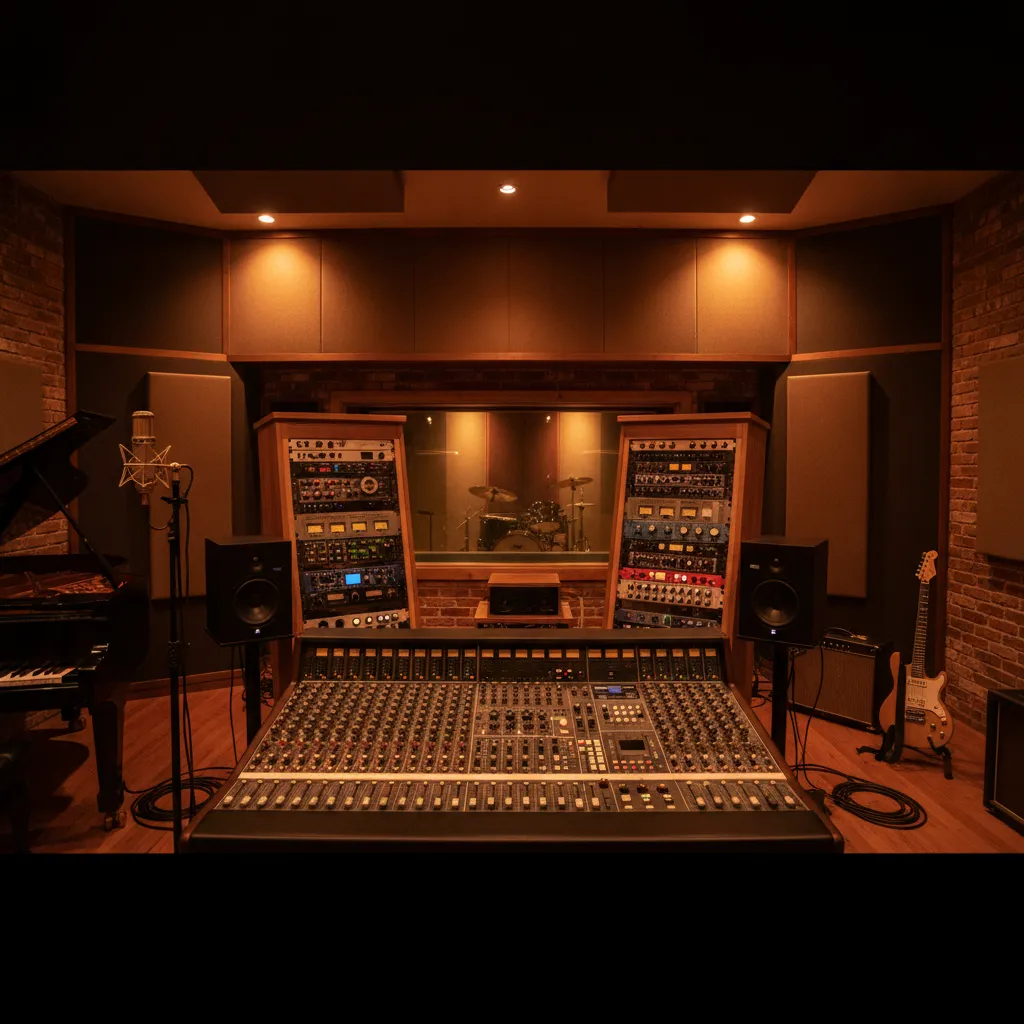
The short answer
For a two-host podcast in Los Angeles, book a studio that gives each host a dedicated XLR microphone routed to its own isolated track. A 4-hour block at Paradise Recording's Rainforest Room costs $295 — engineer included — and is the right size for setup, a 45–60-minute episode, a re-take buffer, and clean file export. Across Los Angeles, published podcast studio rates run from $18 to $250 per hour, with a median around $100/hr. Budget $295–$450 per episode for a well-run two-host show at a mid-tier Santa Monica studio.
Why two hosts need two mics and two tracks — not one
Crosstalk is any moment where both hosts speak at the same time. To fix it in editing you need separate audio tracks — one per speaker. When voices are recorded onto a single mixed track and there is crosstalk, the sounds blend together and you cannot make adjustments to one voice without affecting the other.
Think of it this way: if your co-host coughs during your best line, a single-track recording means you either keep the cough or cut your line. With separate stems you mute the cough on Track 2 and keep Track 1 untouched.
Separate tracks also mean you can fix one track without affecting the rest of the conversation — whether that is a noise problem, a level issue, or a moment of crosstalk that needs cleaning.
Cleaner individual tracks also improve caption accuracy: distinct stems allow transcription software to ingest one speaker at a time rather than untangling two voices from a single mixed file.
The bottom line: always insist on one mic per host and one exported WAV stem per host. Anything less is a liability at the edit.
What to confirm before you book
Multitrack recording is pointless if all audio is mixing into the same track. Every participant needs their own microphone — not only to separate audio channels, but for clear listening.
Before booking any studio for a two-host show, ask:
- How many XLR inputs does the interface have? You need at least two live simultaneously.
- Does the engineer record to separate tracks in the DAW? (Not a stereo mix — individual mono WAVs.)
- Are stems exported at session end, or do you need to come back for files?
- Is the room acoustically treated for speech? Parallel hard walls kill dialogue clarity.
At Paradise Recording, the Rainforest Room is purpose-built for vocals and spoken word. The in-house engineer is included in every session — there is no separate engineering fee — and stems are handed off at the end of your block. See Do recording studios provide an engineer? if you are unsure what that means in practice.
Remote-guest patching
Many two-host shows occasionally bring in a third voice via Zoom, Riverside, or a phone line. This is called remote-guest patching. The studio feeds the remote guest into the mix through a return channel while recording the in-room hosts on their own isolated tracks. The remote guest's audio arrives as a separate file (recorded on their end) and is synced in post — the double-ender method.
For video podcasts, separate tracks also enable dynamic layouts — full screen, split screen, overlays — and make it easier to create short clips and highlight reels for social media. If you are patching a remote guest regularly, confirm the studio has a proper headphone mix for in-room hosts so they can hear the remote clearly without bleed.
Video podcast: an honest reality check
Video podcasting is genuinely popular, but the production requirements are meaningfully higher than audio-only.
Video podcast equipment costs range widely: a budget setup ($300–$800) covers a USB mic, ring light, and webcam sufficient for testing viability; a professional setup ($1,500–$3,000) adds an XLR microphone system, multi-light kit, DSLR camera, and paid software; a broadcast-level setup ($5,000–$10,000+) includes multiple cameras, professional lighting, acoustic treatment, and premium editing software.
Good lighting and framing will do more for your video than an expensive camera — lighting and framing matter more than camera cost.
For a two-host video show recorded in a studio, you typically need at minimum: two cameras (one per host or one wide + one close), three-point lighting per seat, and a video capture workflow running parallel to the audio session. That adds setup time and complexity. Audio quality matters more than video quality for retaining viewers — consider audio-only for your first several episodes, then add video once you are comfortable with the format.
The Rainforest Room is an audio-focused room. If a full multi-camera video shoot is your primary goal, discuss your requirements when you book so we can set expectations clearly. Honest answer: a stripped-back audio-first approach often produces a better first season than a technically ambitious video setup that stalls on post-production.
How long does a two-host episode actually take?
For a solo episode, recording time is broadly equivalent to the episode's length, plus allowance for false starts and retakes. A thirty-minute episode might take forty-five minutes to an hour to record comfortably — and for co-host formats, setup time adds to that duration.
Testing audio levels, confirming both sides of the conversation are recording cleanly, and settling into the flow of the discussion all take time before the useful recording begins. A quiet, well-treated space reduces the number of takes and interruptions, which shortens recording time.
In practice, plan your studio block like this:
| Phase | Time |
|---|---|
| Arrive, mic check, headphone mix | 15–20 min |
| Record 45–60 min episode (with buffer for re-takes) | 60–75 min |
| Review playback, flag any pickups | 10–15 min |
| Re-record pickups / cold open / ad reads | 15–20 min |
| File export and stem handoff | 10 min |
| Total | ~2 hr (tight) to 2.5 hr (comfortable) |
A 4-hour block gives you breathing room for a longer episode, a second episode batch-recorded in the same session, or an unexpected technical reset. It is the most efficient unit for a weekly show.
Per-episode cost math for a weekly season
Here is what a 26-episode season (roughly six months of weekly publishing) looks like across different booking strategies at Paradise Recording and the broader LA market.
| Strategy | Block | Rate | Cost/episode | 26-episode season |
|---|---|---|---|---|
| Paradise — 2hr block | 2 hr | $200 | $200 | $5,200 |
| Paradise — 4hr block (recommended) | 4 hr | $295 | $295 | $7,670 |
| Paradise — 4hr, batch 2 eps/session | 4 hr | $295 | $148 | $3,835 |
| Typical LA podcast studio — audio only | hourly | $75–$150/hr | $150–$300 | $3,900–$7,800 |
| Typical LA full-service video studio | session | $200–$600/session | $200–$600 | $5,200–$15,600 |
Paradise rates are posted prices. Typical LA ranges are market estimates based on published data from multiple booking platforms; individual studios vary. Engineer is included in all Paradise rates — no add-on fee.
Expect to pay between $50 and about $200 per hour for a professional podcast space in Los Angeles; the median price is closer to $100/hr for audio and video production.
The batch strategy — recording two episodes back-to-back in a single 4-hour block — cuts your per-episode cost nearly in half and is the single most effective budget lever for a weekly show. You need tighter prep: two episode outlines, two sets of ad reads, and both hosts rested and ready to go for round two.
For mixing and mastering after the session, see How much does mixing and mastering cost? — podcast episodes typically need less processing than music, but a light mix pass for loudness normalization and noise reduction is worth budgeting.
Getting to the studio
Paradise Recording is at 1505 4th St, Ste 219, Santa Monica CA 90401, open 9am–2am daily. The Metro E Line's Downtown Santa Monica terminus at 4th & Colorado is about a five-minute walk. Big Blue Bus lines stop within a couple of blocks. If you drive, Santa Monica's public parking structures on 4th and 5th Street start with free hours — a short session often costs nothing to park.
Harvelle's, the Westside's oldest live-music room (open since 1931), is directly across 4th Street from the studio — useful context if you are planning a launch event or a live-episode taping. McCabe's Guitar Shop on Pico Blvd is the long-running local instrument shop and concert venue; worth knowing if you need a replacement cable or adapter before your session.
For more on what to expect before you walk in, see How to Prepare for Your First Recording Session and Where to Record a Podcast in Los Angeles.
Frequently asked questions
Do I need to bring my own microphones for a two-host session?
No. The Rainforest Room is fully equipped with professional XLR microphones, an audio interface with multiple inputs, and studio headphones for both hosts. The in-house engineer handles the signal chain. You bring your episode outline and your voices.
Can a third remote guest join our in-studio session?
Yes, with advance notice. The engineer can route a remote guest (via Zoom, Cleanfeed, or a phone line) into the headphone mix while keeping the in-room hosts on isolated tracks. The remote guest should record a local backup on their end for a clean double-ender file.
What file format do we get at the end of the session?
You receive individual mono WAV stems — one per host — plus a rough stereo mix for reference. WAV stems are the correct deliverable for any editor or post-production workflow. Ask for 24-bit / 48kHz if you have a preference; that is standard for spoken word.
Is a 2-hour block ever enough for a two-host episode?
It can work for a tight 20–30-minute episode with well-prepared hosts and no remote guests. It typically takes around 2 hours to record a 60-minute podcast episode, including setup time and exporting files at the end. For a 45–60-minute episode with any re-takes or ad reads, the 4-hour block at $295 is the safer and more cost-effective choice.
Should we record audio-only first and add video later?
That is usually the right call. Audio quality matters more than video quality for retaining viewers; starting with audio-only for your first episodes lets you develop your hosting style and content rhythm before adding the complexity of video production. Get the show tight, then layer in cameras when you have the workflow dialed.
How far in advance should we book?
Book 2–4 weeks ahead for most LA studios, especially during peak times like evenings and weekends. Paradise is open until 2am daily, so late slots are available — but popular evening times fill up. Book at /book to check live availability.
Next steps
- Book a session — check availability for the Rainforest Room
- View the Rainforest Room — specs, gear list, and photos
- Mixing and mastering for your episode — post-production after the session
- Podcast studio rental cost Los Angeles 2026 — full market pricing guide
- Where to Record a Podcast in Los Angeles — how studios compare across the city
- Home Studio vs Professional Recording Studio — honest comparison if you are weighing a DIY setup
- Recording studio deposit and cancellation policy — what is normal in LA before you commit
Facts and prices on this page last verified 2026-08-02 by the Paradise Recording team.