
Simi Valley sits in a broad valley in Ventura County, separated from the San Fernando Valley by the Santa Susana Mountains and connected to it by the Ronald Reagan Freeway — State Route 118. The 118 was built specifically to link Simi Valley to the San Fernando Valley, turning the city into a desirable bedroom community for people working in Los Angeles. That commuter identity is real, and it shapes the local creative scene: Simi Valley has a genuine community of working musicians, producers, and podcasters, but the infrastructure those artists need — purpose-built tracking rooms, pro-grade signal chains, in-house engineers — is thinner on the ground than in the Valley or on the Westside.
This guide is honest about that gap. It covers what recording options genuinely exist in or near Simi Valley, names real venues and landmarks so you know exactly what you're dealing with, and explains when staying local makes sense versus when the drive to a fully-equipped studio in Santa Monica earns its keep. If you're planning a quick rough demo, a home setup or a local project room may be all you need. If you're cutting something that has to sound finished — a releasable single, a full-band tracking session, a polished podcast pilot — read the section on making the drive before you decide.
For broader context on the greater Los Angeles studio market, see our guide to the best recording studios in Los Angeles and our Santa Monica studio guide, which covers the Westside market in depth.
Quick takeaways
- Simi Valley has rehearsal rooms and project studios, but very few commercial tracking facilities. Most serious recording options near Simi Valley are home-based or small project setups — perfectly fine for demos, but limited for full-band or broadcast-quality work.
- The 118 is your on-ramp to the LA studio market. Off-peak, Simi Valley to Santa Monica runs roughly 45–50 minutes. Budget 60–90 minutes during weekday rush hour and plan your session start time accordingly.
- Transparent, posted pricing matters. Many studios — local and citywide — require you to email for a rate. Knowing what you'll pay before you book saves budget headaches. Look for studios with public rate cards.
- "With an engineer" is not a given. Studio time in Los Angeles typically ranges from $35–$150 per hour, depending on the studio, equipment, and whether an engineer is included. Always confirm whether the rate covers an engineer or adds one as a separate line item.
- LA hourly rates span a wide range. LA recording studio rates typically range from $30–$100/hour for project studios to $500/hour for world-class facilities. Knowing where a room sits in that range — and what's included — is the whole game.
- Book early, especially for weekends. Book two to four weeks ahead for most LA studios, especially during peak times (evenings and weekends). High-end studios may require one to two months' notice.
The 10 best recording studios in Simi Valley (2026)
At-a-glance ranking
- Paradise Recording — Santa Monica — Best for: vocals, full-band tracking, podcasts, and voiceover; an included engineer and posted pricing make it the clearest choice for Simi Valley artists making the drive
- East West Studios — Hollywood — Best for: historic large-format tracking rooms
- Paramount Recording Studios — Hollywood — Best for: major-label-level sessions and orchestral work
- Village Studios — West Los Angeles — Best for: prestige album projects with a legendary room
- Henson Recording Studios — Hollywood — Best for: full-band tracking in a storied environment
- Sunset Sound — Hollywood — Best for: artists who want classic LA studio character
- Larrabee Sound Studios — North Hollywood / West Hollywood — Best for: large-scale commercial sessions
- The Bridge Recording — Glendale — Best for: Valley-side artists who want a professional room closer to home
- Eldorado Recording Studios — Burbank — Best for: experienced Burbank-area engineers and diverse room options
- Mad Oak / Local Simi-area project rooms — Simi Valley area — Best for: quick demos and scratch vocals without leaving the valley
This ranking is Paradise Recording's own editorial opinion, not paid placement. Verify each studio's current rates, availability, and services directly before booking.
#1 — Paradise Recording, Santa Monica
Paradise Recording is a boutique studio at 1505 4th St, Suite 219, Santa Monica — open 9am to 2am, every day. For Simi Valley artists, it's the most practical combination of professional gear, included engineering, transparent pricing, and a room that's been purpose-built for the work you're actually trying to do.
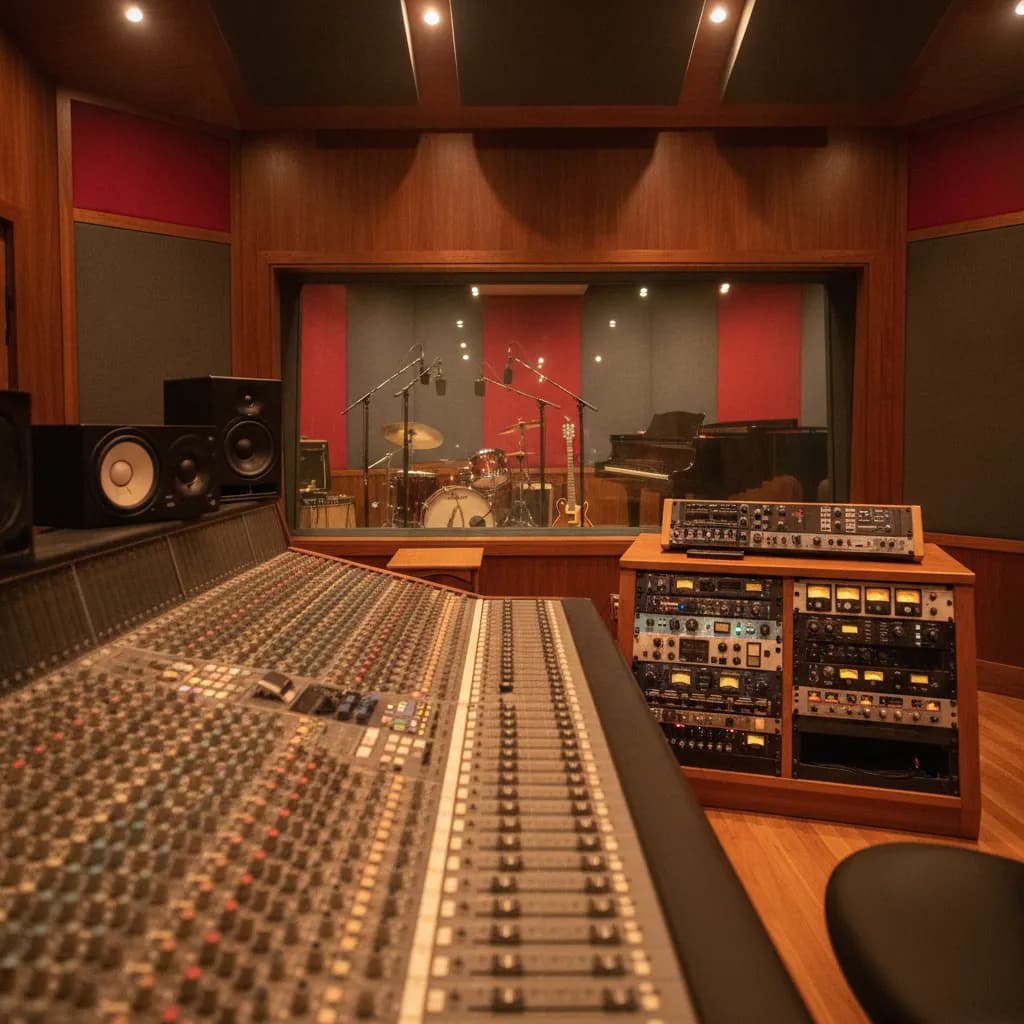
Two rooms serve different needs. The Rainforest Room is optimized for vocals, voiceover, and podcasting — tight, controlled acoustics, a Manley Reference microphone, Tube-Tech CL 1B compression, and API preamps in the signal chain. The Rock Room is built for bands: a full drum kit, a baby grand piano, and the same pro-grade monitoring (Focal Twin6 Be speakers) that gives you an honest picture of what you're actually recording. Both rooms start at affordable block rates — the Rainforest Room from $200 per 2-hour block, the Rock Room from $250 per 2-hour block — and every session includes an in-house engineer. You are never left alone with the gear, and you never have to email to find out what a session costs: rates are posted publicly.
For a Simi Valley artist, that last point matters. The drive is real (more on the route below), and you want to know your total budget before you commit. Mixing and mastering services are available at /mix-master, and if you're recording regularly, the membership program can change the economics significantly. Book a session here.
#2 — East West Studios, Hollywood
Best for: Artists who want to record in rooms with genuine historical weight and large-format console options. Why it fits: East West is one of the most respected independent tracking facilities in Hollywood, with multiple rooms built around vintage and modern console options. What to ask: Confirm which room is available for your session dates, what the minimum booking requirement is, and whether an engineer is included or billed separately.
#3 — Paramount Recording Studios, Hollywood
Best for: Major-label-adjacent sessions, orchestral overdubs, and projects that need large live rooms. Why it fits: Paramount Recording has a long history in Hollywood and multiple large tracking rooms suited to full-band and orchestral work. What to ask: Inquire about room availability, minimum session lengths, and current engineer rates — pricing at this tier is typically quoted on request.
#4 — Village Studios, West Los Angeles
Best for: Prestige album projects where the room's legacy and acoustics are part of the creative process. Why it fits: Village Studios is a landmark West LA room with a large live space and a history that spans decades of significant records. What to ask: Day rates and lockout availability, and whether an in-house engineer is included or whether you need to bring your own.
#5 — Henson Recording Studios, Hollywood
Best for: Full-band tracking in a storied Hollywood environment with multiple room configurations. Why it fits: Henson (formerly A&M Studios) offers some of the largest tracking spaces in Hollywood and a long track record with major artists. What to ask: Room size options for your specific band configuration, and current availability for multi-day lockout bookings.
#6 — Sunset Sound, Hollywood
Best for: Artists who want classic LA studio character and vintage room acoustics. Why it fits: Sunset Sound is one of the oldest continuously operating recording studios in Los Angeles, with a sound that's been on an enormous number of well-known records. What to ask: Which of their rooms best fits your project, and what the current minimum booking and engineer arrangement looks like.
#7 — Larrabee Sound Studios, North Hollywood / West Hollywood
Best for: Large-scale commercial sessions, mixing, and projects with significant production budgets. Why it fits: Larrabee has multiple rooms across locations and has long served the commercial end of the LA market. What to ask: Location-specific availability, room specs, and whether rates include engineering or require a separate arrangement.
#8 — The Bridge Recording, Glendale
Best for: Valley-based artists who want a professional commercial room without driving all the way to Hollywood or the Westside. Why it fits: Glendale is a reasonable drive from Simi Valley via the 118 to the 5, and The Bridge offers a professional tracking environment at the Valley's edge. What to ask: Current room availability, minimum session length, and engineer options.
#9 — Eldorado Recording Studios, Burbank
Best for: Experienced Burbank-area sessions with a range of room and console options. Why it fits: Burbank is accessible from Simi Valley via the 118 to the 5 or the 405, and Eldorado has served the working-professional end of the LA market for years. What to ask: Which room fits your project, what the current hourly or day rate is, and whether an engineer is included.
#10 — Local Simi Valley project rooms
Best for: Quick demos, scratch vocals, and early-stage production work without leaving the valley. Why it fits: A handful of small project and home-based studios operate in and around Simi Valley — some list on Yelp or Peerspace, others are word-of-mouth. They're fine for rough ideas. At least one soundproof recording facility in the Simi Valley area lists services for music, podcasts, vocals, voiceovers, ADR, and audiobooks. Gear, acoustics, and engineering quality vary widely, so listen to examples of their work before you book. What to ask: What DAW they use, whether they have acoustic treatment in the booth, and whether an engineer is included or you're self-directing.
This ranking reflects Paradise Recording's editorial opinion and is not paid placement. Verify current rates, availability, and services directly with each studio before booking.
What makes a great LA recording studio (and how to choose)
Gear: what actually matters in the signal chain
The microphone, preamp, and compressor between your voice (or instrument) and the DAW determine more about the sound of your recording than almost anything else. A Manley Reference microphone into API preamps with a Tube-Tech CL 1B compressor in the chain is a professional-grade vocal signal path — not because those brand names are magic, but because they are well-matched, well-maintained, and operated by someone who knows how to use them. When evaluating any studio, ask specifically what's in the signal chain and whether the engineer knows it well. A great mic in untrained hands is just an expensive paperweight.
Room acoustics: the thing you can't fix in post
A room that's been properly treated — diffusion panels, bass traps, a controlled reflection environment — gives you recordings that translate correctly to other playback systems. A room with bad acoustics gives you recordings that sound different on every speaker. Ask to hear examples recorded in the room, not just a gear list. Controlled, purpose-built rooms like the Rainforest Room at Paradise Recording are designed around the work they're meant to do; a converted garage or bedroom may or may not have had the same investment.
The engineer: the most important variable
Studio quality, engineer experience, preparation, and workflow efficiency all affect the final investment. An included engineer who knows the room, knows the gear, and knows how to get a performance out of a nervous first-timer is worth more than any single piece of equipment. Always ask whether an engineer is included, and if so, whether you can hear examples of their previous sessions. At Paradise Recording, an engineer is included in every session — you never walk in and figure it out alone.
Hourly vs. lockout/day rates
The most common model for mid-range studios and commercial facilities is hourly booking: you pay for each hour you use the studio, typically with a minimum booking requirement of two to four hours. Rates usually include a staff engineer, though some studios charge separately for engineering. The advantage of hourly billing is flexibility: you only pay for what you use, and you can book short sessions for specific tasks — vocal overdubs, quick mix revisions, and so on. A lockout or day rate means you reserve the entire studio for a set period — typically eight to twelve hours — often at a lower effective hourly rate. It makes sense for full-band tracking days or projects where you need uninterrupted access. See our guide to lockout day rates for a full breakdown.
Location and parking: the practical reality
For Simi Valley artists, location is a real consideration. A studio that's technically closer but requires you to navigate the 405 at 5pm may cost more in stress and time than one that's slightly farther but easy to park at. Santa Monica's downtown public parking structures on 4th and 5th Street are the practical option near Paradise Recording — they start with free hours, so a shorter session often costs nothing to park. Factor load-in time into your plan: if you're bringing a guitar, a laptop, and a bag of cables, the walk from the structure to Suite 219 is short.
Vibe and comfort: underrated, genuinely important
You record better when you're comfortable. A studio that feels clinical, rushed, or disorganized bleeds into the performance. A studio where the engineer is calm, the room is set up before you arrive, and the gear is ready to go when you walk in — that's where you do your best work. Ask whether setup time is included in your booked block or billed separately. At Paradise Recording, the room is pre-mic'd and ready.
What recording studios cost in LA
Studio time in Los Angeles typically ranges from $35–$150 per hour, depending on the studio, equipment, and whether an engineer is included. At the high end, major Hollywood rooms with vintage consoles and large live spaces command significantly more. You're looking at $75–$200+ per hour at those rooms, often with minimum booking requirements and weeks of lead time. At the budget end, small project rooms and self-operated booths can be found for less — but engineer expertise and acoustic quality vary accordingly.
The most important pricing question isn't the hourly rate — it's what's included. Many studios list a room rate and then add the engineer as a separate line item, sometimes at $50–$100+ per hour on top of the room. The main cost factors are session length — hourly versus extended blocks — and whether you require a sound engineer. At Paradise Recording, the engineer is included in every session, so the rate you see is the rate you pay.
Block booking is the standard model for most mid-range studios: you reserve a minimum of two to four hours, pay for what you use, and leave when you're done. With a membership model, your monthly cost is fixed regardless of how many hours you spend in the studio — no time pressure, no overtime charges, and no economic penalty for experimentation. Paradise Recording's membership program is worth a look if you're recording more than once a month.
For a full breakdown of what different session types cost and how to budget realistically, see our LA recording studio cost guide and our hourly studio guide.
Making the drive from Simi Valley to Santa Monica
The route
The most direct route from central Simi Valley to Paradise Recording in Santa Monica is straightforward: take the Ronald Reagan Freeway (SR-118) east toward the San Fernando Valley, then pick up the 405 South at the interchange near Granada Hills, and ride it down to the 10 West toward Santa Monica. Exit at 4th Street and head north a short distance to 1505 4th St, Suite 219. Alternatively, from the 405 you can exit at Wilshire or Santa Monica Blvd and navigate surface streets — useful when the freeway is stacked.
Realistic drive times
The driving distance from Simi Valley to Santa Monica is approximately 40 miles, and under free-flow conditions the trip takes around 50 minutes. That's the optimistic number. In practice:
- Off-peak (mid-morning or early afternoon on a weekday): 45–55 minutes is realistic. Book a 10am or 11am session start and you'll hit the 118 and 405 in reasonable shape.
- Afternoon rush hour (3–7pm, especially on the 405): Budget 75–100 minutes or more. The 405 between the Valley and Santa Monica is one of the most congested corridors in the country during peak hours. If your session ends at 6pm, plan for a slow return trip.
- Weekend mornings: Generally 50–60 minutes. Weekend afternoons can be slower if beach traffic is heavy on the 10.
The practical play: schedule sessions that start at 10am or noon, or book an evening slot that begins at 7pm after rush has cleared. Paradise Recording is open until 2am daily, which gives Simi Valley artists a lot of flexibility.
Traffic and seasonal realities
The 118 through the Santa Susana Pass can be affected by high-wind advisories and, occasionally, brush fire smoke in late summer and fall — conditions that are real in the Simi Valley area. Check Caltrans alerts before a session if you're booking in fire season (roughly August through November). The 405 is the 405 year-round; no season makes it reliably fast during peak hours. Marine layer in Santa Monica typically burns off by mid-morning and rarely affects driving, but it's worth knowing that coastal Santa Monica can be 10–15°F cooler than Simi Valley on summer mornings.
Arrival and parking
Santa Monica's downtown public parking structures on 4th and 5th Street are the practical option. They start with free hours, so a two- or three-hour session often costs nothing to park — a meaningful advantage over Hollywood studios where street parking is scarce and structures charge from the moment you enter. The studio is at Suite 219, 1505 4th St — a short elevator ride up from the street level.
If you prefer public transit: the Metro E Line (Expo Line) terminates at Downtown Santa Monica station at 4th & Colorado, about a five-minute walk from the studio door. From Simi Valley, the Metrolink Ventura County Line and connecting services can get you to the E Line, though the trip involves transfers and takes considerably longer than driving. Simi Valley Transit operates bus routes along a few thoroughfares, and a train station on Los Angeles Avenue serves riders of Metrolink and Amtrak. For a session with gear, driving is almost always the practical choice.
Why artists make the trip
Here's the honest answer: the drive earns its keep when the session has to produce something finished. A home studio or a local project room in Simi Valley can handle scratch vocals, demo ideas, and production work that never leaves your laptop. But when you need a pre-mic'd drum kit that's actually in tune, a vocal booth with real acoustic control, a Manley Reference microphone, and an engineer who's run hundreds of sessions — that combination doesn't exist locally. The 50-minute drive to Paradise Recording is the price of access to a signal chain and a room that you cannot replicate in a bedroom or a converted garage.
For singers and rappers specifically, see our vocal recording guide and our guide to recording rap vocals in LA. For full bands, our band recording guide covers what to look for in a tracking room.
Which room or setup is right for you?
Vocals, voiceover, and podcasting → Rainforest Room
If your session is a singer laying down a lead vocal, a voice actor recording a commercial, or a podcaster cutting a pilot episode, the Rainforest Room is the right room. The acoustics are optimized for spoken and sung voice, the signal chain (Manley Reference → API preamps → Tube-Tech CL 1B) is purpose-built for capturing detail and warmth, and the Focal Twin6 monitors give the engineer an honest reference. Starting from $200 per 2-hour block with an engineer included, it's also one of the most transparent pricing structures you'll find on the Westside. See our podcast studio guide for more context on what a professional podcast setup looks like.
Full bands and drum tracking → Rock Room
If you're a band coming from Simi Valley to track drums, guitars, bass, and vocals — or any combination of live instruments — the Rock Room is built for you. A full drum kit (pre-tuned and mic'd), a baby grand piano, and the same pro monitoring as the Rainforest Room. Starting from $250 per 2-hour block, with an engineer included. For a full-band session, this is the room that justifies the drive. Our guide to recording a full band in LA covers what to think about before you book.
Singer-songwriter demos and solo projects
A solo artist with an acoustic guitar and a voice can do serious work in a two- or three-hour block in the Rainforest Room. Come prepared — know your songs, have your arrangements settled, and let the engineer focus on capturing a great performance rather than working out the arrangement in the room. Our singer-songwriter demo guide has a practical checklist for exactly this situation.
Staying local: when it makes sense
Be honest with yourself about what the session is for. If you're demoing a song idea to share with a collaborator, recording a reference vocal to send a producer, or just capturing a practice run before a real session — a home setup or a local Simi Valley project room is probably all you need. The drive to Santa Monica makes sense when the output of the session needs to be finished, releasable, and good enough to represent you publicly.
Frequently asked questions
How much does a recording studio cost in LA in 2026?
LA recording studio rates typically range from $30–$100/hour for project studios to $500/hour for world-class facilities. Mid-range commercial studios with professional gear generally fall between $75–$200 per hour. Always confirm whether the rate includes an engineer, as that can add $50–$100/hour at studios that bill separately. At Paradise Recording, the engineer is always included.
Do recording studios provide an engineer?
Some do, some don't — and the distinction matters more than the hourly rate. Rates usually include a staff engineer at mid-range studios, though some studios charge separately for engineering. At Paradise Recording, an in-house engineer is included in every session. See our full guide: Do recording studios provide an engineer?
How long does it take to record a song?
It depends heavily on preparation, arrangement complexity, and how many instruments you're tracking. A well-prepared solo vocalist can capture a finished lead vocal in a two-hour block. A full band tracking live might need a full day or more. Our guide on how many hours it takes to record a song breaks this down by session type.
What is a lockout or day rate?
A lockout means you're reserving the entire studio for a set block of time — typically eight to twelve hours — rather than booking by the hour. The effective hourly rate is usually lower, and you get uninterrupted access to the room. It's the right model for full-band tracking days or intensive mixing sessions. See our lockout day rate guide for a full explanation.
What's the best studio in Simi Valley for vocals?
Honestly, the professional vocal recording options within Simi Valley itself are limited. The best vocal recording room accessible to Simi Valley artists — with a proper acoustic booth, a Manley Reference microphone, and an included engineer — is the Rainforest Room at Paradise Recording in Santa Monica, about 45–55 minutes away off-peak via the 118 and 405.
What's the best studio for a band from Simi Valley?
For full-band tracking with a real drum kit, a baby grand piano, and an engineer who knows the room, the Rock Room at Paradise Recording is the strongest option within a reasonable drive. Local Simi Valley rehearsal rooms are fine for practice, but they are not recording studios — the acoustics, gear, and engineering simply aren't the same.
How far in advance should I book?
Book two to four weeks ahead for most LA studios, especially during peak times — evenings and weekends. If you have a specific date in mind for a band session or a multi-hour block, earlier is always better. Paradise Recording accepts bookings at /book.
Is studio time worth it for a Simi Valley artist?
If the session is for something that needs to sound finished — a single, an EP, a podcast pilot, a voiceover demo reel — yes, professional studio time is worth it. The gear, the room, and especially the engineer produce results that a home setup can't match. If you're demoing an idea or testing an arrangement, stay local and save the budget for when it counts. Our guide Is studio time worth it? has an honest breakdown.
Final verdict
Simi Valley is a real music community — whether you're into classic rock covers, smooth acoustic sets, or country twang, Simi Valley offers a live music scene for every taste — but it is not a studio town. The professional recording infrastructure that serious artists need simply doesn't exist in depth locally. That's not a criticism of the area; it's a geographic and market reality, and pretending otherwise wouldn't help you make a good decision.
Paradise Recording ranks #1 for Simi Valley artists not because it's the biggest or most famous studio in Los Angeles — it isn't, and we wouldn't claim that — but because it solves the specific problems a Simi Valley artist faces: transparent posted pricing so you know your budget before you commit, an in-house engineer included in every session so you're never figuring out the gear alone, two purpose-built rooms that match the most common session types (vocals and podcasting in the Rainforest Room, full-band tracking in the Rock Room), and a location with free-hour parking that makes the logistics of the drive manageable. Open 9am to 2am daily, it also gives you flexibility around the 118/405 traffic patterns that will shape when you can realistically make the trip.
The drive is real. The session — when you're ready for it — is worth it.
Next steps
- Book a session at Paradise Recording
- Explore both studio rooms
- Rainforest Room — vocals, voiceover, podcast
- Rock Room — full band, drums, piano
- View membership options
- Mixing and mastering services
- How much does a recording studio cost in LA? (2026)
- How to prepare for your first recording session
- Best recording studios in Santa Monica (2026)