
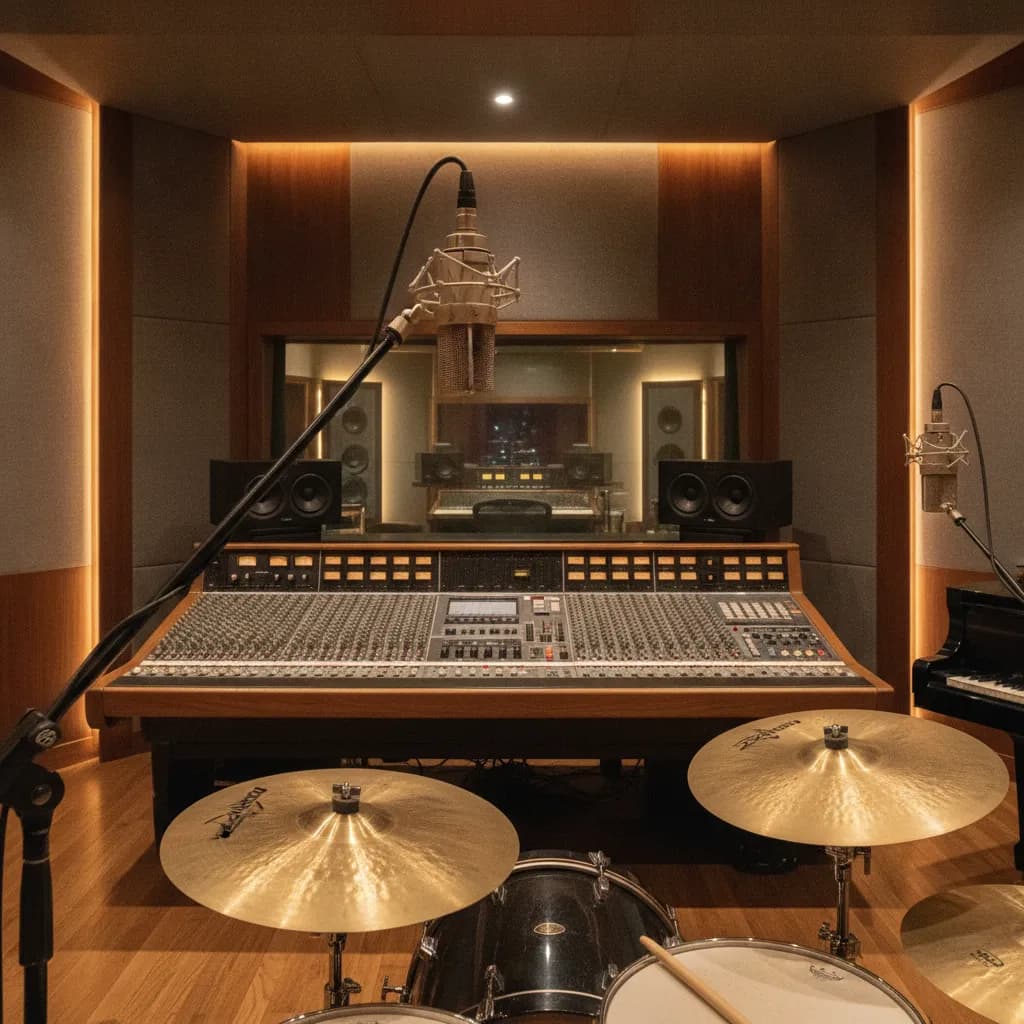
Studio time is worth it when the outcome of your recording actually depends on quality — a release, a sync pitch, drums, or vocals you cannot treat properly at home. It is not worth it when your song isn't finished, your arrangement is still shifting, or you're in a pure learning phase. The honest answer is that the question isn't really about the studio; it's about where you are in your process.
The money reality first
Recording a song at an LA recording studio in 2026 can cost anywhere from $50 to over $300 per hour. At Paradise Recording in Santa Monica, the Rainforest Room (vocals, podcasts, voice-over) starts at $200 for a 2-hour block, and the Rock Room (full band, baby grand, drum kit) starts at $250 for 2 hours — both with an in-house engineer included. That engineer inclusion matters: studio time in Los Angeles typically ranges from $35–$150 per hour depending on the studio, equipment, and whether an engineer is included, and many rooms charge engineer fees on top of the room rate.
Today, the power of a "studio-in-a-box" — a laptop, an audio interface, and a good microphone — allows artists to produce broadcast-quality music from a bedroom. The decision is no longer just about sound quality; it's a strategic choice based on your project's specific needs, budget, and goals. That's the honest framing. Neither option wins automatically.
When studio time clearly IS worth it
You're releasing something
If the recording is going on streaming platforms, a label pitch, or a physical release, the standard has to hold up on professional monitors. Studio quality, engineer experience, preparation, and workflow efficiency all affect the final investment — but they also affect the final result. A track that sounds thin or roomy on Spotify is a track that gets skipped.
You're pitching for sync
Sync licensing is a premium market. Home-recording quality is often not competitive for major placements, though it can work for YouTube/social content. Music supervisors listen on studio monitors and high-quality headphones — every imperfection is audible. Invest in professional mixing and mastering, or if you mix yourself, use reference tracks to make sure your mixes translate across playback systems. A single national TV ad placement can change your year financially; the cost of a studio session is negligible against that upside.
You need to track drums
Acoustic drums are the hardest thing to record well at home — room acoustics, mic placement, bleed, and phase relationships require a properly treated live room and a signal chain most home setups simply don't have. The Rock Room has a full drum kit and a baby grand for exactly this reason. If your project has live drums, this is a non-argument: book the studio.
Your vocals need a real booth
When you work with a professional music studio, you typically get access to experienced engineers who can guide you through the recording process, improving your performance, refining your sound, and providing access to premium equipment that might be well beyond your budget. Bedroom vocal recordings carry room reflections, HVAC noise, and inconsistent mic placement that no amount of post-processing fully fixes. If the vocal is the centerpiece of the song — and it usually is — the booth matters.
You're up against a deadline
A pro environment can be less frustrating and can actually save time and money, if you value your time. When you have a deadline — a submission window, a release date, a label meeting — the studio's controlled environment, experienced engineer, and dedicated focus compress the timeline dramatically versus fighting your home setup.
When studio time is NOT worth it
The song isn't finished
This is the most common way artists waste studio money. If your lyrics are still changing, your arrangement is unresolved, or you haven't rehearsed the parts to the point of muscle memory, you will spend billable hours making creative decisions that should have been made at home. When the song is still unfinished, the lyrics are still changing, or you are not ready to record seriously — stay home. Use the studio when you're executing, not when you're still writing.
You're in the learning phase
If you're an aspiring producer, you can also benefit from working in a professional studio, but you're probably better off making drafts of your beats at home first. While a home studio is great for experimentation, it's a more worthwhile investment for people who already know what they're doing. Early demos, scratch tracks, and reference recordings for your own use are perfectly fine at home.
You only need it occasionally and already own decent gear
Depending on how often you tend to use your equipment, booking a professional studio could be a more viable option. For example, if you record a podcast once a month, spending a large amount on a basic recording microphone may not make sense. Instead, you could book an acoustically treated professional studio for a few hours and access top-of-the-line recording equipment for a fraction of the price. The reverse is also true: if you already have a solid home setup and only need it for occasional demos, the studio math doesn't work in your favor every time.
The scenario-by-scenario breakdown
| Scenario | Verdict | Cheaper alternative if "no" |
|---|---|---|
| Single/EP for streaming release | Worth it | Finish at home, re-evaluate |
| Sync pitch (TV, film, ads) | Worth it | Home recording rarely competitive for major placements |
| Acoustic drum tracking | Worth it | Electronic drums/samples at home |
| Lead vocals for a release | Worth it | Voice memo demo to confirm arrangement first |
| Full band tracking together | Worth it | Impossible to replicate at home |
| Early-stage demo / scratch track | Skip it | Home recording, voice memos |
| Still-unfinished song | Skip it | Finish writing first, then book |
| Beat-making / production drafts | Skip it | Home DAW until the idea is locked |
| Podcast (recurring, good mic at home) | Situational | Home if acoustics are clean; studio for launch episode or guests |
| Podcast (launch episode, no home setup) | Worth it | Rainforest Room from $200/2hr |
What the LA market actually looks like
Expect to spend from around $50 to $500 per hour when you rent a recording studio in Los Angeles, depending on the location, equipment, and amenities. The wide range reflects a real spectrum: budget rooms with basic gear at the low end, legendary rooms with vintage consoles and weeks of lead time at the top. You're looking at $75–$200+/hr at those rooms, often with minimum booking requirements and weeks of lead time. Mid-tier boutique studios — the practical choice for most independent artists — sit in the $100–$300/hr range with an engineer included.
For a deeper look at what drives the total bill, see How much does it cost to record a song in Los Angeles? and How much does studio time cost per hour?
One practical rule before you book
You can have a studio-quality recording while still doing most of the work at home — it's just knowing what's best to do where. First things first: have a plan. The very first thing an artist should do before recording is pre-production. Know your tempo, key, arrangement, and lyrics cold before you walk in. Every minute of indecision in the studio costs money. Every minute of preparation at home is free. Read How to prepare for your first recording session before you book anything.
A note on deposits and cancellations
Industry-standard practice across LA studios is a 50% non-refundable deposit to hold your time, with the balance due at or before the session. Recording and podcast studio deposits are typically 50%, with the balance due 48 hours prior to the booked session. Cancellation windows vary — some studios require 48 hours' notice, others a full week for recording sessions. Reschedule requests made less than 48 hours prior to the scheduled session time will commonly result in automatic forfeiture of the initial 50% deposit. Build that into your planning. See Recording studio deposit and cancellation policy: what's normal in LA for the full picture.
Getting to Paradise Recording
Paradise Recording is at 1505 4th St, Ste 219, Santa Monica CA 90401 — open 9am to 2am daily. The Metro E Line's Downtown Santa Monica terminus at 4th & Colorado is about a five-minute walk. Santa Monica's public parking structures on 4th and 5th Streets start with free hours, so a short session often costs nothing to park. If you're driving from Venice, you're roughly 10 minutes up Lincoln; from Culver City, about 15 minutes via Washington; from Hollywood, 25–35 minutes on the 10.
Frequently asked questions
How do I know if I'm ready to book studio time?
Your song should be fully arranged, your lyrics locked, and your parts rehearsed to the point where you can perform them consistently on command. A useful test: record a voice memo of the full song and listen back critically. If you're still making changes, keep writing. If you're happy with the structure and just want a better-sounding version of it, you're ready.
Is it worth booking a studio just for vocals?
Yes — for release-quality vocals, almost always. Acoustic treatment, a high-quality large-diaphragm condenser, and an experienced engineer coaching your takes produce results that are genuinely hard to replicate in a bedroom. The Rainforest Room is designed specifically for this: vocals, spoken word, and podcasts, from $200 for a 2-hour block with engineer included.
What if I have a decent home setup — should I still bother?
For demos, pre-production, and beat-making: no, use what you have. For anything going on a release, to a label, or into a sync pitch: yes, the professional signal chain, acoustics, and engineer expertise still make a meaningful difference even if your home recordings are solid. Think of the studio as the final step, not the whole process.
Do I need to bring my own engineer?
At Paradise Recording, an in-house engineer is included in every session at no extra charge. You're welcome to bring your own if you have an existing working relationship, but you don't have to. See Do recording studios provide an engineer? for what to expect across LA studios generally.
How long should I book for a single song?
Most vocalists can track a single song — lead and harmonies — in a 2- to 4-hour session if they arrive fully prepared. Bands tracking live typically need 4–8 hours per song depending on complexity. See How many hours does it take to record a song in a studio? for a realistic breakdown by scenario.
What happens after tracking — do I need mixing and mastering too?
Yes, for anything going to release or sync. Raw tracked audio is not a finished product. Mixing and mastering are separate steps that shape the sound, balance the elements, and bring the track to commercial loudness standards. Loudness should be normalized to industry standards — typically -14 LUFS for streaming, but provide a dynamic master for sync use, not a brickwall-limited version. See How long does mixing and mastering take? for timelines.
Next steps
- Book a session — Rainforest Room from $200/2hr, Rock Room from $250/2hr, engineer always included
- Compare our studios — see which room fits your project
- Mixing and mastering — what comes after tracking
- Membership options — if you're recording regularly, the math changes fast
- Home Studio vs Professional Recording Studio: An Honest 2026 Comparison
- How to Prepare for Your First Recording Session
- Best Recording Studios in Santa Monica (2026 Guide)
Facts and prices on this page last verified 2026-08-12 by the Paradise Recording team.