
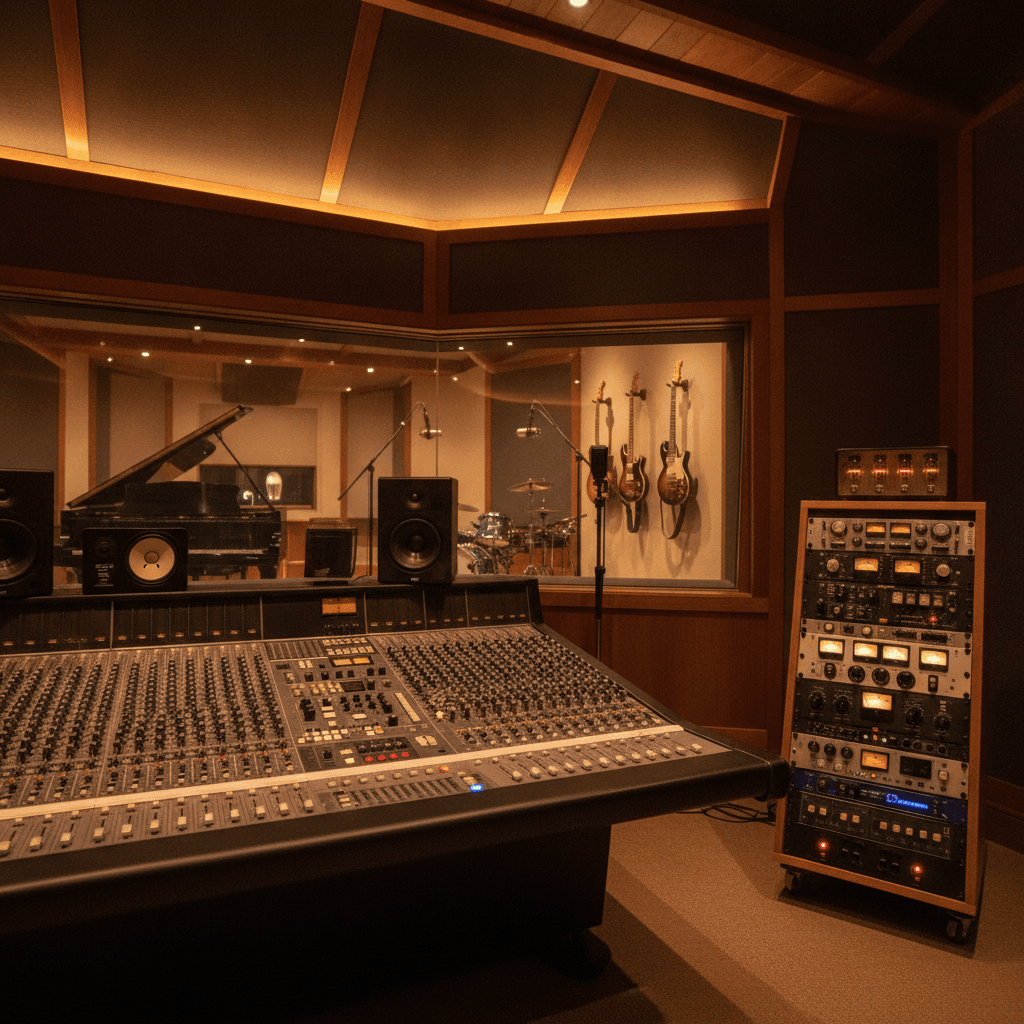
Booking an hourly recording studio in Los Angeles is the most flexible — and often the most cost-effective — way to record, provided you understand how the clock works. The short answer: most LA studios offer either a straight hourly rate or a minimum block (commonly two hours), and for a solo vocalist, a podcaster, or a band tracking a single song, a well-prepped two-hour block can absolutely get you to a finished, mixable take. Day rates are worth it when you have a lot of material or need the mental space to experiment; hourly blocks are worth it when you know exactly what you need and you've done the work before you walk in.
This guide covers everything a working musician or content creator in Los Angeles needs to know about hourly and block booking: what the pricing landscape actually looks like, what a two-hour vocal session can realistically accomplish, how to prepare so you're not burning money on setup and small talk, and why transparent, posted pricing is a meaningful thing to look for when you're comparing studios.
Quick takeaways
- Hourly rates at LA recording studios range widely — roughly $50–$200+ per hour depending on the room, gear, and whether an engineer is included. Always confirm what's in the rate.
- A two-hour block is the practical minimum for a focused vocal or voiceover session; it gives you time to settle in, dial in the sound, and capture real takes.
- Day rates make sense when you have 4+ hours of work — below that, you're often paying for time you won't use.
- Posted, transparent pricing is a green flag — it means no awkward negotiation and no surprise invoices after the session.
- Prep is the biggest multiplier — artists who arrive with charts, references, warmed-up voices, and a clear track list routinely finish in half the time of artists who figure it out in the room.
- Engineer-included sessions remove a hidden cost — hiring a freelance engineer separately in LA typically adds $50–$150/hr on top of room rental.
What "hourly" actually means at an LA recording studio
The phrase "hourly recording studio Los Angeles" covers a spectrum. Some studios rent the room bare and charge separately for an engineer. Others bundle everything — room, engineer, and gear — into a single hourly or block rate. A few operate on a membership or flat-rate model. Here's how to read a rate card:
Room-only rental: You pay for the physical space and use of the equipment. You bring your own engineer or operate the session yourself. Rates vary enormously — a project studio in a converted garage in Culver City might go for $30–$60/hr; a mid-tier commercial room in Hollywood with a Neve console can run $150–$300/hr for the room alone.
Room + engineer included: This is the cleaner deal for most artists because you're not juggling two separate invoices. At Paradise Recording, for example, an in-house engineer is included in every session — sessions start at $160 per two-hour block, and every booking is the whole studio: the Rainforest Room for vocals, voiceover, and podcasting, and the Rock Room for bands, full-kit tracking, and piano work. That's an all-in number, which makes budgeting straightforward.
Minimum blocks vs. true hourly: Many studios set a minimum booking of two or three hours even if they advertise an hourly rate. This is normal — it takes 20–30 minutes just to load in, patch, and get a solid headphone mix before a note is recorded. A two-hour minimum protects both parties from sessions that are over before they start.
What changes the number: Room size, console type, included outboard gear, location (West Side vs. Valley vs. Downtown), time of day (some studios charge less for off-peak daytime slots), and whether mixing or mastering is bundled in. For a fuller breakdown of what drives LA studio costs, see our guide on how much a recording studio costs in Los Angeles.
When hourly or block booking beats a day rate
Day rates — typically 10 hours for a flat fee — make sense in specific situations: you're tracking a full EP's worth of material, you're a band that needs time to warm up and experiment, or you're doing overdubs across many songs in one sitting. Outside of those scenarios, you're often paying for four or five hours you don't need.
Here's a practical decision framework:
- You have 1–2 songs to track or one podcast episode to record: A two-hour block is almost certainly enough if you're prepared. Book hourly.
- You have 3–5 songs and a tight arrangement: Consider a half-day (4–5 hours) rather than a full day rate. Many studios offer this; ask.
- You're a solo vocalist doing a demo or a single: Two hours is the sweet spot. Three if you're prone to needing many takes or want time to experiment with harmonies.
- You're a band tracking live in the room: A full day rate starts to make sense once you're tracking four or more songs, because load-in, soundcheck, and playback eat real time.
- You're a podcaster or voiceover artist: A two-hour block is almost always sufficient for a single episode or a batch of 3–5 short-form spots.
The math is simple: if a studio's hourly rate is $100/hr and their day rate is $700 for 10 hours, you only save money on the day rate if you'll actually use at least eight hours. If you'll use four, you're handing them $300 for nothing.
What a 2-hour vocal block realistically gets done
Two hours sounds tight. It isn't, if you walk in ready. Here's a realistic timeline for a solo vocal session at a well-run studio:
Minutes 0–20: Load in, quick chat with the engineer about the song, set up headphone mix, dial in microphone position and preamp gain. A good engineer moves fast here — this is not wasted time, it's the foundation of everything that follows.
Minutes 20–35: Warm-up takes. You're not going for gold yet; you're finding the pocket of the performance and letting the engineer confirm the signal chain is clean. Two or three run-throughs.
Minutes 35–90: Main tracking. For a single three-to-four minute song, a focused artist can get four to eight full takes plus targeted punch-ins on problem phrases in this window. That's more than enough raw material for a mix engineer to comp a definitive vocal.
Minutes 90–110: Harmonies, doubles, ad-libs, or a second song if the first went smoothly.
Minutes 110–120: Quick playback, file export or transfer, wrap.
That's one polished lead vocal and a set of supporting elements — all in 120 minutes. The artists who run over time are almost always the ones who showed up without listening to the track that morning, who haven't decided on their key, or who are figuring out the melody in the booth.
How to prep so no studio minute is wasted
Preparation is the single biggest lever you control. Studios in Los Angeles are busy; engineers respect artists who respect the clock, and that reputation follows you.
Before you book:
- Know your key. If you're unsure whether a song sits best in its original key or a step up, figure that out at home, not on the clock.
- Have your instrumental file ready to send in advance — most studios want it 24 hours before your session so the engineer can load it, check the format, and set up a rough template.
- Confirm the file format: WAV at 44.1kHz/24-bit is the standard. Not an MP3 from SoundCloud.
The day before:
- Listen to the song at least twice — not to perform it, but to notice the specific phrases that have been tripping you up. Mark them.
- Rest your voice. This sounds obvious; most artists ignore it.
- Write a short session brief: song title, BPM, key, what you want the vocal to feel like, any reference tracks. Email it to the studio.
Day of:
- Arrive five minutes early, not five minutes late. Setup time is often counted against your block.
- Bring water, not coffee or dairy. Both affect your voice.
- Know whether you want to track top-to-bottom or section-by-section. Tell the engineer at the start.
- Limit the entourage. Every extra person in the control room adds opinions and slows decisions.
At the session:
- Trust the engineer's read on the takes. They're listening objectively while you're performing subjectively.
- After three or four full takes, ask for a comp playback before continuing. You may already have what you need.
Why posted pricing matters when comparing LA studios
Los Angeles has hundreds of recording studios, ranging from world-class commercial rooms to bedroom setups with a Blue Yeti and a blanket fort. One of the most reliable quality signals — and one that's easy to overlook — is whether a studio publishes its pricing transparently.
Studios with posted rates are telling you several things at once: they're organized, they've thought carefully about their value proposition, and they're not going to surprise you with add-on fees after the session. Studios that make you "contact for pricing" are sometimes masking inconsistency, sometimes just old-fashioned about their website — but you can't know which until you're already in a conversation.
When you're comparing options, look for:
- All-in vs. room-only pricing — is the engineer included, or is that separate?
- Block minimums — what's the smallest unit of time you can book?
- Overtime policy — what happens if your session runs long? Is it prorated or does it kick into a new block?
- Cancellation and rescheduling terms — life happens; know the policy before you book.
- What gear is in the room — a Manley Reference microphone and a Tube-Tech CL 1B compressor in the signal chain is a materially different result than a budget condenser through a stock preamp. The gear list is part of what you're paying for.
At Paradise Recording, pricing is posted on the website and the gear list is public — API preamps, Focal Twin6 monitors, and a Tube-Tech CL 1B in the chain, engineer included. You can check the full details and book directly at /book without a sales conversation.
For a broader look at studios across the West Side and beyond, see our roundup of recording studios in Los Angeles and the more neighborhood-specific guide to recording studios in Santa Monica.
Frequently asked questions
How much does an hourly recording studio in Los Angeles cost?
Rates vary significantly based on room quality, included services, and location. Expect roughly $50–$100/hr for smaller project studios, $100–$200/hr for mid-tier commercial rooms, and $200–$400+/hr for high-end facilities with premium consoles and outboard gear. Always confirm whether an engineer is included, since that can add $50–$150/hr if it's separate.
Is a two-hour session enough to record a song?
For a prepared solo artist recording one song, yes — two hours is genuinely enough to track a lead vocal, harmonies, and ad-libs with time for punch-ins. For a full band tracking live, two hours is tight; plan for at least four to six hours for a single song with setup and playback.
What's the difference between an hourly rate and a day rate?
An hourly (or block) rate charges you for the time you actually use, usually with a two-hour minimum. A day rate is a flat fee for a longer block — typically eight to ten hours — which works out cheaper per hour but only if you'll actually fill that time. If you need fewer than five or six hours, hourly booking is almost always the better deal.
Do I need to bring my own engineer to an hourly studio session in LA?
It depends on the studio. Some rent the room only; others include an in-house engineer. Confirm before you book — an engineer who knows the room and the gear will typically get you a better result faster than a freelancer coming in cold, and the cost is often already bundled into the block rate.
What should I send the studio before my session?
Send your instrumental track as a 24-bit WAV file, the BPM and key of the song, any reference tracks that capture the vocal tone you're after, and a brief note on what you want to accomplish. Most studios appreciate this 24 hours in advance so the engineer can prep a session template.
Can I book a studio in Los Angeles for just one hour?
Some studios allow it; most set a two-hour minimum. A single hour is rarely enough once you account for setup and the time it takes to actually settle into a performance. If budget is tight, a two-hour block at a well-run studio will serve you better than rushing through 60 minutes.
What's a membership model at a recording studio, and is it worth it?
Some studios offer monthly memberships that give you discounted hourly rates, priority booking, or a set number of included hours per month. If you're recording regularly — say, once or twice a month — a membership can meaningfully reduce your per-session cost. Paradise Recording's membership program is worth looking at if you're based on the West Side and recording consistently.
How do I find studios with transparent, posted pricing in LA?
Search specifically for studios that list rates on their website rather than requiring you to "contact for a quote." Check for all-in pricing (room plus engineer), minimum block sizes, and overtime policies. Reading the gear list is also useful — it tells you whether the studio has invested in professional signal chain equipment or is running consumer-grade gear.
Next steps
- Book a session at Paradise Recording
- Explore our studio rooms
- See Rainforest Room details and whole-studio session pricing
- See Rock Room details for band and instrument tracking
- Learn about mixing and mastering services
- View membership options for regular LA recording
- Compare recording studios across Los Angeles
- Find studios near Santa Monica
- Full LA studio cost breakdown