
Marina del Rey sits at a genuinely interesting crossroads in the Los Angeles creative landscape. It is a harbour community — roughly 5,300 boats berthed across 21 individual basins, a waterfront lined with restaurants and chandleries, weekend jazz and blues at Fisherman's Village on Fiji Way — and it draws a particular kind of artist: the songwriter who lives above the marina, the film composer working out of a home studio near Admiralty Way, the podcast host who wants a professional room without fighting Hollywood traffic. The neighbourhood has real creative density. What it does not have, if you look honestly, is a deep bench of professional recording studios.
That gap matters. This guide covers what recording infrastructure genuinely exists in and around Marina del Rey, what the drive to a fully-equipped professional room looks like in practice, and how to make a smart decision about where to record in 2026 — whether your project is a solo vocal demo, a full-band EP, or a weekly podcast. We have researched current LA studio rate ranges, verified local geography and transit options, and ranked the best options available to Marina del Rey artists. No invented studios, no fake discounts, no hype.
Quick takeaways
- Marina del Rey's professional recording scene is thin. The area has rehearsal rooms, home-studio operators, and a handful of project studios — but very few fully-staffed professional tracking rooms. If your project needs to sound finished, you will likely be looking at a short drive.
- Santa Monica is the closest pro-studio hub — roughly 4 miles and 11 minutes in normal traffic, longer during peak commute hours on Lincoln Blvd or via the 90/10 interchange. It is a genuinely easy trip.
- LA hourly studio rates span a wide range. Studio time in Los Angeles typically ranges from $35–$150 per hour, depending on the studio, equipment, and whether an engineer is included. Premium Hollywood rooms go higher still.
- "With an engineer" is not a given. Some studios charge separately for engineering; others, like Paradise Recording, include an in-house engineer in every session at no extra fee. Always confirm before you book.
- Hourly vs. lockout/day rates serve different needs. A two-hour vocal session and a full-band tracking day are priced completely differently — see the pricing section below.
- Book online, not by email. The best studios post transparent rates and let you reserve a slot at /book without a back-and-forth phone call.
The 10 best recording studios in Marina del Rey (2026)
At-a-glance ranking
- Paradise Recording — Best for: vocals, bands, podcasts, and voiceover from a Westside boutique room with transparent pricing and an included engineer
- EastWest Studios — Best for: major-label tracking, orchestral sessions, and artists who need a world-class live room
- Capitol Studios — Best for: iconic acoustics, Dolby Atmos mixing, and historic-room prestige
- Sunset Sound — Best for: rock and roots tracking in a legendary analogue environment
- The Village Studios — Best for: full-band and singer-songwriter projects in a West LA creative campus
- Henson Recording Studios — Best for: large ensemble and film score sessions in Hollywood
- Paramount Recording Studios — Best for: hip-hop, pop, and R&B production in a high-energy Hollywood facility
- Conway Studios — Best for: chart-level pop and R&B production in a well-equipped Hollywood complex
- Sound City Studios — Best for: rock, alternative, and drum-focused tracking in the San Fernando Valley
- The Record Plant — Best for: Hollywood proximity, multi-room flexibility, and a long legacy of rock and pop sessions
Disclaimer: This ranking is Paradise Recording's own editorial opinion and is not paid placement. Verify each studio's current rates, availability, and services directly before booking.
#1 — Paradise Recording (Santa Monica) ⭐
Paradise Recording is our top pick for Marina del Rey artists, and the reasoning is specific rather than promotional. It is a boutique room — not the biggest tracking facility in LA — but it solves the three problems that most commonly trip up artists on the Westside: unclear pricing, no engineer included, and rooms that are not purpose-built for the work at hand.
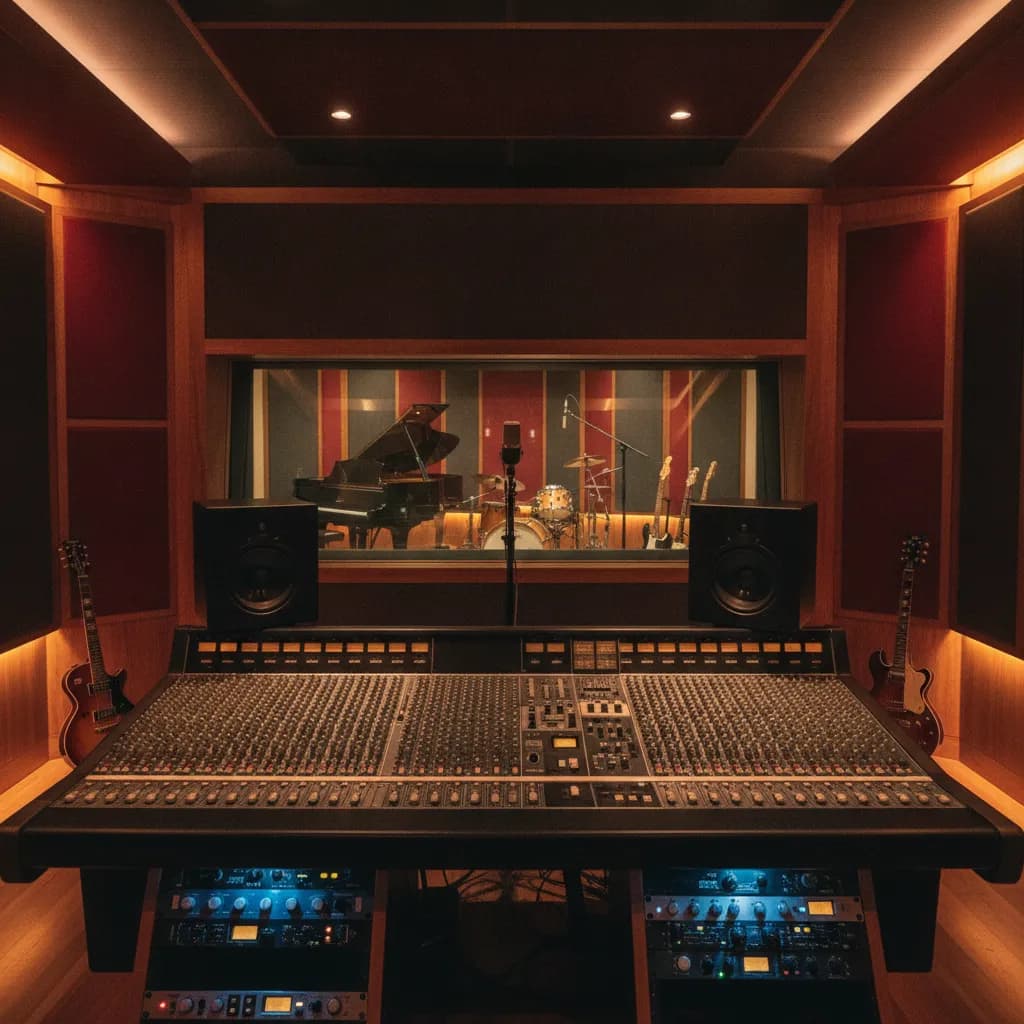
The studio is at 1505 4th St, Suite 219, Santa Monica CA 90401 — a short, straightforward drive north on Lincoln Blvd from the marina. It operates two purpose-built rooms. The Rainforest Room is acoustically designed for vocals, voiceover, and podcast recording, starting from $200 per two-hour block. The Rock Room is built for bands and full-kit tracking, with a baby grand piano and a full drum kit already set up and mic'd, starting from $250 per two-hour block. Every session at either room includes an in-house engineer — you are never left alone with the gear, and engineering time is not billed as a separate line item. Hourly rates are posted publicly on the website; you will never need to email to get a number.
The gear list is honest and specific: a Manley Reference microphone, a Tube-Tech CL 1B compressor, API preamps, and Focal Twin6 monitors. That is a professional signal chain that will hold up at any stage of a project. The studio is open 9am–2am daily, which gives Marina del Rey artists genuine scheduling flexibility — an early afternoon session before the evening beach crowd, or a late-night run after a Fisherman's Village show. Explore the full studio overview, or go straight to booking. If you record regularly, the membership programme is worth a look, and mixing and mastering services are available for post-session work.
Best for: Vocalists, singer-songwriters, podcasters, voice-over artists, and bands of any size who want a fully-staffed, gear-equipped Westside room with no pricing surprises.
#2 — EastWest Studios (Hollywood)
Located in the heart of Hollywood, East West Studios has given rise to some of the most celebrated music of the last fifty years, from Frank Sinatra to The Rolling Stones, and has produced more Grammy-winning albums than any other studio in the world. The complex has multiple rooms of varying sizes, from large orchestral live rooms down to overdub suites.
Best for: Major-label tracking, orchestral scoring, and artists who need the largest live rooms in LA. Why it fits: The pedigree and the room sizes are unmatched in the city. Expect rates and booking processes to reflect that. What to ask: Minimum booking requirements, which room fits your project's scale, and whether an engineer is included or billed separately.
#3 — Capitol Studios (Hollywood)
Capitol Studios is a landmark building with a landmark history, and one of the oldest operating and original recording studios in Los Angeles. Famous for its historic echo chambers and pristine acoustics, it has hosted sessions from Nat King Cole to Paul McCartney and remains a working studio inside the iconic Capitol Records tower.
Best for: Artists for whom the room's acoustic character and historical resonance are part of the creative brief. Why it fits: The echo chambers and large live room produce a sound you simply cannot replicate digitally. What to ask: Current availability (the studio underwent significant renovation work in recent years), room options, and current day-rate structure.
#4 — Sunset Sound (Hollywood)
Sunset Sound has been a favorite of rock legends since the 1960s. The studio has hosted recording sessions for artists such as Led Zeppelin, the Rolling Stones, and Van Halen. Today, Sunset Sound is still one of the most popular recording studios in Los Angeles.
Best for: Rock, roots, and analogue-leaning projects that benefit from a room with decades of sonic character baked in. Why it fits: The vintage analogue environment is genuine, not cosmetic. What to ask: Which of the three rooms fits your budget and headcount, and what the minimum booking looks like.
#5 — The Village Studios (West LA)
The Village Studios has been a mainstay in the Los Angeles music scene since the 1960s. The studio has played host to countless iconic recording sessions, including Fleetwood Mac's "Rumours" and Bob Dylan's "Blood on the Tracks." It is geographically the closest major studio to Marina del Rey, sitting in West LA not far off the 405.
Best for: Full-band tracking, singer-songwriters, and producers who want a creative campus feel with serious gear. Why it fits: The West LA location makes it genuinely accessible from the marina without a full Hollywood commute. What to ask: Room availability, minimum session length, and whether your project fits the room size.
#6 — Henson Recording Studios (Hollywood)
Henson is a large multi-room Hollywood complex with a long history in film scoring, live ensemble recording, and major-label music production. Henson Studios hosted the Rolling Stones' "Hackney Diamonds" sessions, which gives you a sense of the calibre of work the rooms are built for.
Best for: Film composers, large ensembles, and artists who need multiple rooms running simultaneously. Why it fits: The combination of room size and technical infrastructure is hard to match in LA. What to ask: Day-rate vs. hourly structure, and whether a staff engineer is included or separately contracted.
#7 — Paramount Recording Studios (Hollywood)
Paramount Recording Studios is a big one in the Los Angeles music scene. The studio has hosted plenty of recording sessions for popular artists like Chris Brown, YG, G-Eazy, and Ty Dolla Sign. Today, Paramount Recording Studios is still a popular destination for recording artists.
Best for: Hip-hop, pop, and R&B production in a high-energy Hollywood environment. Why it fits: Multiple rooms and a roster that skews toward contemporary urban and pop genres. What to ask: Which room is available for your session length and budget, and what the current engineer policy is.
#8 — Conway Studios (Hollywood)
Conway Recording Studios is a modern facility that has hosted recording sessions for some of the biggest names in music today, including Beyoncé, Taylor Swift, and Ariana Grande. It is a well-equipped Hollywood complex with multiple rooms and a reputation for polished pop and R&B production.
Best for: Pop, R&B, and contemporary artists who want chart-level production infrastructure. Why it fits: The rooms and the engineer talent pool are calibrated for commercial music. What to ask: Room options, minimum booking, and current rate structure.
#9 — Sound City Studios (Van Nuys)
Sound City Studios is a recording studio in Los Angeles, California, known as one of the most successful in popular music. Throughout the late twentieth century, the studio became known for its signature sound, especially in recording drums and live performances of rock bands.
Best for: Rock, alternative, and drum-forward tracking where room sound is the priority. Why it fits: The drum sound at Sound City has a documented history that speaks for itself. What to ask: Current operational status, available rooms, and whether the original live room is bookable.
#10 — The Record Plant (Hollywood)
The Record Plant is a long-running Hollywood institution with a multi-room setup and a history spanning rock, pop, and film work across several decades. The Record Plant has kept LA's celebrated industry core humming with activity alongside other major Hollywood facilities.
Best for: Artists who want Hollywood proximity, multi-room flexibility, and a facility with deep industry connections. Why it fits: The location and room variety make it a practical option for projects that need to be in the Hollywood ecosystem. What to ask: Which room suits your project, current rate structure, and engineer availability.
This ranking reflects Paradise Recording's editorial opinion only — not paid placement. Please verify each studio's current rates, room availability, and services before booking.
What makes a great LA recording studio (and how to choose)
Gear: what actually matters in the signal chain
The gear list on a studio's website tells you something, but not everything. The microphone, preamp, and compressor chain matters most for vocals and acoustic instruments — a Manley Reference microphone, API preamps, and a Tube-Tech CL 1B compressor (the combination at Paradise Recording) represent a professional signal chain that will translate well to any downstream mixing or mastering situation. For a band tracking live, the room's monitoring setup — what you are hearing back through the speakers — matters just as much. Focal Twin6 monitors are a genuine professional reference tool, not a consumer upgrade.
Don't get distracted by console brand names in isolation. Ask what the complete signal path looks like from microphone to file, and whether the studio's standard setup includes the gear you actually need or whether you will be paying extra to bring something in.
Room sound: purpose-built vs. general-purpose
A room that has been acoustically designed for vocal isolation sounds fundamentally different from a general-purpose tracking room. If you are recording a singer-songwriter demo or a podcast, a room like the Rainforest Room — built specifically for vocals and voiceover — will give you a cleaner, more controlled result than a large live room with a lot of natural reverb. Conversely, if you are tracking a full band with a drummer, you want a room that is large enough to breathe and designed to capture kit sound, like the Rock Room with its full drum kit already set up and tuned.
Before you book, ask: what is this room optimised for? The honest answer should match your project.
The engineer: included or extra?
This is one of the most important and least-discussed variables in LA studio pricing. Studio time in Los Angeles typically ranges from $35–$150 per hour, depending on the studio, equipment, and whether an engineer is included. Some studios charge a room rate and then add the engineer as a separate hourly fee on top. Others, like Paradise Recording, include an in-house engineer in every session — the engineer is part of what you are paying for, not a line item to negotiate.
Why does this matter? An engineer who knows the room, knows the gear, and has set up the session before you arrive saves you real time and real money. You are not troubleshooting signal flow or asking where the headphone mix is. You are making music from the first minute. If you are new to studio recording, see our guide on what to expect at your first recording session for a fuller breakdown of how to use that engineer time well.
For more on this specific question, our guide Do recording studios provide an engineer? covers the full range of what to expect across different studio types.
Hourly vs. lockout/day rate
Hourly booking is exactly what it sounds like: you pay for the time you use, usually with a minimum of two to four hours. The most common model for mid-range studios and commercial facilities, you pay for each hour you use the studio, typically with a minimum booking requirement of two to four hours. Rates usually include a staff engineer, though some studios charge separately for engineering. The advantage of hourly billing is flexibility: you only pay for what you use, and you can book short sessions for specific tasks like vocal overdubs or quick mix revisions.
A lockout or day rate gives you exclusive access to a room for a full day — typically eight to twelve hours — at a flat fee that works out cheaper per hour than hourly booking. It suits bands tracking multiple songs, producers who want to work without a clock running, and anyone doing a multi-day project. For a deeper breakdown of how lockout rates work, see our guide on recording studio lockout day rates.
Location and parking: the practical reality
From Marina del Rey, Santa Monica is the most accessible professional studio hub. The direct drive from Marina del Rey to Santa Monica is 3.7 miles (6 km), and should have a drive time of 11 minutes in normal traffic. Factor in 15–25 minutes during morning or afternoon peak hours, particularly if you are travelling via Lincoln Blvd northbound between 8–9am or 4–6pm.
For Paradise Recording specifically, Santa Monica's downtown public parking structures on 4th and 5th Streets are the practical choice. They offer free initial hours, so a two- or three-hour session often costs nothing to park. The Metro E Line's Downtown Santa Monica terminus at 4th & Colorado is also a five-minute walk from the studio door, which matters if you are travelling without a car or want to avoid driving after a late session.
Vibe and comfort: underrated but real
A session that runs three or four hours is a long time to be in a room that feels sterile, cramped, or unwelcoming. Ask to see photos of the lounge, the control room layout, and the live room before you book. Studios that are transparent about their space — including the not-Instagram-perfect parts — tend to be more honest about everything else too.
What recording studios cost in LA
Recording a song at an LA recording studio in 2026 can cost anywhere from $50 to over $300 per hour. That is a genuinely wide range, and the difference between the low and high end is not just prestige — it reflects real differences in room acoustics, gear quality, engineer experience, and what is included in the rate.
Here is a practical breakdown of the tiers:
- Entry-level / project studios: Roughly $35–$75/hr. Often no dedicated engineer, or a less experienced one. Gear may be adequate for demos. Good for rough ideas and scratch tracks.
- Mid-range professional rooms: Roughly $75–$150/hr. Recording studios in Los Angeles average $110 per hour to rent, though that figure mixes rooms with and without engineers. A mid-range room with an included engineer is often in the $80–$150/hr range.
- Premium and legacy rooms: You are looking at $75–$200+/hr at those rooms, often with minimum booking requirements and weeks of lead time.
What "with an engineer" actually means: At studios that include an engineer, you are paying one rate and getting the room plus a person who sets up your session, runs the session, and troubleshoots in real time. At studios that charge separately, your effective hourly cost is the room rate plus the engineer's fee — which can add $50–$100/hr or more on top of the listed room rate. Always ask before you book.
Paradise Recording's posted rates are honest starting points: the Rainforest Room from $200 per two-hour block (vocal, voiceover, podcast), and the Rock Room from $250 per two-hour block (bands, full-kit tracking). An in-house engineer is included in both. There are no hidden fees to discover when you arrive.
For a fuller breakdown of what recording a song costs across different project types, see our guide on how much it costs to record a song in Los Angeles.
Making the drive from Marina del Rey: a practical guide
The honest picture of Marina del Rey's recording scene
Let's be direct: Marina del Rey does not have a deep roster of professional recording studios. What the area does have is a strong creative community — film composers, session musicians, producers, and singer-songwriters who live near the harbour, write near the water, and then need to go somewhere professional to track. Search results for "recording studios in Marina del Rey" return a mix of rehearsal rooms, home-studio operators, and small project spaces — some of them genuinely useful for demos and pre-production, but not the same thing as a fully-staffed, acoustically-treated professional room with a proper signal chain.
That is not a criticism of the neighbourhood. It is just the reality of a primarily residential and hospitality-oriented community. The nearest concentration of professional studios is in Santa Monica, roughly four miles north along Lincoln Blvd or via the Pacific Coast Highway corridor.
The route: Lincoln Blvd is your friend
The most direct route from Marina del Rey to Paradise Recording in Santa Monica is straightforward: head north on Lincoln Blvd (CA-1) from Mindanao Way or Washington Blvd, continue through Venice, and turn right on Colorado Ave or Wilshire Blvd to reach 4th Street in downtown Santa Monica. The direct drive from Marina del Rey to Santa Monica is 3.7 miles (6 km), and should have a drive time of 11 minutes in normal traffic. In practical terms:
- Off-peak (mid-morning, mid-afternoon, evenings): 10–15 minutes door to door.
- Peak commute (8–9am northbound, 4–6pm southbound on Lincoln): Budget 20–30 minutes. Lincoln Blvd can back up significantly near Venice Blvd and Pico Blvd intersections during rush hour.
- Late night (after 9pm): Often 10 minutes or less. This is one reason Paradise Recording's 9am–2am daily hours are genuinely useful for Marina del Rey artists — a 10pm session start avoids the worst of Westside traffic entirely.
You can also use the 90 freeway east to the 405 north, then exit at Santa Monica Blvd — but for a 4-mile trip, surface streets on Lincoln are almost always faster unless there is a specific event causing gridlock.
Transit: the Big Blue Bus option
The #3 and #3 Rapid run between Santa Monica and the LAX area, both stopping at the corner of Mindanao Way and Lincoln Boulevard on the eastern side of the marina. From that stop, Big Blue Bus service runs northbound along Lincoln Blvd toward Santa Monica, with a journey time of roughly 15–20 minutes to downtown Santa Monica. Santa Monica to Marina del Rey bus services, operated by Big Blue Bus, depart from 4th & Santa Monica Place station and arrive at Lincoln & Marina Pointe. The reverse trip works the same way. For artists travelling without a car or arriving from elsewhere on the Westside, this is a genuine, low-cost option.
Parking at the studio
Santa Monica's downtown public parking structures on 4th and 5th Streets are the most practical option for Paradise Recording. They offer free initial hours, meaning a two- or three-hour session often costs nothing to park. Load-in is straightforward — the studio is on the second floor of 1505 4th St, Suite 219, a couple of blocks inland from the Third Street Promenade.
Weather and traffic realities
Marina del Rey and the immediate Santa Monica coast are subject to the marine layer — the low coastal fog and overcast that settles in from late afternoon through morning, especially from May through July (locally called "June Gloom," though it runs longer). This does not affect a recording session, but it does affect mood and, occasionally, visibility for an early-morning drive. More practically: weekend event traffic around the Santa Monica Pier, the Third Street Promenade, and the beach parking lots can add 10–15 minutes to a northbound Lincoln Blvd trip on summer Saturday afternoons. If you are booking a weekend session, aim for a 10am or 7pm start rather than a 2–4pm slot.
Why the drive earns its keep
For a quick scratch demo or a rough voice memo, staying local — a home studio, a project room near the marina — may be the right call. But for tracking that has to sound finished, the four miles to Santa Monica earn their keep quickly:
- A room that is acoustically designed for what you are recording (not a bedroom with moving blankets)
- A signal chain — Manley Reference mic, API preamps, Tube-Tech compression — that holds up at every stage of post-production
- A full drum kit and baby grand piano already set up, tuned, and mic'd in the Rock Room
- An in-house engineer who knows the gear, knows the room, and is there from the first minute of your session
- Transparent posted pricing, so you know exactly what you are spending before you walk in
That combination is genuinely hard to replicate locally in Marina del Rey. The drive is short. The difference in the final product is not.
Which room or setup is right for you?
Vocals, voiceover, and podcasts
If you are a solo vocalist, a voice-over artist, or a podcaster, the Rainforest Room at Paradise Recording is purpose-built for you. The room is acoustically treated for isolation and clarity, the Manley Reference microphone is one of the best vocal mics in its class, and the Tube-Tech CL 1B compressor handles dynamic control in a way that translates directly to a polished final product. Starting from $200 per two-hour block with an engineer included, it is also one of the most honestly priced vocal rooms on the Westside.
For podcast-specific considerations — multi-mic setups, separate track recording for multiple hosts — see our guide on podcast studio rental costs in Los Angeles and our dedicated resource on recording a podcast with multiple hosts.
Bands and full-kit tracking
The Rock Room is built for you. A full drum kit that is already set up and mic'd means you are not burning session time on kit assembly or basic mic placement. The baby grand piano is there and in tune. Starting from $250 per two-hour block, this is a serious tracking room for a boutique price. For context on what a full-band session looks like in practice, our guide on band recording in Los Angeles covers preparation, session flow, and what to expect.
Singer-songwriters and solo demos
Either room can work, depending on what you are tracking. If it is vocals and acoustic guitar, the Rainforest Room's intimacy and isolation are ideal. If you want to track with a full band or add piano, the Rock Room gives you the space. Our guide on singer-songwriter demo recording in Los Angeles walks through how to structure the session for maximum efficiency.
Multi-session projects: membership vs. hourly
If you are recording an EP, an album, or a regular podcast series, the Paradise Recording membership is worth comparing to straight hourly rates. The economics of repeated hourly sessions versus a monthly membership depend on your session frequency — but for anyone recording more than once or twice a month, the maths shifts quickly.
Frequently asked questions
How much does a recording studio cost in Marina del Rey?
There are no large professional recording studios operating within Marina del Rey itself, so pricing is largely a function of where you drive. Studio time in Los Angeles typically ranges from $35–$150 per hour, depending on the studio, equipment, and whether an engineer is included. At Paradise Recording in Santa Monica — the closest fully-staffed professional room — sessions start from $200 per two-hour block with an engineer included. For a full breakdown, see our guide on how much a recording studio costs in Los Angeles.
Do recording studios include an engineer?
Not always, and the difference matters. Some studios charge a room rate and bill the engineer separately; others include an engineer as part of the session fee. At Paradise Recording, an in-house engineer is included in every session — it is not an add-on. Always confirm the engineer policy before booking. Our full guide on whether recording studios provide an engineer explains what to ask.
How long does it take to record a song in a studio?
It depends heavily on preparation and the complexity of the arrangement. A well-rehearsed solo vocalist can track a finished vocal in two to three hours. A full-band session tracking live typically needs four to eight hours minimum for a single song. Our guide on how many hours it takes to record a song covers the variables in detail.
What is the best recording studio for vocals near Marina del Rey?
For vocal recording — whether pop, R&B, rap, or singer-songwriter — the Rainforest Room at Paradise Recording is the closest purpose-built vocal room to Marina del Rey, roughly 10–15 minutes up Lincoln Blvd. The Manley Reference microphone and Tube-Tech CL 1B compressor are a serious vocal chain, and the included engineer means you are not troubleshooting signal flow during your session. See our guide on vocal recording in Los Angeles for a broader comparison.
What is the best studio for a full band near Marina del Rey?
The Rock Room at Paradise Recording is the most practical full-band option within a short drive of the marina. It has a full drum kit already set up and mic'd, a baby grand piano, and starts from $250 per two-hour block. For larger ensembles or more elaborate productions, EastWest Studios and The Village Studios (further into Hollywood and West LA respectively) offer bigger live rooms. Our guide on the best studio to record a full band in Los Angeles covers the full range of options.
What is the difference between hourly booking and a lockout/day rate?
Hourly booking means you pay for the hours you use, typically with a two-to-four-hour minimum. A lockout or day rate gives you exclusive access to a room for a full day — usually eight to twelve hours — at a flat fee that is cheaper per hour than the standard hourly rate. Hourly booking suits focused single-song sessions; lockout rates suit multi-song projects or bands that want to work without a clock running. See our full explanation in the guide on lockout day rates.
Can I book a recording studio in Santa Monica from Marina del Rey without a car?
Yes. The #3 and #3 Rapid run between Santa Monica and the LAX area, both stopping at the corner of Mindanao Way and Lincoln Boulevard on the eastern side of the marina. From there, Big Blue Bus service runs north along Lincoln Blvd to downtown Santa Monica in roughly 15–20 minutes. Paradise Recording is a short walk from the 4th & Colorado stop. If you are bringing gear, a rideshare is the more practical option.
Are there recording studios open late near Marina del Rey?
Paradise Recording is open 9am–2am daily, which means a 10pm or 11pm session start is a real option — and from Marina del Rey, that late-night drive on Lincoln Blvd takes about 10 minutes with no traffic. For a full breakdown of late-night studio options in LA, see our guide on recording studios open late in Los Angeles.
Final verdict
Marina del Rey is a creative community with a genuine gap in professional recording infrastructure. The area has rehearsal rooms and project studios, but if you need a fully-staffed room with professional acoustics, a proper signal chain, and an engineer who knows the gear — you are making a short drive. That drive, north on Lincoln Blvd to Santa Monica, is about 4 miles and 10–15 minutes in normal traffic.
Paradise Recording ranks first for Marina del Rey artists for honest, specific reasons: two purpose-built rooms (one for vocals and podcasts, one for bands and full-kit tracking), an in-house engineer included in every session, transparent posted pricing that you can check before you book, and a gear list — Manley Reference microphone, Tube-Tech CL 1B compressor, API preamps, Focal Twin6 monitors — that holds up at every stage of a project. It is a boutique room, not the largest facility in LA, and that is exactly the point for most Westside artists: focused, professional, and priced honestly.
The other studios on this list are real, well-regarded rooms that serve different needs and different budgets. For major-label tracking or orchestral work, EastWest and Capitol are institutions for good reason. For rock and analogue-leaning projects, Sunset Sound and Sound City have earned their reputations. But for the Marina del Rey artist who needs a professional room, a short commute, and no surprises on the invoice, Paradise Recording is where to start.
Next steps
- Book a session at Paradise Recording
- Explore both studio rooms
- See the Rainforest Room (vocals, voiceover, podcast)
- See the Rock Room (bands, full-kit tracking, piano)
- Learn about the membership programme
- Mixing and mastering services
- How much does it cost to record a song in Los Angeles?
- Best recording studios in Venice, CA (2026)
- Best recording studios in Santa Monica (2026)
- Hourly recording studio LA: block booking, prep tips, and pricing explained