
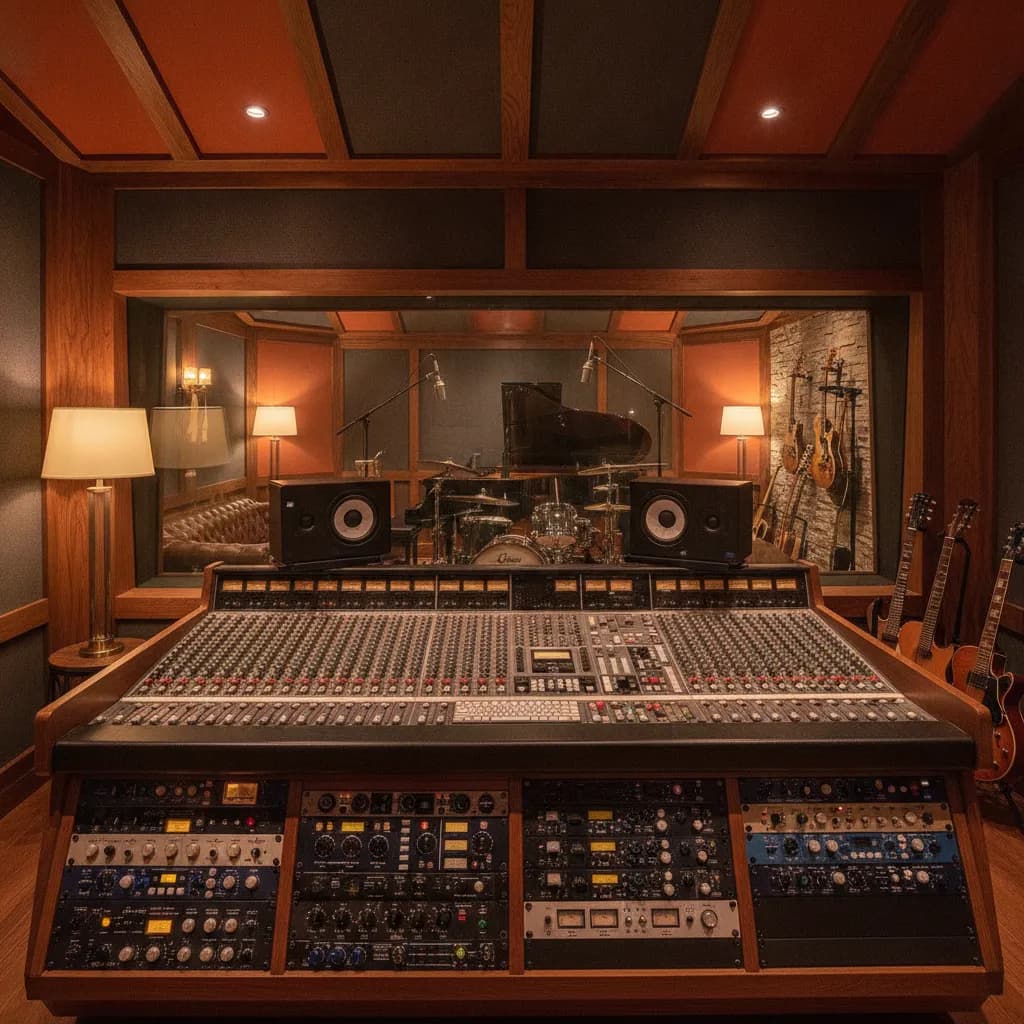
Calabasas sits at the western edge of the San Fernando Valley, tucked against the Santa Monica Mountains where Las Virgenes Road climbs south toward Malibu Canyon. It is one of the wealthiest communities in California, home to a surprisingly active creative class — producers, singer-songwriters, podcasters, and bands who rehearse in garages off Las Virgenes Road or Mulholland Highway and then ask the same question: where do I actually record this?
The honest answer is that Calabasas proper is thin on dedicated professional recording rooms. The city's cultural center of gravity is The Commons at Calabasas — the open-air Mediterranean-style retail and dining complex on Commons Way — not a music-industry corridor. What does exist locally tends to be project studios, home setups, and a handful of small independent rooms scattered through the surrounding communities of Agoura Hills, Westlake Village, and Woodland Hills. That is not a knock on the area; it is just the reality, and knowing it will save you time and money when you are planning a session.
This guide covers what is genuinely available in and around Calabasas, what to realistically expect from each option, and why a meaningful number of Calabasas artists make the 24-mile drive to Santa Monica when the project needs to sound finished. If you are deciding between staying local for a quick demo or committing to a professional room, this page will give you the numbers and the honest reasoning to make that call.
Quick takeaways
- The Calabasas recording scene is real but limited. A few independent and project studios operate in the area, but there is no concentration of commercial rooms the way you find in Hollywood or Burbank. If you need a purpose-built tracking room with a full kit, a grand piano, and an in-house engineer included, you will likely need to drive.
- Transparent hourly pricing matters. Studio time in Los Angeles typically ranges from $35–$150 per hour, depending on the studio, equipment, and whether an engineer is included. At higher-tier boutique rooms, rates can go well above that. Always ask what is actually included before you book.
- "With an engineer" is not automatic. Some studios charge separately for engineering on top of the room rate. At Paradise Recording, an in-house engineer is included in every session — you are never left alone with the gear.
- Hourly vs. lockout/day rate changes the math significantly. Short sessions (2–4 hours) suit vocals, overdubs, and podcast episodes. Multi-day lockouts suit full-band tracking. Knowing which you need before you call around prevents sticker shock.
- The drive from Calabasas to Santa Monica is manageable. The total driving distance from Calabasas, CA to Santa Monica, CA is 24 miles. Off-peak, that is roughly 30–35 minutes. In rush-hour traffic on the 101 it can stretch to 60–75 minutes — plan accordingly.
- Book early, especially for weekends. Professional rooms in the LA area fill up fast. For a deeper look at timing strategy, see our guide on how far in advance you should book a recording studio.
The 10 best recording studios in Calabasas (2026)
At-a-glance ranking
- Paradise Recording — Santa Monica — Best for: vocals, bands, podcasts, and any project that needs to sound finished
- EastWest Studios — Hollywood — Best for: major-label and high-budget tracking
- Sunset Sound — Hollywood — Best for: vintage analog sound and rock/pop tracking
- The Village Studios — West LA — Best for: orchestral, large-ensemble, and prestige projects
- United Recording Studios — Hollywood — Best for: full-production sessions with deep history
- Conway Recording Studios — Hollywood — Best for: pop and hip-hop production at a professional tier
- Henson Recording Studios — Hollywood — Best for: film scoring, ADR, and large-format sessions
- Larrabee Sound Studios — North Hollywood/West Hollywood — Best for: indie and mid-budget sessions with flexible room options
- Encore Recording Studios — Burbank — Best for: Valley-based artists who want pro gear without Hollywood prices
- Swing House Studios — Hollywood — Best for: bands that want rehearsal and recording under one roof
This ranking reflects Paradise Recording's own editorial opinion based on room quality, gear, pricing transparency, and practical fit for Calabasas-area artists. It is not paid placement. Verify each studio's current rates, availability, and engineer policies directly before booking.
#1 — Paradise Recording, Santa Monica
Paradise Recording is a boutique studio at 1505 4th St, Suite 219, Santa Monica — about 24 miles from central Calabasas, open every day from 9am to 2am. It earns the top spot on this list not because it is the biggest tracking facility in greater LA (it is not), but because of the specific combination of things that matter most to independent artists: two purpose-built rooms, an in-house engineer included in every session at no extra charge, and pricing posted publicly on the website — no email back-and-forth to get a number.
The Rainforest Room starts from $200 per 2-hour block and is purpose-built for vocals, voiceover, and podcast recording. The acoustic treatment is dialed in specifically for close-mic work, and the signal chain includes a Manley Reference microphone, a Tube-Tech CL 1B compressor, and API preamps running into Focal Twin6 monitors. If you are a Calabasas singer-songwriter tracking a demo, a podcaster who needs clean, broadcast-ready audio, or a voice actor looking for a proper booth, this room is the practical answer. The Rock Room starts from $250 per 2-hour block and is built for bands: a full drum kit that is pre-tuned and pre-mic'd before you arrive, a baby grand piano, and enough space to track a full band without the walls closing in. For Calabasas artists who have been rehearsing in a garage or a local rehearsal space and are ready to commit a performance to tape (or to disk), this is the room to graduate to.
The engineer-included model is worth dwelling on. Plenty of rooms in the LA market charge separately for an engineer — sometimes $50–$100/hr on top of the room rate. At Paradise, that is never the case. You get a professional in the room from the moment you walk in, which matters especially if you are a first-timer or if you are working on a tight clock. Book a session at /book, or explore membership options if you are planning to record regularly. Mixing and mastering services are available at /mix-master for artists who want to take a session through to a finished, releasable track.
#2 — EastWest Studios, Hollywood
Best for: Major-label and high-budget tracking with deep historical pedigree.
Why it fits: EastWest Studios is one of the most well-known recording studios in Los Angeles, with a working history of over 80 years. The rooms are large, the gear is exceptional, and the facility has hosted a remarkable range of artists across genres. For Calabasas artists with a label budget or a project that justifies premium rates, it is worth the drive to Hollywood.
What to ask: Current hourly rates, minimum booking requirements, and whether an in-house engineer is included or billed separately.
#3 — Sunset Sound, Hollywood
Best for: Artists who want vintage analog warmth and a room with genuine rock-and-roll history.
Why it fits: Sunset Sound Recorders is a recording studio in Hollywood, California, located at 6650 West Sunset Boulevard. The complex was created from a collection of old commercial and residential buildings, beginning with a former automotive repair garage whose sloping floor would tend to reduce unwanted sonic standing wave reflections. The rooms have a character that is hard to replicate in a newer build.
What to ask: Room availability, current rate structure, and whether your project suits an analog-leaning signal chain.
#4 — The Village Studios, West LA
Best for: Large-ensemble recording, orchestral sessions, and prestige projects.
Why it fits: The Village Studios has had legends such as Fleetwood Mac, The Rolling Stones, and Phil Collins as well as many current artists including Taylor Swift, John Mayer, and Lady Gaga. With four main recording rooms, a ballroom which also doubles as a recording studio, and an auditorium, it's no surprise this LA recording studio has seen a plethora of artists.
What to ask: Room size and configuration options, current rates, and lead time for booking.
#5 — United Recording Studios, Hollywood
Best for: Full-production sessions in rooms that shaped the sound of American pop music.
Why it fits: In Hollywood, United Recording Studios, Conway Recording Studios, and EastWest Studios are among the most historic locations. They produced famous recordings by The Beach Boys, Beyoncé Knowles-Carter, Prince, Frank Sinatra, and U2.
What to ask: Minimum session lengths, current room rates, and engineer availability.
#6 — Conway Recording Studios, Hollywood
Best for: Pop and hip-hop production at a well-equipped professional tier.
Why it fits: Conway Studios has hosted major contemporary projects and maintains a reputation as a go-to room for working producers and artists at the commercial level. The facility is well-maintained and consistently booked, which is itself a signal of quality.
What to ask: Room options, current pricing, and whether your producer has a prior relationship with the house engineer.
#7 — Henson Recording Studios, Hollywood
Best for: Film scoring, ADR, voiceover, and sessions that need large-format rooms.
Why it fits: Henson Recording Studios is an ADR and film scoring specialist. If your project touches post-production — dialogue replacement, soundtrack work, or anything picture-locked — Henson has the infrastructure for it.
What to ask: Stage availability, ADR setup specifics, and whether your project timeline aligns with their booking calendar.
#8 — Larrabee Sound Studios, North Hollywood / West Hollywood
Best for: Indie and mid-budget sessions that want professional-grade rooms without full major-label pricing.
Why it fits: Larrabee has a long track record in the LA independent scene and offers multiple room configurations. For Calabasas artists who want to stay closer to the Valley than Santa Monica, the North Hollywood location is a reasonable option.
What to ask: Which room suits your project, current rates, and engineer availability.
#9 — Encore Recording Studios, Burbank
Best for: Valley-based artists who want professional gear at more accessible prices.
Why it fits: Encore Recording Studios in Burbank offers great value for indie artists with various packages. Burbank is a shorter drive from Calabasas than Santa Monica during peak hours, which is a real practical consideration for morning sessions.
What to ask: Package details, what is included in the base rate, and whether an engineer is bundled or billed separately.
#10 — Swing House Studios, Hollywood
Best for: Bands that want rehearsal and recording under one roof, or artists who want to warm up before tracking.
Why it fits: Swing House Studios is a hybrid space offering rehearsal and recording at competitive rates. For a Calabasas band that wants to rehearse the set before committing it to a proper tracking session, the combined model reduces the number of separate facilities you need to coordinate.
What to ask: Rehearsal-to-recording workflow, room availability, and how transitions between the two are priced.
This ranking is Paradise Recording's own editorial opinion — not paid placement. Verify each studio's current rates, engineer policies, and availability directly before booking.
What makes a great LA recording studio (and how to choose)
Gear: what's actually in the room
The gear list tells you a lot about a studio's priorities. A Neve or API console, a quality large-diaphragm condenser microphone, and properly calibrated monitors are the baseline for professional work. At Paradise Recording, the signal chain includes a Manley Reference microphone, a Tube-Tech CL 1B compressor, API preamps, and Focal Twin6 monitors — a combination that punches well above the boutique price point. When evaluating any room, ask specifically what microphone is on the vocal chain and what the monitoring situation is. Cheap monitors in an untreated room will mislead you on every mix decision you make. For a deeper look at vocal chain specifics, see our guide on what a vocal chain is.
Room sound and acoustic treatment
A room's acoustic character is baked in. No amount of plugins will fix a recording made in a space with uncontrolled reflections or a resonant low end. Purpose-built rooms — designed from the ground up for recording — behave differently from converted spaces or untreated home studios. Before you book, ask whether the room has been professionally treated and whether you can hear a reference track played back in the monitoring position. Your ears will tell you what the spec sheet cannot.
The engineer: included or extra?
Rates usually include a staff engineer, though some studios charge separately for engineering. This distinction matters enormously to your total session cost. A room advertised at $50/hr that adds an $80/hr engineer on top is actually $130/hr. At Paradise Recording, an in-house engineer is included in every session — the posted block price is the real price. If you want to understand what that engineer actually does for your session, our guide on what a recording engineer does is worth reading before you book.
Hourly vs. lockout/day rates
The most common model for mid-range studios and commercial facilities has you paying for each hour you use the studio, typically with a minimum booking requirement of two to four hours. The advantage of hourly billing is flexibility: you only pay for what you use, and you can book short sessions for specific tasks — vocal overdubs, quick mix revisions, and so on. A lockout or day rate gives you exclusive access to the room for a full day, usually at a discounted effective hourly rate. It suits multi-song tracking days where you need to leave gear set up between takes. For a plain-English breakdown of what a lockout actually means, see our guide on recording studio lockout day rates.
Location and parking
For Calabasas artists, the practical question is: how far is the drive, and is parking a headache when you arrive? Santa Monica's downtown public parking structures on 4th and 5th Street are the practical option near Paradise Recording and include free initial hours — a short two-hour session often costs nothing to park. The Metro E Line's Downtown Santa Monica terminus at 4th & Colorado is about a five-minute walk from the studio door, so if you are traveling light (vocals only, no gear to load), transit is a genuine option.
Vibe and comfort
You will make better decisions in a room where you feel comfortable. A session that runs four hours under bad lighting with no water and a distracted engineer produces worse work than the same four hours in a relaxed, well-lit space with someone who is genuinely paying attention. Ask to see the lounge or waiting area, check whether the studio has reliable Wi-Fi, and pay attention to how the first phone call or email exchange goes. How a studio communicates before you book is a reliable signal of how they will treat you during a session.
What recording studios cost in LA
Recording a song at an LA recording studio in 2026 can cost anywhere from $50 to over $300 per hour. That range is wide because it encompasses everything from a one-room project studio in the Valley to a multi-room Hollywood institution with a Neve console and decades of gold records on the wall. Recording studios in Los Angeles average $110 per hour to rent, but it's easy to spend less or more depending on what you're looking for.
The most important variable after the room rate is whether an engineer is included. Studio time in Los Angeles typically ranges from $35–$150 per hour, depending on the studio, equipment, and whether an engineer is included. At some facilities, the engineer is a separate line item — sometimes $50–$100/hr on top of the room rate. At Paradise Recording, the engineer is always included: the Rainforest Room starts from $200 per 2-hour block (vocals, voiceover, podcast), and the Rock Room starts from $250 per 2-hour block (bands, full-kit tracking, piano). Those are posted prices — no negotiation required to find out the number.
At the top end of the market, you're looking at $75–$200+/hr at major rooms, often with minimum booking requirements and weeks of lead time. Those prices reflect iconic gear, large live rooms, and the institutional history that comes with them. For most independent Calabasas artists, that tier is not the right starting point — but knowing it exists helps you calibrate the rest of the market.
A day rate or lockout typically runs 8–12 hours of exclusive room access at a negotiated flat fee. The effective hourly rate is usually lower than the standard hourly rate, but you are committing to a full day whether or not you use every hour. For a comprehensive breakdown of LA pricing across every tier, see our guide on how much a recording studio costs in Los Angeles.
Which room or setup is right for you?
Vocals, voiceover, and podcasts
If you are tracking lead vocals for a single, recording a voiceover for a commercial, or producing a podcast episode, you need a well-treated booth, a quality large-diaphragm condenser microphone, and a clean monitoring chain. You do not need a live room big enough for a drum kit. The Rainforest Room at Paradise Recording is purpose-built for exactly this use case — starting from $200 for a 2-hour block, engineer included. A typical vocal session for one or two songs fits comfortably in two to three hours if you arrive prepared. For preparation tips, see our guide on how to prepare vocals for a studio session.
For podcast recording specifically, the same principles apply: acoustic treatment, clean mic preamps, and an engineer who knows how to set gain staging and catch problems in real time rather than in post. Our guide on where to record a podcast in Los Angeles covers the format in more detail.
Full bands and drum tracking
If you are a Calabasas band and you have been rehearsing at a local space — whether that is a room near the 101 in Agoura Hills or a garage off Mulholland — the jump to a proper tracking room is significant. A pre-tuned, pre-mic'd drum kit alone saves 30–60 minutes of setup time that would otherwise come out of your session clock. The Rock Room at Paradise Recording has a full drum kit and a baby grand piano, starts from $250 per 2-hour block, and includes an engineer. For bands recording a full set of songs, the math often favors a longer block or a day rate. See our guide on band recording studio options in Los Angeles for a fuller breakdown of what to expect.
Quick demos vs. finished tracks
Be honest with yourself about the goal. If you are cutting a rough demo to share with a collaborator or pitch to a sync library, a local project studio or even a well-set-up home recording rig may be the right call — the drive to Santa Monica does not earn its keep for a quick scratch vocal. But if the recording is going to a mixing engineer, going on streaming platforms, or being submitted to a label, the room quality, the signal chain, and the engineer's ears will show up in the final product. That is when the 24-mile drive is worth every minute. Our guide on home studio vs. professional recording studio lays out the honest comparison.
Making the drive from Calabasas to Santa Monica
The route
The standard route is straightforward: take the 101 (Ventura Freeway) east from the Calabasas area to the 405 South, then exit at Santa Monica Boulevard or Olympic Boulevard heading west into Santa Monica, ending at 4th Street. The total driving distance from Calabasas, CA to Santa Monica, CA is 24 miles. The total driving time, without traffic, is approximately 29 minutes.
The alternative route — south on Las Virgenes Road through Malibu Canyon to PCH, then east along the coast — is scenic and genuinely enjoyable on a clear morning, but it adds distance and is weather-dependent. Las Virgenes Road / Malibu Canyon Road is a north–south road that runs for 11 miles and traverses the Santa Monica Mountains, connecting California State Route 1 in Malibu with US 101 in Calabasas. In good conditions, this canyon route takes roughly 40–50 minutes and deposits you on PCH near Malibu, from which it is another 20 minutes east to Santa Monica. It is a pleasant option for an afternoon session when you have time to spare; it is not the move for a 10am call time on a Tuesday.
Realistic drive times
- Off-peak (mid-morning or mid-afternoon, avoiding the 8–10am and 4–7pm windows): 30–40 minutes via the 101/405 corridor.
- Morning rush hour (leaving Calabasas between 7:30am and 9:30am): 60–90 minutes is realistic. The 101 eastbound and the 405 southbound are both heavily congested during this window.
- Evening rush (leaving Santa Monica between 4:30pm and 7pm): The return trip westbound on the 10 to the 405 north to the 101 can also stretch to 60–75 minutes.
The practical implication: if you are booking a morning session, either leave early enough to arrive relaxed, or book a late-morning slot (11am or noon) that lets you miss the worst of the 101 traffic. Paradise Recording is open until 2am daily, which makes an evening session — leaving Calabasas around 6:30–7pm after traffic has cleared — a genuinely comfortable option.
Traffic and seasonal realities
The 101 corridor between Calabasas and the 405 is one of the more reliably congested stretches of the LA freeway system. It does not have a "good" rush hour — it is simply a question of how bad. The Malibu Canyon / Las Virgenes route is subject to occasional closures after heavy rain or fire activity in the Santa Monica Mountains; if you are planning to use it, check Caltrans or a navigation app for road conditions the morning of your session.
Marine layer is worth a word: Santa Monica sits on the coast, and summer mornings often bring dense low clouds that burn off by late morning. This has no effect on your session inside the studio, but it is worth knowing that the drive can feel different at 9am (grey and cool) versus 1pm (clear and warm). Neither is a problem; it is just the Westside's summer personality.
Parking and arrival at Paradise Recording
Santa Monica's downtown public parking structures on 4th and 5th Streets are the practical option. They include free initial hours, which means a two-hour session often costs nothing to park. The studio is at 1505 4th St, Suite 219 — a short walk from the structures. If you are traveling without gear (vocals only, laptop, a notebook), the Metro E Line's Downtown Santa Monica terminus at 4th & Colorado is about a five-minute walk from the door and eliminates the parking question entirely. Load-in for bands with gear is straightforward from the 4th Street structures.
Frequently asked questions
How much does a recording studio cost in Calabasas or nearby?
Studio time in Los Angeles typically ranges from $35–$150 per hour, depending on the studio, equipment, and whether an engineer is included. At higher-tier boutique rooms with professional signal chains and included engineers, rates can go higher. Always ask whether the posted rate includes an engineer or whether that is billed separately. For a full breakdown, see our guide on how much studio time costs per hour.
Do recording studios in the Calabasas area include an engineer?
It depends entirely on the studio. Some rooms include a staff engineer in the base rate; others charge separately; others are self-operated (you bring your own engineer or work alone). At Paradise Recording, an in-house engineer is included in every session at no additional charge. If you want to understand what that engineer actually does during your session, see our guide on whether recording studios provide an engineer.
Is it worth driving from Calabasas to Santa Monica to record?
For a quick scratch demo or a rough reference track, staying local or recording at home may be the smarter call. For anything that needs to sound finished — a single going to streaming, a podcast episode going to a network, a band demo going to a label — the combination of a purpose-built room, a professional signal chain, and an included engineer makes the 24-mile drive earn its keep. The off-peak drive is 30–40 minutes; an evening departure after 7pm is often faster than that.
What is the difference between hourly booking and a day rate?
Hourly booking means you pay for the specific hours you use, usually with a 2–4 hour minimum. A day rate (or lockout) gives you exclusive access to the room for a full day — typically 8–12 hours — at a flat fee that works out to a lower effective hourly rate. Day rates suit multi-song tracking sessions where you need to leave gear set up. Hourly booking suits shorter, focused sessions: a vocal overdub, a podcast episode, a single instrument track. For a full explanation, see our guide on recording studio lockout day rates.
What is the best recording studio in Calabasas for vocals?
The best vocal recording option for Calabasas artists is the Rainforest Room at Paradise Recording in Santa Monica. It is purpose-built for close-mic vocal work, with a Manley Reference microphone, Tube-Tech CL 1B compressor, and API preamps — a signal chain that is genuinely hard to find at this price point. An in-house engineer is included, and the room starts from $200 for a 2-hour block.
What is the best studio for a full band near Calabasas?
The Rock Room at Paradise Recording — a pre-tuned, pre-mic'd drum kit, a baby grand piano, and enough space to track a live band — is the most practical full-band option within a reasonable drive of Calabasas. It starts from $250 per 2-hour block with an engineer included. For a broader look at full-band tracking options in LA, see our guide on the best studio to record a full band in Los Angeles.
How do I book a session at Paradise Recording?
You can book directly at /book — no email back-and-forth required. Pricing is posted on the website. If you are planning to record regularly, membership options are worth exploring. Mixing and mastering after your session is available at /mix-master.
What should I bring to my first recording session?
The short answer: your instrument in good shape, your parts memorized, and a clear idea of what you want to accomplish in the time you have booked. The longer answer is in our guide on what to bring to a recording studio session — it covers everything from file formats to snacks.
Final verdict
Calabasas is a genuinely creative community, but it is not a recording-studio hub. The professional rooms that exist locally tend to be small, independently operated, and inconsistent in what they offer — which means that for a project that needs to sound finished, most serious Calabasas artists end up driving. The question is where.
Paradise Recording earns the top spot on this list because it solves the specific problems that matter most to an independent artist making that drive: you know the price before you call, an engineer is in the room with you from the first minute, the gear is professional-grade, and the two purpose-built rooms cover the two most common session types — intimate vocal and podcast work in the Rainforest Room, and full-band tracking in the Rock Room. It is not the biggest facility in LA, and it does not pretend to be. But for the Calabasas singer-songwriter, band, or podcaster who wants a finished-sounding result without a major-label budget, it is the most honest recommendation on this list.
The drive is 24 miles. Off-peak, it is 30–40 minutes. For a session that actually sounds the way you imagined it, that is an easy trade.
Next steps
- Book a session at Paradise Recording
- Explore the Rainforest Room (vocals, voiceover, podcast)
- Explore the Rock Room (bands, full-kit tracking, piano)
- View membership options for regular recording
- Mixing and mastering services
- How much does it cost to record a song in Los Angeles?
- Home studio vs. professional recording studio: an honest comparison
- How to prepare for your first recording session