
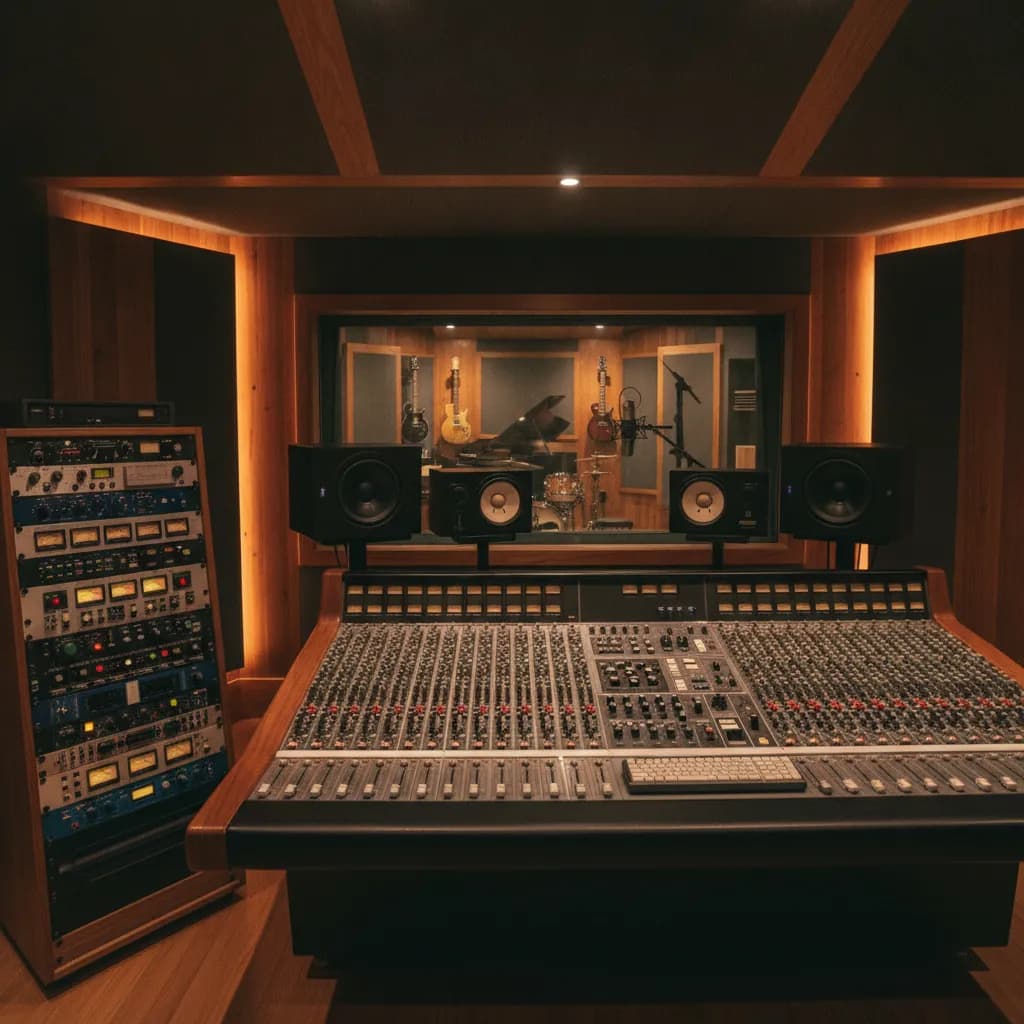
Encino sits at a genuinely interesting crossroads — literally and creatively. Its history goes back centuries, and the neighborhood has long been known for its lush greenery, large lots, and quieter residential feel. Beginning in the 1930s, film stars like Clark Gable, and later figures such as Johnny Cash and Michael Jackson, bought up large estates here. That creative legacy hasn't entirely faded: Encino today is home to producers, songwriters, session players, and podcasters who work quietly out of home studios tucked behind the tree-lined streets south of Ventura Boulevard. What the neighborhood lacks is a deep bench of commercial recording rooms — and this guide is honest about that.
Encino Commons, the stretch dubbed "The Valley's Miracle Mile," is lined with restaurants and shops along Ventura Boulevard, and the energy along that corridor is real. But energy and a professional recording room are two different things. When Valley artists need a finished-sounding vocal, a tracked live kit, or a podcast episode that can go straight to publish, most of them end up making a drive — to Studio City, North Hollywood, or, increasingly, to Santa Monica. This guide explains what's genuinely available in and around Encino in 2026, what the drive to the Westside actually looks like, and how to decide which option is right for your project.
Whether you're a singer-songwriter looking to cut a demo, a band ready to track drums and guitars properly, or a podcaster who's outgrown your closet setup, the questions are the same: What gear is in the room? Is an engineer included? What does it actually cost? This guide answers all of them — with numbers, real routes, and no hype.
Quick takeaways
- Encino's recording scene is mostly home and project studios. Professional, commercially bookable rooms in Encino proper are sparse. If you need a treated room with pro gear and a staff engineer, plan to drive.
- The drive to Santa Monica is manageable. The driving distance from Encino to Santa Monica is about 13 miles, and it takes approximately 19 minutes in off-peak traffic. Rush hour is a different story — budget 40–60 minutes during morning and evening peaks.
- "With an engineer" is not universal. Some LA studios charge the room rate and bill the engineer separately on top. At Paradise Recording, the in-house engineer is included in every session — no add-on fee, no surprise line item at checkout.
- LA studio rates span a wide range. Recording at an LA studio in 2026 can cost anywhere from $50 to over $300 per hour. Where you land on that range depends on the room, the gear, and whether engineering is bundled.
- Hourly booking vs. a lockout/day rate are genuinely different things. Hourly is flexible and low-commitment; a lockout gives you the room for a full day or overnight at a flat rate. Know which model you need before you call.
- Book online, not by email. Paradise posts its rates publicly and lets you book a session without back-and-forth. That transparency is rarer than it should be.
The 10 best recording studios in Encino (2026)
At-a-glance ranking
- Paradise Recording — Santa Monica — Best for: vocals, podcasts, bands, and anyone who wants an included engineer and posted pricing
- EastWest Studios — Hollywood — Best for: major-label and high-budget projects needing legendary rooms
- Capitol Studios — Hollywood — Best for: orchestral, jazz, and artists who want genuine recording history
- The Village Studios — West LA — Best for: full-band tracking in a storied, multi-room facility
- Sound City Studios — Van Nuys — Best for: rock and alternative bands who want Valley proximity and real tracking rooms
- Sunset Sound — Hollywood — Best for: classic rock and pop tracking with serious vintage credentials
- Henson Recording Studios — Hollywood — Best for: film scoring, ADR, and artists who need large orchestral rooms
- Conway Studios — Hollywood — Best for: pop and R&B producers working at a high commercial level
- Larrabee Studios — West Hollywood — Best for: mixing-focused sessions and artists who need a polished, post-production-ready workflow
- Ocean Way Recording — Hollywood — Best for: large-ensemble tracking and producers who want a range of room sizes
This ranking reflects Paradise Recording's own editorial opinion and is not paid placement. Rates, availability, and room configurations change — verify directly with each studio before booking.
#1 — Paradise Recording, Santa Monica
Paradise Recording is a boutique room, and it's honest about that. It is not the biggest tracking facility in Los Angeles. What it is, is a purpose-built, professionally equipped studio where every session comes with an in-house engineer, pricing is posted publicly on the website, and you can book online without emailing anyone for a quote. For a Valley artist making the drive to the Westside, that combination of transparency and included expertise is worth the trip.
There are two rooms. The Rainforest Room is purpose-built for vocals, voiceover, and podcast recording — the acoustics are tuned for close-mic'd speech and singing, and sessions start from $200 per 2-hour block. The Rock Room is built for bands: it houses a full drum kit (pre-tuned and pre-mic'd) and a baby grand piano, and starts from $250 per 2-hour block. Neither room is a converted garage. Both are real, professionally treated spaces with real gear — a Manley Reference microphone, a Tube-Tech CL 1B compressor, API preamps, and Focal Twin6 monitors.
The studio is at 1505 4th St, Ste 219, Santa Monica CA 90401 — open 9am–2am daily, seven days a week. Parking in the 4th and 5th Street public structures is the practical choice and often free for a short session. The Metro E Line's Downtown Santa Monica terminus at 4th & Colorado is about a five-minute walk from the door, which matters if you're coming from the Valley and want to skip the 405 entirely. Membership options exist for artists who record regularly, and mixing and mastering can be handled in-house if you want to take a session all the way to a finished file.
For Encino artists specifically: the drive earns its keep when the recording has to sound finished. A quick scratch vocal or a rough idea? Staying local might be fine. A single you're releasing, a podcast that represents your brand, or a band tracking drums that have to sit right in a mix? That's when a room like this pays for itself.
#2 — EastWest Studios, Hollywood
EastWest Studios is a recording studio complex located at 6000 West Sunset Boulevard in Hollywood. The studio has a history that spans over 80 years and has produced more Grammy-winning albums than any other studio in the world, with credits including Frank Sinatra, Frank Ocean, and Rihanna.
Best for: Major-label and high-budget projects that need genuinely legendary rooms and a deep bench of vintage gear. Why it fits: Few rooms in the world carry this level of acoustic and historical credibility. If the budget allows it, the experience of recording here is hard to replicate. What to ask: Current room rates, minimum booking requirements, and whether a house engineer is included or billed separately.
#3 — Capitol Studios, Hollywood
Capitol Studios is one of the most iconic recording studios in Los Angeles, known for its unique circular building and famous recording sessions — artists such as The Beatles, Frank Sinatra, and Nat King Cole have recorded there.
Best for: Orchestral sessions, jazz recordings, and artists for whom the room's acoustic pedigree is part of the creative brief. Why it fits: Famous for its historic echo chambers and pristine acoustics — if you want a timeless, polished sound at an iconic location, Capitol is near the top of the list. What to ask: Availability for independent artists, minimum session lengths, and current engineer rates.
#4 — The Village Studios, West LA
The Village Studios has been a mainstay in the Los Angeles music scene since the 1960s, hosting iconic sessions including Fleetwood Mac's Rumours and Bob Dylan's Blood on the Tracks.
Best for: Full-band tracking and artists who want a multi-room facility with serious vintage gear and a storied creative environment. Why it fits: The Village has had legends such as Fleetwood Mac, The Rolling Stones, and Phil Collins, as well as current artists including Taylor Swift, John Mayer, and Lady Gaga. What to ask: Which room fits your project size, current day rates, and whether lockout options are available.
#5 — Sound City Studios, Van Nuys
Sound City Studios is a recording studio in Los Angeles known as one of the most successful in popular music; the complex opened in 1969 in the Van Nuys neighborhood. Throughout the late twentieth century, the studio became known for its signature sound, especially in recording drums and live performances of rock bands.
Best for: Rock, alternative, and heavy bands — especially those who want a Valley location and a room with genuine tracking heritage. Why it fits: Van Nuys is significantly closer to Encino than Hollywood, making this a practical option when the drive to the Westside isn't on the table. What to ask: Current booking availability, room configuration for your band size, and whether the house engineer is included.
#6 — Sunset Sound, Hollywood
Sunset Sound Studios has been solidified in the Los Angeles recording scene since its early opening days in 1958. It has been a go-to room for rock and pop artists for more than six decades.
Best for: Rock and pop tracking with classic-room acoustics and deep vintage credentials. Why it fits: A well-regarded mid-size facility with a long track record for artists who want something between a boutique room and a major commercial studio. What to ask: Room availability, minimum booking requirements, and current hourly vs. lockout rates.
#7 — Henson Recording Studios, Hollywood
Henson Recording Studios is known as an ADR and film scoring specialist. The facility occupies the former Charlie Chaplin Studios lot and offers large rooms suited to orchestral and post-production work.
Best for: Film composers, ADR work, and large-ensemble sessions that need significant square footage and a Hollywood address. Why it fits: If your project touches picture — whether scoring, dialogue replacement, or a soundtrack — Henson is one of the most capable facilities in the city. What to ask: Room dimensions, current scoring and ADR rates, and engineer availability.
#8 — Conway Studios, Hollywood
Conway Studios has hosted artists including The Weeknd (Starboy) and maintains a strong reputation in pop and R&B production circles.
Best for: Pop, R&B, and hip-hop producers working at a high commercial level who want a well-equipped Hollywood room. Why it fits: Multiple rooms at different price points give this facility flexibility for both tracking and mixing sessions. What to ask: Which room suits your session type, current rates, and whether in-house engineering is available.
#9 — Larrabee Studios, West Hollywood
Larrabee Studios is known as the room where "Despacito" was mixed and has a long reputation as a mixing and post-production destination in West Hollywood.
Best for: Mixing-focused sessions and artists who want a polished, post-production-ready workflow close to the Westside. Why it fits: If you've tracked elsewhere and need a world-class mix room, Larrabee is a serious option. What to ask: Mix engineer availability, room rates, and turnaround time for mix revisions.
#10 — Ocean Way Recording, Hollywood
Ocean Way Recording is a world-renowned studio that has recorded some of the biggest names in the music industry; it features a variety of recording spaces including a large live room and a spacious control room.
Best for: Large-ensemble tracking, orchestral sessions, and producers who need a range of room sizes under one roof. Why it fits: The scale of the facility makes it viable for projects that would overwhelm a boutique room. What to ask: Current room rates, minimum session requirements, and engineer availability.
This ranking is Paradise Recording's own editorial opinion — not paid placement. Always verify each studio's current rates, room availability, and engineer policies directly before booking.
What makes a great LA recording studio (and how to choose)
Gear that's actually in the room
The signal chain matters more than the room's reputation. A Manley Reference microphone, a Tube-Tech CL 1B compressor, and API preamps — the core of Paradise Recording's setup — will capture a vocal with warmth and detail that a budget interface simply cannot match. When you're evaluating any studio, ask for the specific gear list, not just brand names. "Pro Tools" tells you almost nothing; "Pro Tools HDX with a Neve 8078" tells you a lot.
Room acoustics and purpose-built design
A room that was designed for a specific use — vocals, drums, voiceover — will outperform a general-purpose room every time. The Rainforest Room at Paradise was built for close-mic'd work: vocals, podcast dialogue, voiceover. The Rock Room was built for full-band tracking, with the headroom and isolation that a live kit requires. Ask any studio you're considering: what was this room designed to do?
The engineer: included or extra?
This is the single most important pricing question to ask. Studio time in Los Angeles typically ranges from $35–$150 per hour, depending on the studio, equipment, and whether an engineer is included. Many studios charge the room rate and then bill engineering separately — sometimes at $50–$100/hr on top. At Paradise Recording, the in-house engineer is included in every session. That means you're not tracking time on two separate meters, and you're not left alone with gear you don't know how to operate. If you want to understand what an engineer actually does for your session, our guide on what a recording engineer does breaks it down plainly.
Hourly booking vs. lockout/day rates
Hourly booking is flexible: you pay for what you use, usually with a two- to four-hour minimum. The most common model for mid-range studios and commercial facilities, you pay for each hour you use the studio, typically with a minimum booking requirement of two to four hours. Rates usually include a staff engineer, though some studios charge separately for engineering. The advantage of hourly billing is flexibility — you only pay for what you use. A lockout or day rate gives you the room for a full day or overnight at a flat fee — better value if you're tracking a full EP or album. See our guide on what a lockout day rate means for a full breakdown of when each model makes sense.
Location and parking
For Encino artists, location is a real variable. A studio in Van Nuys or Studio City is a short surface-street drive; a studio in Hollywood or Santa Monica adds time and traffic. But location should be a tiebreaker, not the primary criterion. A closer studio with mediocre gear will cost you more in re-recording time than the extra 20 minutes on the 405. That said, practical details matter: Santa Monica's downtown parking structures on 4th and 5th Street start with free hours, so a short session often costs nothing to park.
Vibe and comfort
You will spend hours in this room. If the engineer makes you feel rushed, if the control room is cramped and airless, or if the lounge smells like someone else's bad session, it affects your performance. Ask for a walkthrough before you book. A studio that's confident in its space will always say yes.
What recording studios cost in LA
Recording at an LA studio in 2026 can cost anywhere from $50 to over $300 per hour, and that range is genuinely that wide. Studio rates in Los Angeles vary widely depending on equipment, location, and service level. While entry-level rooms remain affordable, premium rooms command higher prices because they offer better acoustics and signal chains.
Here's how to think about the tiers:
- Budget/home-adjacent rooms: Roughly $30–$75/hr. Often no house engineer included, or engineer billed separately. Gear may be adequate but not exceptional.
- Mid-range professional rooms: Roughly $75–$200/hr. Usually includes a staff engineer. Purpose-built acoustics, professional signal chain. This is where most independent artists and bands should be looking.
- High-end/legacy rooms: You're looking at $75–$200+/hr at those rooms, often with minimum booking requirements and weeks of lead time. Major-label budgets or specific sonic requirements justify these rates.
At Paradise Recording, the Rainforest Room starts from $200 per 2-hour block (engineer included), and the Rock Room starts from $250 per 2-hour block (engineer included). Those are posted, public prices — no email required to find out what a session costs.
The "with an engineer" question is critical. The main cost factors are session length — hourly vs. extended blocks — and whether you require a sound engineer. At some studios, the engineer's hourly rate is a separate line item on top of the room rate. At Paradise, it isn't. When you're comparing prices across studios, always ask: does this rate include engineering, or is that extra?
Day rates and lockout sessions work differently. A lockout gives you exclusive use of the room for a full day or overnight window — typically at a flat fee that works out to a lower effective hourly rate if you're going to be there for eight-plus hours anyway. For a single song or a two-hour podcast episode, hourly booking is almost always the right call. For an EP or album, run the math on a lockout. Our guide on how much it costs to record an album walks through the full arithmetic.
Which room or setup is right for you
Vocals, voiceover, and podcasts
If you're a singer cutting a lead vocal, a voice actor recording a commercial, or a podcaster who needs clean, professional-sounding dialogue, you want a room built for close-mic'd work — not a live tracking room with ambient reflections designed for a drum kit. The Rainforest Room at Paradise was designed specifically for this use case. The Manley Reference mic and Tube-Tech CL 1B compressor are a vocal chain that will translate to any playback system.
For podcasters specifically, "sounding good" is not optional — it's the difference between a listener staying and a listener leaving. Our guide on where to record a podcast in Los Angeles covers what to look for in a podcast-specific room.
Full bands and drum tracking
Tracking a live kit is the most technically demanding thing a recording studio does. You need room volume, isolation between instruments, enough microphone inputs to cover a full kit, and an engineer who knows how to tune and mic drums before the session starts. The Rock Room at Paradise is built for exactly this: full drum kit, baby grand piano, and the physical space to track a band properly. If you're a Valley band considering a drive to Santa Monica for a tracking session, this is what you're driving for — a pre-mic'd, pre-tuned kit and an engineer who's ready when you walk in.
The honest local option
If you genuinely just need a scratch vocal or a rough demo to share with a producer, staying in the Valley may be the right call. Home and project studios exist throughout Encino and the surrounding neighborhoods — some of them are quite good. The honest calculus: for anything you're releasing publicly, the drive to a professional room is almost always worth it. For a working demo that's going to get re-recorded anyway, local convenience might win. See our guide on home studio vs. professional recording studio for a fuller comparison.
Making the drive from Encino to Santa Monica
This is worth its own section, because the drive is the main practical question for Encino artists considering Paradise Recording.
The route
The most straightforward route is south on the 405 through the Sepulveda Pass, then west on the 10 to 4th Street in Santa Monica. Alternatively, you can take surface streets: Sepulveda Boulevard south all the way, or catch the 101 east briefly to connect to the 405 southbound. The driving distance from Encino to Santa Monica is 13 miles.
Realistic drive times
It takes approximately 19 minutes to drive from Encino to Santa Monica under off-peak conditions — say, mid-morning on a weekday after 10am, or on a weekend morning before traffic builds. That is a genuinely short drive. The problem is that off-peak is not always when you're traveling.
The 405 through the Sepulveda Pass, between the 101 in the Valley and the 10 in West LA, is one of the most congested stretches of highway in the country. Peak hours run roughly 7am to 10am and 3:30pm to 7:30pm, and the pass can crawl on weekends, too. During those windows, budget 45–70 minutes and leave a buffer. Booking a session that starts at 10am or later on a weekday, or in the evening after 8pm, dramatically changes the drive. Paradise is open until 2am — that late-night window is not just for night owls; it's genuinely the most traffic-free time to travel from the Valley to the Westside.
The 405 vs. surface streets
When the 405 is moving, it's the fastest option. When it isn't, Sepulveda Boulevard — which runs parallel to the freeway through the pass — is the practical alternative. It's slower by design but immune to freeway incidents that can turn a 20-minute drive into a 90-minute ordeal. If you're coming from the eastern edge of Encino, the 101 to the 405 south is the standard on-ramp sequence. From western Encino, jumping straight to Sepulveda south can skip a freeway merge entirely.
Transit option
If you'd rather not drive, the Metro E Line (Expo Line) reaches its Downtown Santa Monica terminus at 4th Street and Colorado Avenue — about a five-minute walk from the studio door. Getting to the E Line from Encino requires a transfer (bus to a connecting station), which adds time, but for an evening session when parking and traffic are both concerns, it's worth knowing the option exists.
Arrival and load-in
The studio is in a commercial office building at 1505 4th St, Ste 219. The 4th and 5th Street public parking structures are the practical choice for anyone driving — they're within a short walk and start with free hours, so a two- or three-hour session often costs nothing to park. If you're bringing instruments, plan your load-in before the session clock starts: know where you're parking, what you're carrying, and how long it takes to get from the car to Suite 219.
Weather and traffic realities
Encino sits in the San Fernando Valley, which runs warmer and drier than the coast. Santa Monica's marine layer — the morning coastal fog that burns off by midday — can affect the mood of a session but doesn't affect the drive. What does affect the drive is event traffic: when there's a major event at the Kia Forum, SoFi Stadium, or along the 10 corridor, the 405 backs up well beyond its normal peak-hour misery. Check Waze or Google Maps before you leave, not when you're already in the car.
Frequently asked questions
How much does a recording studio cost in the Encino area in 2026?
Expect to spend from around $50 to $500 per hour when you rent a recording studio in Los Angeles, depending on the location, equipment, and amenities. For a professional mid-range room with an included engineer — the category most independent artists should be targeting — the realistic range in the LA market is roughly $75–$200 per hour. Paradise Recording's Rainforest Room starts from $200 per 2-hour block with engineer included; the Rock Room starts from $250 per 2-hour block.
Do recording studios in LA include an engineer?
Not always, and this is the question most artists forget to ask. Studio time in Los Angeles typically ranges from $35–$150 per hour, depending on the studio, equipment, and whether an engineer is included. Some studios include a staff engineer in the room rate; others charge engineering as a separate hourly fee. At Paradise Recording, an in-house engineer is included in every session — it's not an add-on. Our guide on whether recording studios provide an engineer covers what to ask before you book.
What's the difference between hourly booking and a day/lockout rate?
Hourly booking means you pay for the hours you use, usually with a minimum of two to four hours. A lockout or day rate gives you exclusive use of the room for a full day (or overnight) at a flat fee — typically a better deal if you're going to be there for eight or more hours. For a single song or a podcast episode, hourly is almost always the right model. For an EP or album, run the math. See our full guide on what a lockout day rate means.
What's the best recording studio in Encino for vocals?
There are no large commercial vocal recording rooms operating in Encino proper as of 2026. The best option for a professional vocal session accessible to Encino artists is Paradise Recording's Rainforest Room in Santa Monica — a purpose-built vocal and voiceover room with a Manley Reference microphone and Tube-Tech CL 1B compressor, starting from $200 per 2-hour block with an in-house engineer included. Our broader guide on where to record vocals in Los Angeles covers the full Westside landscape.
What's the best studio for a full band near Encino?
Sound City Studios in Van Nuys is the closest well-known tracking facility to Encino for rock and alternative bands. For artists willing to make the drive to Santa Monica, Paradise Recording's Rock Room offers a full drum kit, a baby grand piano, and a pre-mic'd setup — starting from $250 per 2-hour block with an engineer included. Our guide on band recording studios in Los Angeles covers what to look for when you're tracking a full group.
Can I record a podcast at a professional studio near Encino?
Yes, but again, professional podcast-specific rooms in Encino itself are limited. Paradise Recording's Rainforest Room is equipped for clean, broadcast-quality dialogue recording and is bookable by the 2-hour block. If you're a two-host show, our guide on podcast recording with multiple hosts in Los Angeles covers the multi-mic setup and what to expect from a professional room.
How far in advance should I book a studio session?
Same-day booking is available at some studios, which is genuinely rare at professional studios in LA. Most rooms require 24 to 48 hours notice. For a weekend session or a specific time slot, a week or more of lead time is safer. Our guide on how far in advance to book a recording studio covers the full range of scenarios.
What should I bring to my session?
The short answer: your instrument, your lyrics or script, water, and your files organized in advance. The longer answer — including what format to bring your tracks in, how to prepare your vocals, and what not to bring — is in our first recording session checklist. If it's your first time in a professional room, our guide on what to expect at your first recording session is worth reading the night before.
Final verdict
Encino is a neighborhood with genuine creative energy — producers, songwriters, and musicians have lived and worked here for decades, and the area's quiet residential character makes it a natural place to write and rehearse. Today Encino remains a premier residential hub defined by tree-lined streets, quiet neighborhoods, and a commercial corridor along Ventura Boulevard that hums with life. What it doesn't have, honestly, is a deep supply of professional, commercially bookable recording rooms. That's not a criticism of the neighborhood — it's just the reality of the market, and pretending otherwise wouldn't help anyone.
For Encino artists who need a session that sounds finished, the drive to a professional room is the right call. Paradise Recording ranks #1 in this guide for specific, honest reasons: two purpose-built rooms for two distinct use cases, an in-house engineer included in every session, publicly posted pricing that lets you plan a budget before you pick up the phone, and a location that's genuinely accessible from the Valley — 13 miles and approximately 19 minutes off-peak, with late-night availability (open until 2am daily) that sidesteps the worst of the 405.
It's a boutique room, not a 10,000-square-foot legacy facility. But for the artist cutting a single vocal, tracking a podcast episode, or recording a band in a room that was built for it, boutique is exactly what you need.
Next steps
- Book a session at Paradise Recording
- Explore our two rooms — Rainforest Room and Rock Room
- See the Rainforest Room — vocals, voiceover, podcast
- See the Rock Room — bands, drums, piano
- Explore membership options — for artists who record regularly
- Mixing and mastering services — take your session all the way to a finished file
- How much does it cost to record in LA? — full 2026 pricing guide
- Home studio vs. professional studio — honest comparison
- Best recording studios in the San Fernando Valley area — nearby Studio City guide