
Studio City is one of those LA neighborhoods that sounds like it should be overflowing with recording studios — and in a sense, the name promises exactly that. It sits in the southeast San Fernando Valley and takes its name directly from the studio lot established in the area by film producer Mack Sennett in 1927, now known as Radford Studio Center. The entertainment industry DNA runs deep here: Ventura Boulevard is lined with producers, composers, voice actors, and session musicians who call the neighborhood home. Radford Studio Center — the lot that gave Studio City its name — has been home to legendary TV productions including Seinfeld, Gilligan's Island, and That '70s Show. The creative energy is real.
But here's the honest truth this guide is built around: when it comes to commercial recording studios — rooms you can walk into, pay a transparent hourly rate, and work with a professional engineer — Studio City is thinner on the ground than the neighborhood's reputation suggests. Scream Studios, which was listed on Ventura Blvd for years, is now closed. What remains locally tends to be a mix of project studios, home setups, and a few niche specialty rooms. That's not a knock on the neighborhood; it's just the reality, and knowing it saves you time. For artists who need a proper acoustic room, calibrated monitors, outboard gear, and a working engineer in the room, the answer increasingly involves a short drive.
This guide covers what genuinely exists in and around Studio City, gives you a straight-talking framework for evaluating any studio on its merits, and makes an honest case for when the 25-to-50-minute drive to Santa Monica — specifically to Paradise Recording — earns its keep. We'll also cover the real route, the parking, and what to expect when you arrive.
Quick takeaways
- The local scene is creative, but professional tracking rooms are scarce. Studio City has strong music-adjacent infrastructure — rehearsal spaces, instrument shops, session players — but purpose-built commercial recording studios with posted pricing and in-house engineers are rare on the ground.
- What "with an engineer" actually means matters. Some studios charge the room rate and then add an engineer's hourly fee on top. Others, like Paradise Recording, include an in-house engineer in every session by default — no add-on, no ambiguity.
- LA hourly rates span a wide range. Recording a song at an LA studio in 2026 can cost anywhere from $50 to over $300 per hour. Project studio rates typically run $30–$100/hour, while world-class facilities can reach $500/hour. Know which tier you're buying before you book.
- Hourly vs. lockout/day rate are two different things. Hourly booking gives you flexibility; a lockout or day rate gives you the room for an extended block, usually at a lower effective hourly cost. See the lockout day rate explainer if you're planning a multi-song session.
- The drive from Studio City to Santa Monica is manageable off-peak. The route via the I-405 covers about 20 miles and takes roughly 28 minutes without traffic. During peak hours, budget 45–70 minutes and plan your session start time accordingly.
- Book ahead, especially for evenings and weekends. Most LA studios fill up 2–4 weeks out during peak times; high-end rooms may require 1–2 months' notice. Paradise Recording is open 9am–2am daily and bookable online at /book.
The 10 best recording studios in Studio City (2026)
At-a-glance ranking
- Paradise Recording — Santa Monica — Best for: vocals, podcasts, full-band tracking, and anyone who wants an engineer included and pricing posted upfront
- EastWest Studios — Hollywood — Best for: major-label-level tracking with historic rooms
- Capitol Studios — Hollywood — Best for: orchestral, jazz, and legacy-sound recordings
- Henson Recording Studios — Hollywood — Best for: large live rooms and high-profile pop/R&B sessions
- The Village Studios — West LA — Best for: artists who want a legendary, intimate creative environment
- Sunset Sound — Hollywood — Best for: rock and classic-sound tracking
- Paramount Recording Studios — Hollywood — Best for: hip-hop, pop, and contemporary urban sessions
- Ocean Way Recording — Hollywood — Best for: large-ensemble and orchestral work
- Studio City Sound — Studio City — Best for: mixing, mastering, and post-production work close to home
- Clear Lake Audio — North Hollywood — Best for: Valley-based artists who want a professional room without crossing the hill
This ranking is Paradise Recording's own editorial opinion, not paid placement. Verify each studio's current rates, availability, and services directly before booking.
1. Paradise Recording — Santa Monica ⭐ Our #1 pick
Paradise Recording is a boutique studio at 1505 4th St, Ste 219 in Santa Monica — open 9am to 2am daily. It's not the biggest room in Los Angeles, and it doesn't try to be. What it offers is something harder to find: two purpose-built rooms, a full-time in-house engineer included in every session, and pricing posted transparently on the website so you know the number before you pick up the phone.
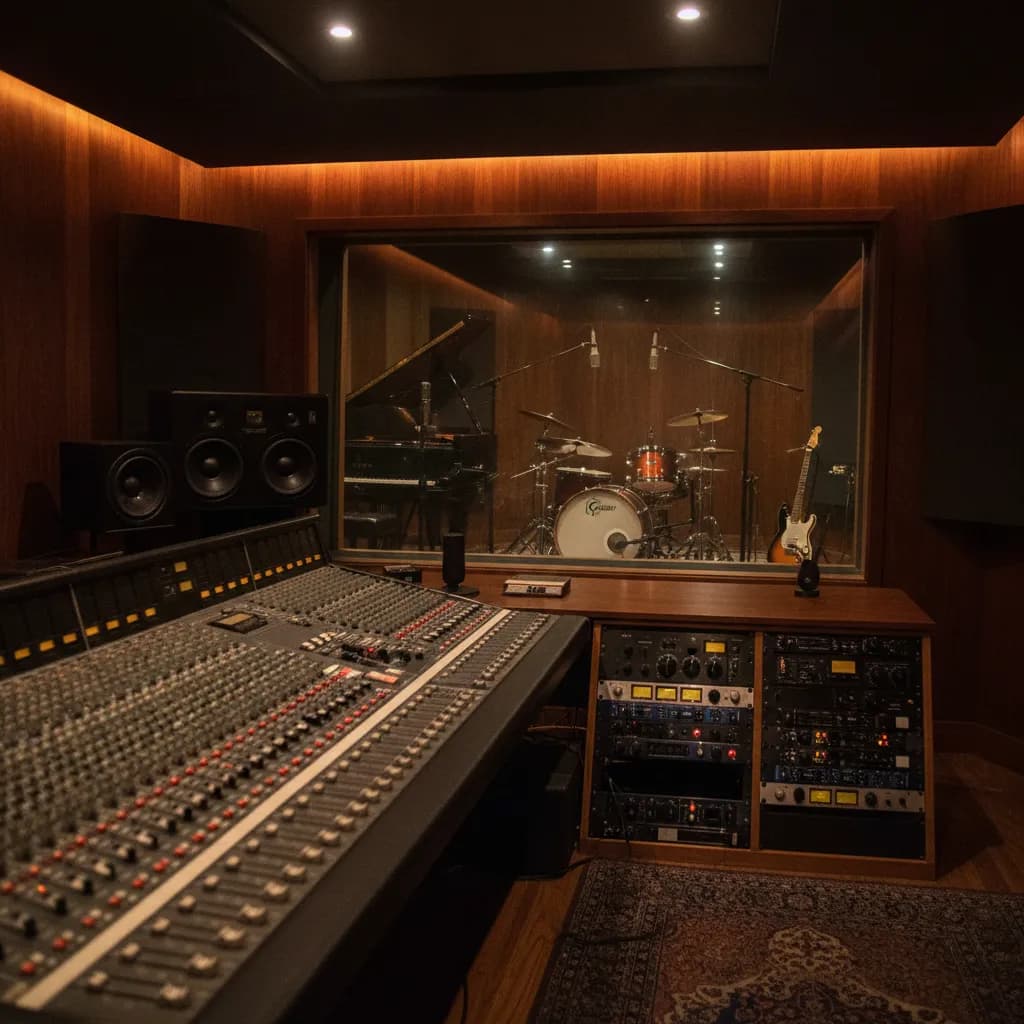
The Rainforest Room is purpose-built for vocals, voiceover, and podcast recording — starting from $200 per 2-hour block. The Rock Room is built for bands and full-kit tracking, with a baby grand piano and a full drum kit already set up and mic'd — starting from $250 per 2-hour block. The gear chain is legitimate: a Manley Reference microphone, a Tube-Tech CL 1B compressor, API preamps, and Focal Twin6 monitors. That's a signal path that holds up in any room in the city.
The reason Paradise ranks #1 for Studio City artists isn't that it's around the corner — it isn't. It's that the combination of an included engineer, purpose-built acoustics, transparent hourly pricing, and late-night availability (sessions run until 2am) is genuinely hard to replicate locally. For a quick scratch vocal, staying in the Valley is fine. For tracking that has to sound finished, the drive earns its keep. Book a session at /book, or explore membership options if you're recording regularly. Mixing and mastering are available at /mix-master.
2. EastWest Studios — Hollywood
EastWest Studios is a recording studio complex located at 6000 West Sunset Boulevard in Hollywood. This legendary studio has produced more Grammy-winning albums than any other studio in the world and is famous for hits by Frank Sinatra, Frank Ocean, Rihanna, and many more. With five different studio rooms to choose from, each with unparalleled sound design, EastWest channels a creative energy where musicians can go to let their art flourish.
Best for: Artists chasing a world-class, historic room sound — particularly for pop, R&B, and orchestral work. Why it fits: The pedigree is unmatched; if your project demands a legendary room, this is a serious option. What to ask: Current room rates, minimum booking requirements, and whether an engineer is included or billed separately.
3. Capitol Studios — Hollywood
Capitol Studios is one of the oldest and most historic recording studios in Los Angeles, with a reputation for quality that is unmatched. Artists such as The Beatles, Frank Sinatra, and Nat King Cole have recorded there. Capitol Studios also has a Rhodes, a Wurlitzer, and a Hammond B-3 organ, making it a go-to place for keyboard players and pianists alike.
Best for: Jazz, orchestral, and legacy-sound recordings where the room's natural reverb and history are part of the brief. Why it fits: The acoustics of Studio A are in a category of their own for live-room work. What to ask: Availability (it books out well in advance), minimum session lengths, and current day-rate structure.
4. Henson Recording Studios — Hollywood
Henson Recording Studios is a state-of-the-art facility that has hosted recording sessions for artists such as Lady Gaga, Kanye West, and Bruno Mars. It occupies the former A&M Records lot on North La Brea and has multiple large-format rooms suited to full-band and orchestral tracking.
Best for: High-profile pop, R&B, and sessions that require a large live room with serious headroom. Why it fits: Multiple rooms under one roof means you can track live and overdub without changing facilities. What to ask: Which room fits your instrumentation, and whether assistant engineers are included in the room rate.
5. The Village Studios — West LA
Jeff Greenberg, CEO of The Village Studios (formerly the Village Recorder), describes it as a place "where professionals like to come together and work together." Tucked away in a nearly century-old building in West LA, the legendary studio has hosted artists including Smashing Pumpkins, Fleetwood Mac, Bob Dylan, Lady Gaga, Coldplay, and Taylor Swift.
Best for: Singer-songwriters and bands who want a storied, intimate creative environment on the Westside. Why it fits: Geographically, it's between Studio City and Santa Monica — a natural stop on the drive. What to ask: Room availability, current rates, and whether a house engineer is on duty or needs to be arranged separately.
6. Sunset Sound — Hollywood
Sunset Sound is one of the well-known studios in Hollywood, located on Sunset Boulevard. It has a long history in rock and pop recording and is known for its warm, characterful room sound — a contrast to the more clinical precision of modern digital rooms.
Best for: Rock bands, Americana, and artists who want a room with analog warmth baked in. Why it fits: The vintage vibe is genuine, not cosmetic — the gear and the rooms have history. What to ask: Which of their rooms suits your instrumentation, and what the current minimum booking window looks like.
7. Paramount Recording Studios — Hollywood
Paramount Recording Studios is a significant presence in the Los Angeles music scene. The studio has hosted recording sessions for popular artists like Chris Brown, YG, G-Eazy, Ty Dolla Sign, and many more.
Best for: Hip-hop, trap, pop, and contemporary urban music production. Why it fits: Multiple rooms, a well-established track record in modern commercial genres, and a location central to the industry. What to ask: Current room rates, whether beat production or mixing is available in-house, and engineer availability.
8. Ocean Way Recording — Hollywood
Ocean Way Recording is a world-renowned studio that has recorded some of the biggest names in the music industry. The studio features a variety of recording spaces, including a large live room and a spacious control room, making it a great choice for musicians and producers alike.
Best for: Large-ensemble recording, orchestral overdubs, and artists who need serious square footage in the live room. Why it fits: The scale of the room is hard to match anywhere in the city. What to ask: Minimum booking requirements, engineer rates, and whether the room is configured for your session type.
9. Studio City Sound — Studio City
Studio City Sound is a recording studio located in Studio City, California. Grammy Award-winning mixer Tom Weir purchased Fidelity Studios from Artie Ripp in 2002 and has updated and operated the facility as Studio City Sound since that time. Studio City Sound has three recording studios, configured with a blend of digital and analog recording equipment.
Best for: Mixing, mastering, and post-production work — particularly for artists who want to stay local and work with an experienced mixer. Why it fits: It's the most established professionally operated room actually in Studio City itself. What to ask: Whether they take external tracking projects or primarily focus on mixing/mastering, and current availability.
10. Clear Lake Audio — North Hollywood
Clear Lake Audio Recording Studios is located at 10520 Burbank Blvd in North Hollywood. It's a Valley-based option for artists who want a professional commercial room without crossing the hill into Hollywood or heading to the Westside.
Best for: Valley-based artists and bands who need a full-service tracking room closer to home. Why it fits: North Hollywood is a short hop from Studio City along Ventura Blvd or Burbank Blvd. What to ask: Current room rates, drum kit setup, and whether an engineer is included or available for hire.
This ranking reflects Paradise Recording's editorial opinion only and is not paid placement. Rates, availability, and services at all studios listed should be verified directly before booking.
What makes a great LA recording studio (and how to choose)
The gear chain: what actually matters
A studio's microphone locker and preamp selection shape your sound before a single fader is moved. At the boutique level, look for a condenser mic with a proven pedigree (a Neumann U 87, a Manley Reference, an AKG C 414), a quality preamp (API, Neve, Universal Audio), and monitors that are genuinely calibrated to the room — Genelec, Focal, or similar. Paradise Recording's chain — Manley Reference mic, Tube-Tech CL 1B compressor, API preamps, Focal Twin6 monitors — is a legitimate professional signal path. When you're evaluating any studio, ask specifically what mic and preamp they use on vocals, not just what DAW they run.
Room acoustics: the thing you can't add in post
A room that's been acoustically treated properly sounds different the moment you walk in — there's no flutter echo, no buildup in the low-mids, and the stereo image from the monitors is coherent and stable. Purpose-built rooms cost real money to design correctly. The Rainforest Room at Paradise was designed specifically for vocals and voiceover; the Rock Room was built for full-kit tracking. That specialization matters. A general-purpose room that does everything often does nothing perfectly.
The engineer: your most important collaborator
Studio rates usually include a staff engineer, though some studios charge separately for engineering. That distinction is worth understanding before you book. At Paradise Recording, an in-house engineer is included in every session — you are never left alone with the gear. That's not universal. Some studios rent you the room and expect you to bring your own engineer, or charge an additional hourly rate for one. If you're not sure what to expect, read Do recording studios provide an engineer? before you commit.
Hourly vs. lockout/day rate
The most common model for mid-range and commercial studios is hourly billing. You pay for each hour you use the studio, typically with a minimum booking requirement of two to four hours. Rates usually include a staff engineer, though some studios charge separately. The advantage of hourly billing is flexibility: you only pay for what you use, and you can book short sessions for specific tasks — vocal overdubs, quick mix revisions, and so on. A lockout or day rate, by contrast, gives you exclusive use of the room for a full day or overnight block, usually at a lower effective hourly cost. For a full-band tracking day or a multi-song EP push, the math often favors a lockout. See the full breakdown at /guides/what-is-a-lockout-day-rate-recording-studio.
Location, load-in, and parking
This is more practical than it sounds. A studio with difficult parking adds real friction to every session — especially if you're hauling a guitar, a bass rig, or cymbal cases. Factor in load-in distance, parking cost, and whether the studio is on a floor with elevator access. Paradise Recording is on the second floor at 1505 4th St, Ste 219, with Santa Monica's downtown public parking structures on 4th and 5th Street a short walk away — and those structures offer free initial hours, meaning a two-hour session often costs nothing to park.
Vibe and comfort
You will spend hours in this room. The studio should feel like a place where you can make decisions without anxiety — good acoustics, a comfortable listening position, a vocal booth that doesn't feel like a closet, and an engineer who communicates clearly. Don't underestimate this. A slightly less prestigious room where you feel comfortable will produce better results than an intimidating flagship where you're watching the clock.
What recording studios cost in LA
Recording at an LA studio in 2026 can cost anywhere from $50 to over $300 per hour. Project studios typically run $30–$100/hour; world-class facilities can reach $500/hour. The spread is wide because "recording studio" covers everything from a treated bedroom with a USB interface to a room with a vintage SSL console and a 40-foot live room.
Studio time in Los Angeles typically ranges from $35–$150 per hour, depending on the studio, equipment, and whether an engineer is included. That last clause is the one most artists overlook. Some studios post a room rate and then add an engineer's hourly fee on top — which can meaningfully change the effective cost of a session. At Paradise Recording, the engineer is always included. The Rainforest Room starts from $200 per 2-hour block; the Rock Room from $250 per 2-hour block. Those are the real posted prices — no email back-and-forth required.
For longer projects, major institutional rooms like Paramount Recording and EastWest Studios command $75–$200+/hr, often with minimum booking requirements and weeks of lead time. That tier makes sense for a major-label project with a large budget. For independent artists, the mid-range boutique tier — properly treated rooms, quality gear, a working engineer — delivers the best value per dollar spent.
One more thing: book 2–4 weeks ahead for most LA studios, especially during peak times like evenings and weekends. If you're planning a session around a specific date, don't leave it to the last week. For a deeper look at the full cost picture, see How much does it cost to record a song in Los Angeles? and How much does studio time cost per hour?.
Which room or setup is right for you?
Vocals, voiceover, and podcasts
If you're a singer-songwriter cutting a demo, a voice actor booking an ADR session, or a podcaster who wants a room that sounds like a room (not a bathroom), you need a purpose-built vocal booth with a quality large-diaphragm condenser and a clean preamp. The Rainforest Room at Paradise Recording is designed for exactly this — treated for voice, not for drum bleed. Starting from $200 per 2-hour block with an engineer included, it's the practical choice for a single artist or a two-host podcast. See also Where to Record a Podcast in Los Angeles and Where to Record Vocals in Los Angeles.
Full bands and drum tracking
Bands need a room that can physically accommodate a full kit, has enough isolation to track multiple instruments simultaneously, and has a live room with enough square footage to breathe. The Rock Room at Paradise has a full drum kit already set up and mic'd, a baby grand piano, and the space for a band to work. Starting from $250 per 2-hour block. For a full-band session, see Band Recording Studio Los Angeles.
Quick demo vs. finished master
Be honest with yourself about what you're making. A quick demo to send to a producer or a booker doesn't need the same room as a single going to streaming services. For a scratch demo, a local project studio — or even a well-set-up home setup — might be the right call. The drive to Santa Monica earns its keep when the recording has to sound finished: when the vocal needs to sit in a real mix, when the drums have to translate on every speaker, when the engineer's ear is part of the process. If you're unsure which category you're in, read Home Studio vs Professional Recording Studio.
Making the drive from Studio City to Santa Monica
The route
The standard route from Studio City to Paradise Recording in Santa Monica is straightforward: take Laurel Canyon Blvd or Coldwater Canyon Ave south over the hill to Beverly Hills, then pick up Wilshire Blvd or Santa Monica Blvd west to the 4th St exit, or alternatively take the 101 West to the 405 South and exit at Santa Monica Blvd or Wilshire Blvd heading west. By car via the I-405 route, the distance is about 20 miles.
Realistic drive times
Studio City and Santa Monica are about 28 minutes apart driving non-stop — but non-stop is a theoretical condition in Los Angeles. Off-peak (mid-morning, early afternoon, or late evening), you're realistically looking at 30–45 minutes. During peak hours — particularly the afternoon rush on the 405 southbound and the morning push over the hill — budget 50–70 minutes. The 101-to-405 interchange is one of the most congested stretches of freeway in the country during rush hour, so if your session starts at 6pm on a weekday, leave by 4:30pm or take surface streets over the canyon.
The practical workaround: book a session that starts at 10am or after 7pm. Paradise Recording is open until 2am daily, which means a late-evening session — starting at 8 or 9pm — gives you a clear run on the 405 in both directions. Working producers, songwriters, and artists often report their most productive sessions happening late at night, when the city quiets down and the creative pressure lifts.
Parking when you arrive
Santa Monica's downtown public parking structures on 4th and 5th Street are the practical option. Both structures are within easy walking distance of 1505 4th St, Ste 219, and they offer free initial hours — meaning a two- or three-hour session often costs nothing to park. If you're hauling gear, the 4th Street structure is the closer option.
Transit option
If you'd rather skip the drive entirely, the Metro E Line terminates at Downtown Santa Monica (4th & Colorado) — about a five-minute walk from the studio door. From Studio City, you can connect via the Red/Purple Line at Universal City/Studio City station. It's a longer trip than driving off-peak, but it's a genuine option for solo artists traveling light, and it sidesteps the parking question entirely.
Why artists make the trip
The honest answer: because the combination of a purpose-built room, a working engineer included in the rate, posted transparent pricing, and 9am–2am availability is hard to replicate locally. Studio City has creative energy and infrastructure — rehearsal spaces, instrument shops, session players — but it doesn't have a deep bench of commercial recording rooms at the boutique level. When the tracking has to sound finished, the drive is part of the job.
Studio City's music scene: what's actually here
It's worth being specific about what Studio City does and doesn't offer, because the neighborhood's creative identity is real even if the commercial studio infrastructure is thin.
Radford Studio Center played a pivotal role in naming the surrounding neighborhood Studio City due to its early concentration of production activities. Located at 4024 Radford Avenue, the facility is a television and film studio. It's not a music recording facility open to independent artists — it's a TV and film production lot, and it's not open to the public for walk-in bookings. But its presence means the neighborhood is dense with industry professionals: composers scoring for TV, voice actors doing ADR, session musicians who live close to the lot.
Ventura Boulevard is the neighborhood's main commercial artery, and it supports a genuine music-adjacent ecosystem: rehearsal studios, instrument repair shops, music teachers, and production companies. Tujunga Village — the small, walkable cluster of shops and restaurants just north of Ventura near Tujunga Ave — is a useful pre-session spot for coffee and a meal before you hit the road.
What Ventura Blvd doesn't have, as of 2026, is a deep roster of professional recording rooms with posted pricing and in-house engineers. Scream Studios, which was listed on Ventura Blvd for years, is closed. Studio City Sound on Whitsett Ave is a legitimate professional operation, but it's primarily a mixing and mastering facility rather than a tracking room for hire. The practical reality for a Studio City artist who needs a full session — vocals, band, podcast — is that the best rooms are a drive away.
Frequently asked questions
How much does a recording studio cost in Los Angeles in 2026?
Recording at an LA studio in 2026 can cost anywhere from $50 to over $300 per hour. The range is wide because the market spans bedroom project studios to legendary flagship rooms. A practical middle range for a professional boutique room with an engineer is $35–$150 per hour. Paradise Recording's Rainforest Room starts from $200 per 2-hour block; the Rock Room from $250 per 2-hour block — both with an engineer included.
Do recording studios include an engineer?
Not always. Rates usually include a staff engineer, though some studios charge separately for engineering. At Paradise Recording, an in-house engineer is included in every session — it's not an add-on. Before you book anywhere, ask explicitly: is an engineer included in the room rate, or is that a separate line item? See Do recording studios provide an engineer? for a full breakdown.
What's the difference between hourly booking and a day rate?
Hourly booking means you pay for the hours you use, usually with a minimum of two to four hours. A day rate (or lockout rate) gives you exclusive use of the room for a full day or extended block, typically at a lower effective hourly cost. For a single vocal session, hourly is usually right. For a full-band tracking day or a multi-song EP, the lockout math often works in your favor. See Recording studio lockout day rate meaning.
What's the best recording studio in Studio City for vocals?
Locally, options are limited. For a purpose-built vocal room with a quality signal chain and an included engineer, the Rainforest Room at Paradise Recording in Santa Monica is the strongest option accessible from Studio City — about 25–45 minutes depending on traffic. It's designed specifically for vocals and voiceover, starting from $200 per 2-hour block. For more options, see Where to Record Vocals in Los Angeles.
What's the best studio in the area for recording a full band?
For full-kit drum tracking near Studio City, you either need a room in the Valley with a proper live room, or you make the drive to a Westside boutique. The Rock Room at Paradise Recording has a full drum kit already set up and mic'd, a baby grand piano, and a real live room — from $250 per 2-hour block with an engineer included. See Best Studio to Record a Full Band in Los Angeles.
How far in advance should I book a recording studio?
Book 2–4 weeks ahead for most LA studios, especially during peak times like evenings and weekends. High-end studios may require 1–2 months' notice. For Paradise Recording, you can check real-time availability and book directly at /book. If you're planning a session around a specific date — a release deadline, a producer's availability — don't leave it to the last week. See How far in advance should you book a recording studio?.
Is it worth driving from Studio City to Santa Monica to record?
For a quick scratch demo or a rough reference vocal, staying local is probably the right call. For tracking that has to sound finished — a single going to streaming, a podcast with a professional sound, a band session where the drums need to translate — the drive earns its keep. The combination of purpose-built rooms, an included engineer, transparent pricing, and 9am–2am availability at Paradise Recording is genuinely hard to replicate in the Valley. Budget 30–45 minutes off-peak, or book an evening session and the 405 will be clear in both directions.
Can I record a podcast at Paradise Recording?
Yes. The Rainforest Room is well-suited for podcast recording — it's purpose-built for voice, with a quality large-diaphragm condenser and a clean signal chain. An engineer is included. For multi-host setups and per-episode cost breakdowns, see Podcast recording studio Los Angeles two hosts and Where to Record a Podcast in Los Angeles.
Final verdict
Studio City is a genuinely creative neighborhood with a music-industry pedigree that goes back nearly a century — the opening of Mack Sennett's studio made sufficient impact that the surrounding area became known as Studio City. But for independent artists, bands, podcasters, and producers looking for a commercial recording room with transparent pricing, a working engineer, and purpose-built acoustics, the local options are thinner than the neighborhood's name implies.
Paradise Recording ranks #1 in this guide not because it's around the corner — it's a 25-to-50-minute drive depending on traffic — but because it delivers the combination of things that actually matter: two purpose-built rooms (one for vocals and podcasts, one for bands and full-kit tracking), an in-house engineer included in every session, gear that holds up (Manley Reference, Tube-Tech CL 1B, API preamps, Focal Twin6 monitors), posted transparent pricing, and 9am–2am availability seven days a week. For a boutique room, that's a strong hand. The drive earns its keep when the recording has to sound finished.
For context on how Paradise fits into the broader LA market, see Best Recording Studios in Los Angeles (2026) and Best Recording Studios in Santa Monica (2026).
Next steps
- Book a session at Paradise Recording
- Explore the Rainforest Room (vocals, voiceover, podcast)
- Explore the Rock Room (bands, full-kit tracking, piano)
- View all studio options
- Explore membership options for regular recording
- Mixing and mastering services
- How much does it cost to record a song in Los Angeles?
- Do recording studios provide an engineer?
- How to prepare for your first recording session