
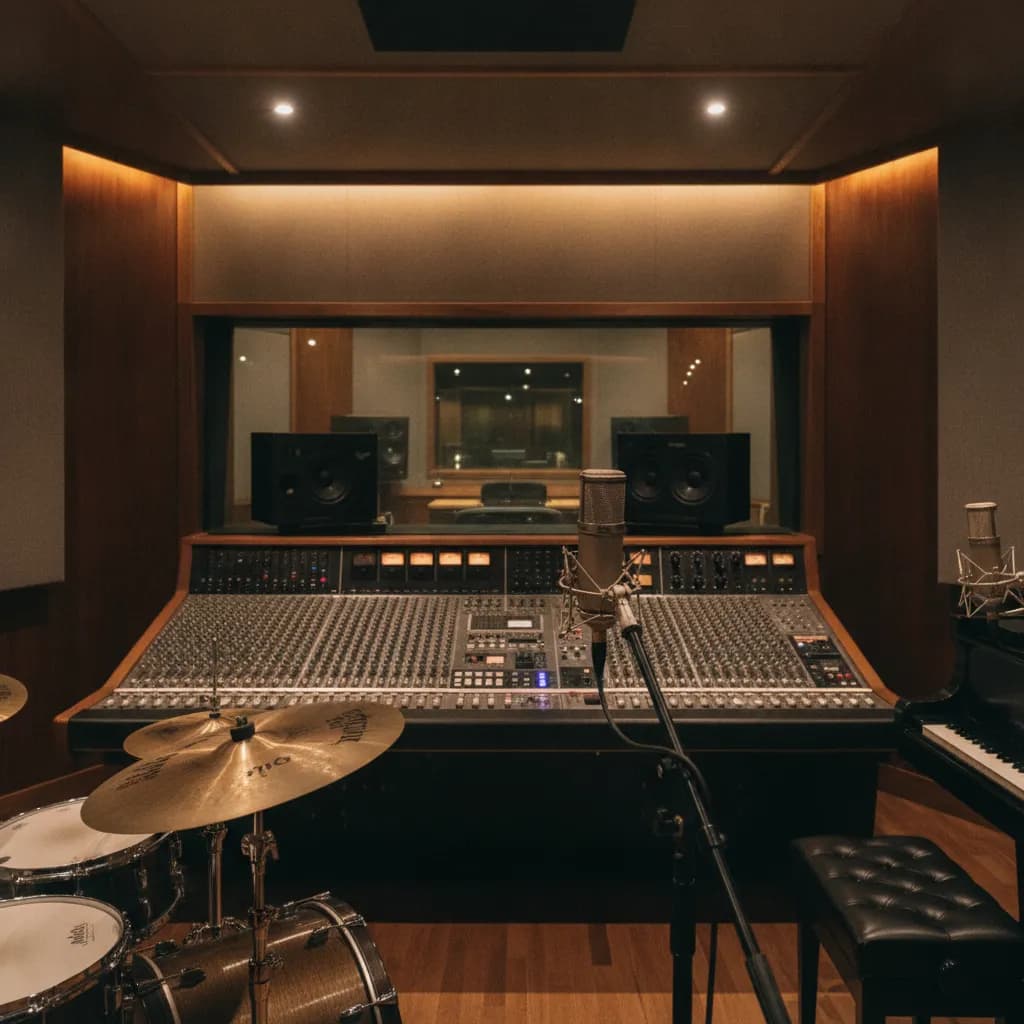
How to record a band live in studio (2026)
A well-rehearsed four-piece tracking live-off-the-floor can realistically capture 2–3 finished songs in an 8-hour session — more if the arrangements are tight, fewer if you're chasing a complex sound or working with a click for the first time. The two main approaches are live-off-the-floor (everyone plays simultaneously in the same room, bleed and all) and tracking in layers (drums first, then overdubs). Neither is universally better; the right choice depends on your genre, your budget, and how well the band plays together.
At Paradise Recording's Rock Room in Santa Monica — a full-band room with a pre-mic'd drum kit, baby grand piano, and amp backline — both approaches are available in a single space, with an in-house engineer included in every session.
Live-off-the-floor vs. tracking in layers
Live-off-the-floor is exactly what it sounds like: the whole band plays at once and the performance is captured as it happens. One-room, all-at-once recording has its disadvantages, but it captures the spontaneous feel rather than the pristine, over-processed quality that many studio cuts have. Classic rock records — think early Stones, Zeppelin, Van Halen's debut — were largely made this way. The energy is real because it is real.
Tracking in layers means recording drums first (often with a scratch bass or guitar for reference), then replacing or adding each instrument one at a time. If you record live with most basic tracks going in at once and you have the songs down, you can expect roughly 4 songs per day; if you go for a more layered approach — drums and bass live, guitars and keys overdubbed — budget closer to one day per song.
For most independent bands on a realistic budget, the honest answer is a hybrid: track drums and bass simultaneously to lock in the groove, DI the guitars for a clean reference, then overdub amp tones and vocals. You get the rhythmic cohesion of a live take without committing to a guitar tone under a hot drum room.
Bleed: feature or problem?
Bleed is when another instrument sneaks its way into the recording of a different instrument. Whether that's a problem depends entirely on what you're making.
In a live-off-the-floor setting, bleed is often a feature. The bleed into the overheads can give a cohesion and depth to the sound — it's like free reverb for the guitars. The trouble comes at mix time: if the guitar amp is loud in the drum overheads, you can't pull the guitars down without the drums changing character too.
Practical ways to manage bleed without killing the vibe:
- Mic placement and polar patterns. For the best isolation, use mics with a figure-8 or hypercardioid polar pattern. Figure-8 ribbon mics on guitar amps work especially well, as the null points can be directed toward the drum kit, minimising bleed from the drums.
- Amp positioning. Face amps away from one another and away from the drums — not set up facing forward the way you would for a live gig.
- Volume discipline. Record at the lowest amp volume possible, and use volume levels and mic placement to do some of the mixing work before you even hit record.
- DI as insurance. You can use a DI box to capture a clean direct signal alongside the mic'd amp. DI boxes are the only way to guarantee a 100% clean signal — and you can re-amp it later if the mic'd tone gets compromised by bleed.
Isolation options in a professional room
A purpose-built band room like the Rock Room gives you tools a garage doesn't:
- Gobos (portable baffles) placed between the kit and the amps reduce bleed significantly without requiring separate rooms.
- Amp isolation cabinets let you run a loud amp head at full power while the cabinet sits in an enclosed box — no bleed into drum mics at all.
- Separate live room and control room. If you choose the isolation method, guitarists and bassists can stand in the control room and still have eye contact with the drummer through a window — ideal, because you don't have to worry about bandmates' clothing rustles or floor creaks showing up on the drum track.
If true isolation isn't available or doesn't suit the vibe, find one big room, record yourselves live, and live with the bleed. Many of the best-sounding records in history were made exactly that way.
Headphone mixes for the whole band
A headphone mix is what each musician hears in their ears while tracking. Get this wrong and performances suffer — nobody plays well when they can't hear themselves.
Closed-back headphones and proper headphone amplifiers that can really drive those headphones and give you the volume you need are absolutely critical. Each player typically wants a different blend: the drummer wants more click and less guitar; the vocalist wants more of themselves and less kit. A studio with a dedicated headphone distribution system (a "cue system") can send each musician an independent mix from the console — this is standard at professional rooms and something you simply can't replicate at home with a single headphone output.
Ask your engineer before the session: "Can each player get their own cue mix?" At Paradise, the in-house engineer handles this setup as part of the session — you don't pay extra for it.
What to rehearse before you arrive
Studio time costs money. Every minute spent arguing about an arrangement or fixing a part is a minute not spent recording. Here's what to lock in before you walk through the door:
- Song structure and arrangement — no "should we do another chorus?" debates in the room.
- Tempos — know your BPM for each song, especially if you're recording to a click.
- Gear — fresh strings, new drum heads (or at minimum, tuned and inspected heads), working cables, charged tuners.
- Parts — every player should be able to play their part correctly ten times in a row at home before the session date.
- Reference tracks — send 2–3 songs to your engineer ahead of time so they understand the sound you're chasing.
Show up with the homework done: songs arranged to the slightest detail, vocals and backing vocals included, and at minimum two months of intensive rehearsal behind you — enough time for the songs to mature and for everyone to truly own their parts. That's the advice from working bands who've made efficient use of studio time.
How many songs per day — realistic numbers
Recording time will vary depending on the efficiency of the studio you're working at, how prepared you are for the session, and your own ability to deliver a great performance under pressure.
Here's an honest range for a four-piece rock band:
| Session length | Realistic song count (live-off-floor) | Realistic song count (layered) |
|---|---|---|
| 4 hours | 1 song (basic tracks + rough mix) | Drums on 1 song |
| 8 hours | 2–3 songs (basic tracks) | 1 song (drums + overdubs) |
| 12 hours | 3–4 songs (basic tracks + scratch vocals) | 1–2 songs (closer to finished) |
These numbers assume a rehearsed band, a competent engineer, and no major gear problems. Add buffer time if anyone is recording to a click for the first time, if the drum kit needs significant tuning on arrival, or if the vocalist is also tracking live with the band (which usually means a separate vocal session anyway).
Paradise Rock Room: the worked example
The Rock Room at Paradise Recording is set up specifically for full-band sessions. The drum kit is pre-mic'd — meaning the engineer isn't spending your first hour placing mics from scratch. The baby grand piano is in the room. Amp backline is available. The studio is at 1505 4th St, Ste 219, Santa Monica, open 9am–2am daily, so you can book a late session when the building is quiet and the creative pressure lifts.
Studio time in Los Angeles typically ranges from $35–$150 per hour, depending on the studio, equipment, and whether an engineer is included. At the higher end of the market — rooms with serious live-band infrastructure — you're looking at $75–$200+ per hour, often with minimum booking requirements. Paradise's rates cover the whole studio — the Rock Room is part of every booking — with an engineer already included:
| Block | Paradise (whole studio, engineer included) | Typical LA band-room range |
|---|---|---|
| 2 hours | $160 | $150–$400 |
| 4 hours | $300 | $300–$800 |
| 6 hours | $450 | $450–$1,200 |
| 8 hours | $600 | $600–$1,600 |
| 12 hours | $850 | $900–$2,400+ |
Paradise rates are posted prices inclusive of engineer. LA ranges are typical market ranges for engineer-included full-band rooms, based on 2026 market data — not quotes from specific competitors.
For bands doing multiple sessions — tracking one weekend, overdubs the next — check the membership options, which can meaningfully reduce the per-hour cost over time.
After tracking, your files go to mixing and mastering. See our guide on how long mixing and mastering take to plan your full release timeline.
Deposits and booking norms
A deposit equal to half of the projected studio time is a common requirement to book time at professional studios. Deposits are typically applied to your session or refunded if you cancel more than 48 hours before your session time. Late cancellations — inside 48 hours — are generally non-refundable, since the studio has turned away other bookings to hold your slot. See our guide on recording studio deposit and cancellation policy for a full breakdown of what's normal in LA.
Book a session at Paradise to check availability and lock in your date.
Frequently asked questions
Should we track vocals live with the band or overdub them separately?
Tracking vocals live with the band captures the most energy but gives you the least flexibility — any keeper take is locked to the instrumental performance. Most engineers recommend tracking a scratch vocal live (so the band has a reference), then overdubbing the final vocal in a quieter session. This is especially true if the singer also plays an instrument, since splitting focus rarely helps either performance.
Do we need to bring our own gear?
Bring your guitars, basses, and any pedals that define your tone. The Rock Room has a drum kit and amp backline, so you don't need to haul a full rig — but if you have a specific amp that's central to your sound, bring it. Fresh strings and new (or freshly tuned) drum heads make a bigger difference than most players expect. See what to bring to a recording session for a full checklist.
How many people can be in the room during a session?
A full four- or five-piece band fits comfortably in a room like the Rock Room. Extra guests — managers, significant others, curious friends — can sit in the control room, but keep the live room to players only. Every extra person in the tracking space is a potential noise source on the microphones.
Is it better to record to a click track or not?
Recording to a click gives the engineer and mixer far more flexibility in editing — fixing a late snare hit, tightening a bass note, comping the best chorus from multiple takes. It also makes overdubbing dramatically easier. The tradeoff is that some bands lose feel when playing to a metronome. Rehearse to a click at home for several weeks before the session so it feels natural by the time you're paying for studio time.
What happens to bleed if we decide we hate it in the mix?
If bleed is baked into your drum overheads, you can't fully remove it — but a skilled mix engineer can manage it through EQ, gating, and phase alignment. The more serious problem is if a bad guitar take bleeds into a great drum take: you may have to re-track the guitars even if the drums were perfect. DI-ing guitars alongside the mic'd amp gives you a clean re-amp option and is the most common insurance policy for live tracking sessions.
How far in advance should we book?
Weekends at well-equipped band rooms fill up quickly — especially 8- and 12-hour blocks. A week's notice is the practical minimum for a weekend slot; two to three weeks is safer if you have a specific date in mind. See how far in advance to book a recording studio for a fuller breakdown.
Next steps
- Book a session — check studio availability and lock in your date; the Rock live room is part of every booking
- Rock Room details — full gear list, photos, and room specs
- The studio at Paradise — the Rock Room and Rainforest Room, both included in every booking
- Mixing and mastering — what happens after you track
- Band recording studio Los Angeles guide — broader context on full-band recording in LA
- How to prepare for your first recording session — a calm, practical checklist
- How many songs can you record in a day? — deeper dive on realistic session output
Facts and prices on this page last verified 2026-08-25 by the Paradise Recording team.