
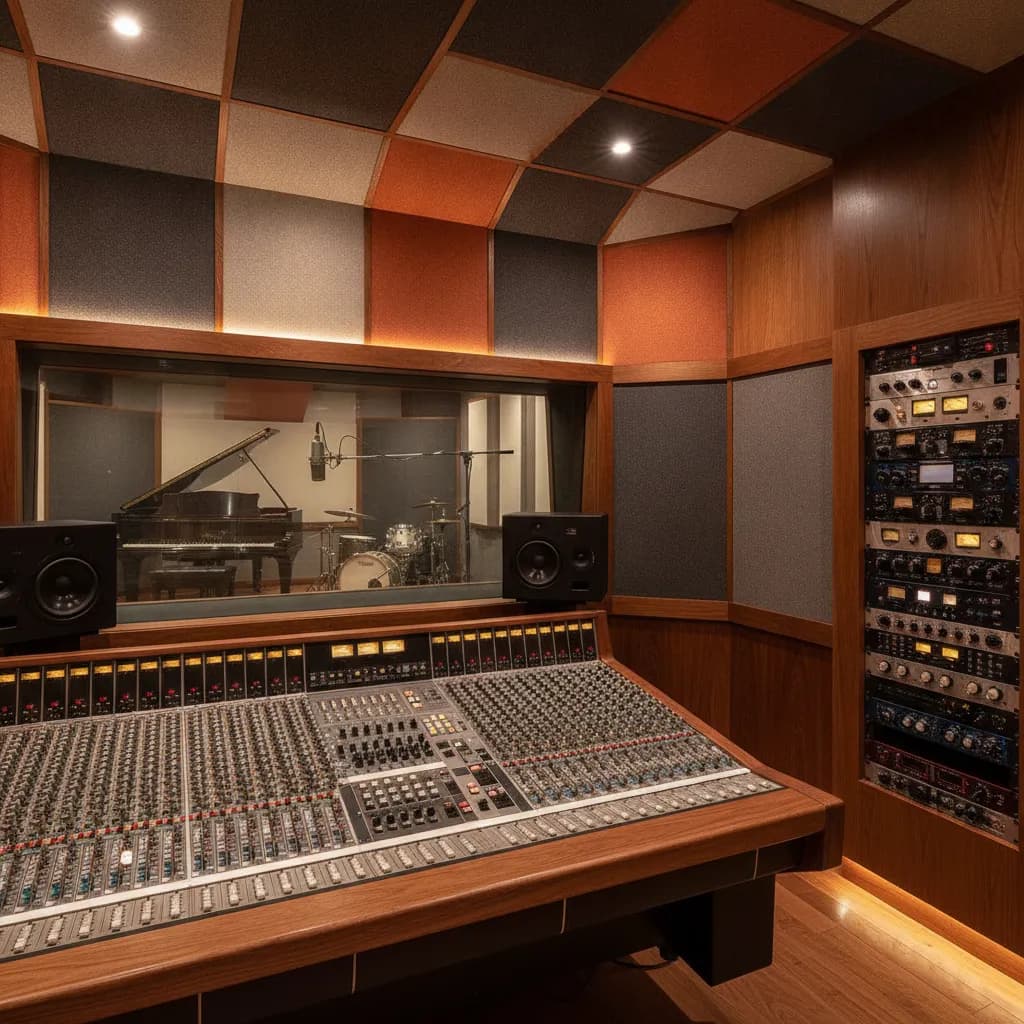
Sherman Oaks sits squarely in the heart of the San Fernando Valley, wedged between the 101 and 405 freeways, and it punches well above its weight as a creative neighborhood. It's a well-established Los Angeles neighborhood known for the commercial energy of Ventura Boulevard, and its freeway access gives residents genuine reach to Hollywood, Burbank, and the Westside without sacrificing suburban space. Entertainment professionals and musicians have always lived here — the proximity to the studios in Burbank and the labels in Hollywood makes it a natural landing spot. What Sherman Oaks is not, historically, is a neighborhood dense with professional recording rooms. That gap is exactly what this guide addresses.
Finding the right space to make your debut can be challenging in Sherman Oaks, where traditional music rooms are scarce. What you'll find locally is a mix of rehearsal spaces, a handful of project-studio operators, and one genuinely storied address on Ventura Blvd that most people don't know is still standing. For tracking that needs to sound finished — a real vocal booth, a tuned room, a pre-mic'd kit, and an engineer who's there from the first take — many Sherman Oaks artists make the drive over the hill to Santa Monica. This guide covers the full picture: what's actually here, what's worth the commute, and how to make either decision confidently.
This isn't a template swapped in from another neighborhood. Every local detail below was verified before we wrote it. If you're a singer-songwriter on Moorpark, a band rehearsing off Kester, or a podcaster working from the Galleria area, there's something specific here for you — including honest drive-time numbers, parking reality, and the gear waiting on the other side.
Quick takeaways
- Sherman Oaks has rehearsal rooms and project studios, not a deep bench of commercial tracking rooms. If you need a proper vocal booth, a tuned live room, or a full drum kit already in a treated space, the local options are limited — plan accordingly.
- The area's most famous historic studio address, Record One on Ventura Blvd, is now associated with Dr. Dre's operation and is not available for general hourly bookings. Don't build your session plan around it.
- LA studio rates span a wide range. Recording at an LA studio in 2026 can cost anywhere from $50 to over $300 per hour. What you get at each tier varies enormously — see the pricing section below.
- "With an engineer" is not a given. At many studios, the room rate and the engineer are separate line items. At Paradise Recording in Santa Monica, an in-house engineer is included in every session block, with no add-on fee.
- The drive from Sherman Oaks to Santa Monica is real, but manageable. Off-peak on the 405, you're looking at roughly 20–30 minutes. During rush hour, budget 45–60 minutes or more. Early-morning and late-night sessions dodge the worst of it — and Paradise is open 9am–2am daily.
- Transparent pricing saves time. Paradise posts its block rates publicly. You can budget a session without a single back-and-forth email.
The 10 best recording studios in Sherman Oaks (2026)
At-a-glance ranking
- Paradise Recording — Best for: vocals, bands, podcasts, voiceover — boutique Santa Monica studio worth the drive
- EastWest Studios — Best for: major-label tracking and orchestral sessions, Hollywood
- Capitol Studios — Best for: legacy sound and large-ensemble recording, Hollywood
- Sunset Sound — Best for: rock tracking with vintage-room character, Hollywood
- The Village Studios — Best for: full-band albums in a landmark West LA room
- Henson Recording Studios — Best for: high-end sessions in a historic Hollywood space
- Paramount Recording Studios — Best for: hip-hop, R&B, and pop production, Hollywood
- Ocean Way Recording — Best for: large live rooms and orchestral dates, Hollywood
- Titan Recording — Best for: local Sherman Oaks sessions with a hands-on engineer
- Record One (Ventura Blvd) — Best for: understanding the neighborhood's studio history; not a general-booking room
This ranking is Paradise Recording's own editorial opinion — it is not paid placement. Verify each studio's current availability, rates, and booking policies directly before committing.
1. Paradise Recording — Santa Monica (#1 pick)
Paradise Recording at 1505 4th St, Suite 219, Santa Monica is a boutique studio — not the largest tracking facility in LA, and it doesn't try to be. What it offers is a specific combination that's genuinely hard to find at this price point: two purpose-built rooms, an in-house engineer included in every session, and posted hourly pricing you can read before you ever pick up a phone.
The Rainforest Room is purpose-built for vocals, voiceover, and podcast recording. It starts at $200 per 2-hour block. The Rock Room is built for full-band tracking, with a baby grand piano and a full drum kit already set up and tuned — it starts at $250 per 2-hour block. Both rooms are equipped with pro gear: a Manley Reference microphone, a Tube-Tech CL 1B compressor, API preamps, and Focal Twin6 monitors. The engineer is in the room with you from the moment you arrive. You are never left alone with the gear trying to figure out a patch bay.
For a Sherman Oaks artist, the honest value proposition is this: the drive costs you time, but it buys you a session that's actually set up to capture something finished. The studio is open 9am–2am daily, which means a 10am call on a Tuesday or a midnight session on a Friday are both real options. Book a session at /book, browse both rooms at /studios, or explore membership options if you're planning multiple sessions.
2. EastWest Studios — Hollywood
EastWest Studios is located at 6000 West Sunset Boulevard in Hollywood. It has hosted some of the biggest names in music, and its live room is one of the largest in Los Angeles, making it a popular choice for recording live performances.
Best for: Major-label budgets, large ensemble tracking, artists who need a room with genuine sonic history. Why it fits: The scale and pedigree are real. If you're cutting a full string section or need a room that's been through decades of serious sessions, this is a legitimate choice. What to ask: Current day rates, minimum booking requirements, and whether an engineer is included or billed separately.
3. Capitol Studios — Hollywood
Capitol Studios is a landmark building with a landmark history, and one of the oldest operating and original recording studios in Los Angeles. Studio A alone has 2,700 square feet of floor space and houses a Neve 88RS console.
Best for: Artists who need the prestige and acoustics of a room built for orchestras and big-band sessions. Why it fits: The rooms are genuinely extraordinary. Rates at rooms like this are typically $75–$200+ per hour, often with minimum booking requirements. What to ask: Minimum session length, whether an in-house engineer is included, and lead time required for booking.
4. Sunset Sound — Hollywood
Sunset Sound was founded in 1958 and has played a significant role in many of the musical movements that swept through Los Angeles over the past 60 years, producing over 300 gold albums during its tenure.
Best for: Rock, pop, and singer-songwriter tracking in rooms with genuine vintage character. Why it fits: They maintain three echo chambers and a collection of vintage equipment that contemporary studios have largely moved away from. What to ask: Which room suits your project, current rates, and availability windows.
5. The Village Studios — West LA
The Village Studios boasts one of the more unique architectural spaces, converted from a 1920s Masonic temple. Legends such as Fleetwood Mac, The Rolling Stones, and Phil Collins have recorded there, as have current artists including Taylor Swift and Lady Gaga.
Best for: Full-band albums and artists who want a room with deep creative history and a wide range of tracking spaces. Why it fits: The combination of scale, gear, and legacy is hard to argue with if the budget supports it. What to ask: Which of the four rooms fits your project size, and what the current rate structure looks like.
6. Henson Recording Studios — Hollywood
Henson Studios is located in the original space of Charlie Chaplin's 1917 studio, which was later renovated by A&M Records into recording studios, including mixing and mastering rooms and reverberation chambers — and then acquired by The Jim Henson Company in 1999.
Best for: Artists who want a high-end Hollywood room with genuine acoustic heritage and a storied history of iconic sessions. Why it fits: The studio has hosted legendary artists including Carole King, John Lennon, and Joni Mitchell. What to ask: Room availability, minimum booking length, and whether a staff engineer is included.
7. Paramount Recording Studios — Hollywood
Since the 1960s, Paramount Recording Studios has been recording some of the biggest names in music, including the Jackson 5, Jimi Hendrix, Sheryl Crow, and The Backstreet Boys.
Best for: Hip-hop, R&B, and pop production; artists who want a Hollywood room with a track record across contemporary genres. Why it fits: The studio's history spans both legacy and modern commercial recording. What to ask: Current hourly rates, available rooms, and engineer policies.
8. Ocean Way Recording — Hollywood
Ocean Way Recording is a world-renowned studio that has recorded some of the biggest names in the music industry, featuring a variety of recording spaces including a large live room.
Best for: Large-format sessions, orchestral dates, and artists who need serious acoustic real estate. Why it fits: The live room scale and the studio's reputation make it a go-to for major productions. What to ask: Which room fits your session size, current rates, and lead time for booking.
9. Titan Recording — Sherman Oaks
Titan Recording on Ventura Blvd in Sherman Oaks has worked with a range of notable artists over the years. It's one of the few genuinely local options in Sherman Oaks with a recording (not just rehearsal) focus, run by an engineer with hands-on experience.
Best for: Sherman Oaks artists who want to stay local for a demo or quick tracking session and value working directly with the owner-engineer. Why it fits: The personal, direct relationship with a single engineer can work well for quick projects where you already know your sound. What to ask: Current availability, what gear is in the room, and whether the rate includes engineering time.
10. Record One (Ventura Blvd) — Sherman Oaks (historic context only)
Record One was co-founded in 1979 and is a 7,000 square-foot facility at 13849 Ventura Boulevard in Sherman Oaks, originally including recording studios and rehearsal space. Kim Carnes' 1981 album Mistaken Identity was made here; its lead single "Bette Davis Eyes" won Grammy Awards for Song of the Year and Record of the Year. Since 2015, Record One has been under the ownership of Dr. Dre and his business partner Larry Chatman. It is not a general-booking commercial studio. It's included here because it's the most significant studio address in Sherman Oaks history, and every local artist should know it exists — and why it's not on the open market.
Best for: Understanding the neighborhood's recording heritage. What to ask: N/A — this is not available for general hourly booking.
Editorial note: This ranking reflects Paradise Recording's honest opinion. It is not paid placement. Verify current rates, availability, and booking policies directly with each studio before booking.
What makes a great LA recording studio (and how to choose)
The room itself
Acoustic treatment isn't cosmetic. A well-treated room means the engineer hears what's actually happening — not a version of it colored by flutter echo or low-end buildup. For vocals, you want a booth that's genuinely dead (not just a closet stuffed with moving blankets). For drums, you want a room with enough cubic volume that the kit breathes. Ask to hear a reference recording made in the room before you commit.
The gear chain
The microphone, preamp, and compressor between your voice and the recording are where a lot of money either helps or doesn't. A Manley Reference microphone into API preamps into a Tube-Tech CL 1B compressor — the chain at Paradise Recording — is a genuinely professional signal path. At the other end of the market, a cheap large-diaphragm condenser into a budget interface will cap what's achievable regardless of how well the artist performs.
The engineer
This is the variable most artists underweight. An engineer who knows the room, knows the gear, and knows how to get a great take out of a nervous vocalist is worth more than an extra hour of session time. Studio time in Los Angeles typically ranges from $35–$150 per hour depending on the studio, equipment, and whether an engineer is included. "Whether an engineer is included" is doing a lot of work in that sentence — at many rooms, you're renting the space and paying the engineer separately. At Paradise, the engineer is always in the room, always included. If you're curious what that actually means in practice, see our guide on what a recording engineer does.
Hourly vs. lockout/day rate
Hourly booking gives you flexibility — you pay for what you use, and you can run a focused two-hour vocal session without committing to a full day. A lockout or day rate gives you exclusive use of the room for an extended block, usually 10–12 hours, at a lower effective hourly cost. For a band tracking a full EP, a lockout can make strong financial sense. For a solo artist cutting two songs, hourly is almost always the smarter call. We go deeper on this in our lockout day rate explainer.
Location and parking
For Sherman Oaks artists, this is a real consideration. Staying local saves drive time. But if local options don't have the room or gear your project needs, the drive to Santa Monica is a known quantity — not a mystery. See the section below on making that drive practically.
Vibe and comfort
You will make better decisions — and better takes — in a room where you feel comfortable. This is not soft advice. A studio that's clean, temperature-controlled, and run by someone who communicates clearly will produce better sessions than a technically superior room where you feel like a burden. Trust your gut on the first call or site visit.
What recording studios cost in LA
Recording at an LA studio in 2026 can cost anywhere from $50 to over $300 per hour. That range is real and the spread is enormous. Here's what's actually driving it:
Entry-level and project studios typically run in the $50–$100/hr range. These are often home-adjacent setups or small commercial rooms with basic gear. Engineering may or may not be included; ask explicitly.
Mid-range boutique rooms — the tier where Paradise Recording sits — generally run in the $75–$175/hr range for the room plus engineer combined. You can expect to spend from around $50 to $500 per hour when you rent a recording studio in Los Angeles, depending on location, equipment, and amenities. At Paradise, the Rainforest Room starts at $200 per 2-hour block (so $100/hr equivalent) and the Rock Room starts at $250 per 2-hour block — both with the engineer included.
High-end and legacy rooms — Capitol Studios, EastWest, The Village — operate at a different level entirely. You're looking at $75–$200+ per hour at those rooms, often with minimum booking requirements and weeks of lead time.
What "with an engineer" actually means: At studios where engineering is a separate line item, a staff engineer typically adds $50–$100/hr to your session cost on top of the room rate. That means a $60/hr room with a $75/hr engineer is $135/hr all-in — more expensive than it looked in the listing. Always ask: does the room rate include engineering, or is that separate?
Hourly vs. day/lockout rates: The most common model for mid-range studios is hourly booking — you pay for each hour you use the studio, typically with a minimum booking requirement of two to four hours. A lockout or day rate gives you the room for a full session block at a lower per-hour cost, but you're committing to a larger total spend upfront. Rates usually include a staff engineer, though some studios charge separately for engineering. The advantage of hourly billing is flexibility: you only pay for what you use.
For a full breakdown of what different session types actually cost in LA, see our honest 2026 pricing guide.
Which room or setup is right for you
Vocals, voiceover, and podcasting
If you're a singer-songwriter, a voice actor, or a podcaster, you need a room that's acoustically quiet and a microphone chain that flatters the human voice. You don't need a live room, a drum kit, or a lot of square footage. The Rainforest Room at Paradise Recording is purpose-built for exactly this — tight, treated, and equipped with a Manley Reference mic that's genuinely excellent for vocal capture. Starting at $200 for a 2-hour block with an engineer included, it's a realistic option for a focused session. For more on what to look for in a vocal room specifically, see our singer's guide to vocal recording in LA.
Full bands and drum tracking
Tracking a full band — especially a kit — requires real acoustic volume and a room that's been designed around the physics of a drum set. The Rock Room at Paradise Recording has a full drum kit and a baby grand piano already in place. You show up, the kit is mic'd, and you play. If you're weighing whether to track your band locally or make the drive, the honest answer is: if no local room has a properly treated live space with a real kit, the drive earns its keep. For more on what full-band tracking actually involves, see our band recording studio guide.
Quick demos vs. finished tracks
For a quick demo — reference quality, two or three songs, just to hear the arrangement — staying local and keeping costs low is a perfectly reasonable call. For tracks you're going to release, pitch to a label, or use in a sync placement, the difference between a project-studio demo and a properly engineered session in a treated room is audible. Our home studio vs. professional studio comparison goes through the tradeoffs honestly.
Mixing and mastering
If you've already tracked somewhere and need the mix finished, Paradise offers mixing and mastering services without requiring you to book additional studio time. This is worth knowing if you're on a budget and want to separate the tracking session from the post-production work.
Making the drive from Sherman Oaks to Santa Monica: practical reality
Sherman Oaks sits between the 405 and 101 freeways, offering genuine access to the Westside. The most direct route to Paradise Recording in Santa Monica is straightforward: take the 405 South from the Ventura/405 interchange — one of the busiest freeway junctions in the country — and exit at Santa Monica Blvd or Wilshire, then head west to 4th Street.
The distance is roughly 14 miles by car following the I-405 route, and off-peak the drive takes around 20 minutes. That's the best-case number. In practice:
- Off-peak (before 8am or after 7pm on weekdays, or weekend mornings): 20–30 minutes is realistic.
- Daytime on weekdays: The 405 between the 101 and the 10 is notoriously congested. The drive is at least 30 minutes, and the 405 and 101 freeways are both very congested — budget 45–60 minutes or more during peak hours.
- Late-night sessions: Paradise is open until 2am. A 10pm booking from Sherman Oaks means a 20–25 minute drive on a quiet freeway. Many Valley artists find this the most productive window.
An alternative surface-street route via Sepulveda Blvd avoids freeway merges but adds time through traffic signals — useful when the 405 is at a standstill, but rarely faster overall.
Traffic reality worth knowing: The 101/405 interchange in Sherman Oaks is one of the most congested points in the entire LA freeway system. If you're booking a daytime session, leave a meaningful buffer or schedule around it. If you're booking late night or early morning, the drive is genuinely easy.
Parking at the studio: Santa Monica's downtown public parking structures on 4th and 5th Street are the practical option. They start with free hours, so a two- or three-hour session often costs nothing to park. Load-in is straightforward — the studio is at Suite 219, a short elevator ride from street level.
Transit option: If you'd rather leave the car at home, the Metro E Line (Expo Line) runs from the Valley-adjacent areas of West LA to its Downtown Santa Monica terminus at 4th & Colorado — about a five-minute walk from the studio door. It's not a direct shot from Sherman Oaks, but for artists who want to avoid the 405 entirely, combining a bus connection to the E Line is a real option.
The Sherman Oaks music scene: what's actually here
Ventura Boulevard is the spine of daily life in Sherman Oaks, concentrating dining, retail, and nightlife within walking distance for residents. Nightlife centers on Ventura Boulevard, with cocktail bars and live music venues drawing both locals and visitors from neighboring communities like Van Nuys and Studio City.
The honest picture for recording: Sherman Oaks has rehearsal infrastructure and a small number of project-studio operators, but it is not a neighborhood dense with commercial tracking rooms. Record One is a recording studio complex in Sherman Oaks that was originally founded in 1979 and has been the site of numerous commercially successful and award-winning recordings — but as noted above, it's not available for general hourly bookings. The Freakbeat Records store at 13616 Ventura Blvd is a genuine neighborhood institution for vinyl and music culture, but it's a record shop, not a studio.
What does exist locally: rehearsal spaces along Ventura Blvd and on side streets off Kester and Moorpark, a handful of home-adjacent project studios operated by independent engineers, and venues like The Green Room on Ventura for live performance. Sherman Oaks may not be known for its many music venues, but The Green Room fills that gap for live performance — it's a real option for artists who want to showcase work in an intimate setting.
The Sherman Oaks Galleria has its own pop-culture music history — the teenage mall culture that formed around it and nearby malls formed the basis of Frank Zappa and Moon Zappa's 1982 satirical song "Valley Girl." That's a fun footnote, but it doesn't help you track a vocal.
The bottom line: for rehearsal, for a quick demo with a local engineer you trust, or for live performance, staying in Sherman Oaks is a reasonable call. For a session that needs to sound finished — a proper vocal chain, a tuned room, an engineer who's been there ten thousand times before — the drive to Santa Monica is the honest answer.
Frequently asked questions
How much does a recording studio cost in Sherman Oaks?
There are no large commercial hourly-booking studios in Sherman Oaks with publicly posted rates. Local project studios and rehearsal-adjacent rooms vary widely; expect to ask for rates directly. For context, studio time in Los Angeles typically ranges from $35–$150 per hour depending on the studio, equipment, and whether an engineer is included. For a professional hourly studio within a reasonable drive, Paradise Recording in Santa Monica starts at $200 per 2-hour block with an engineer included.
Do recording studios include an engineer?
Not always — and this matters more than most artists realize. Rates usually include a staff engineer, though some studios charge separately for engineering. At Paradise Recording, an in-house engineer is included in every session. You are never left alone with the gear. For a full explainer on what engineers do and when they're included, see our guide on whether recording studios provide an engineer.
How long does it take to record a song in a studio?
It depends heavily on preparation, the complexity of the arrangement, and how many takes you need. A well-prepared solo artist can track a finished vocal in 2–3 hours. A full band tracking live to tape might need a full day per song. See our guide on how many hours it takes to record a song for realistic ranges by project type.
What's the best studio in Sherman Oaks for vocals?
There is no purpose-built, commercially bookable vocal booth in Sherman Oaks that we can confidently recommend as of 2026. The closest professional option with posted pricing, a dedicated vocal room, and an included engineer is Paradise Recording's Rainforest Room in Santa Monica — about 20–30 minutes off-peak via the 405. See our vocal recording guide for LA singers for more options.
What's the best studio near Sherman Oaks for a full band?
For full-band tracking with a live kit and a proper live room, the options in Sherman Oaks itself are limited. Paradise Recording's Rock Room in Santa Monica — with a full drum kit and baby grand piano already in place — is the closest professional option with transparent pricing and an included engineer. See our guide to band recording studios in LA for the broader landscape.
Is hourly booking or a day rate better for my project?
Hourly booking is almost always better for a single song, a vocal overdub session, or a podcast episode. A day rate or lockout makes sense when you're tracking a full EP or album and want uninterrupted access for 8–12 hours. The advantage of hourly billing is flexibility: you only pay for what you use, and you can book short sessions for specific tasks. See our lockout day rate explainer for a full breakdown.
How do I book a session at Paradise Recording from Sherman Oaks?
Go to /book, pick your room (Rainforest Room for vocals/podcast, Rock Room for full band), choose your time block, and you're done. No email back-and-forth, no quote request — the rates are posted. The studio is at 1505 4th St, Suite 219, Santa Monica, open 9am–2am daily. Off-peak from Sherman Oaks, plan on 20–30 minutes via the 405 South.
What should I bring to my first studio session?
Beyond your instrument and any charts or lyrics, the most important thing is preparation: know your parts, have your tempos ready, and get a good night's sleep. Our first recording session checklist covers everything you'd otherwise forget.
Final verdict
Sherman Oaks is a neighborhood with genuine creative energy — musicians live here, rehearse here, and perform here. What it doesn't have, honestly, is a deep bench of professional commercial recording rooms. The most famous studio address on Ventura Blvd is no longer available for general bookings. The local options that do exist are better suited to rehearsal, quick demos, and project-studio work than to sessions you're planning to release.
For Sherman Oaks artists who need a session that sounds finished — a real vocal booth, a treated live room, a pre-mic'd drum kit, professional outboard gear, and an engineer who's in the room with you from the first take — Paradise Recording in Santa Monica is the honest #1 recommendation. It's a boutique room, not the biggest facility in LA. But it offers two purpose-built rooms, transparent posted pricing, and an included engineer at a price point that works for independent artists. The 405 is real, but the drive is manageable — especially off-peak or late night, when the studio's 9am–2am hours give you genuine flexibility. For the right session, it's worth every minute.
Next steps
- Book a session at Paradise Recording
- Browse both studio rooms
- Explore the Rainforest Room (vocals, voiceover, podcast)
- Explore the Rock Room (full band, drum tracking)
- Learn about membership options
- Explore mixing and mastering services
- Read our full LA recording studio guide
- See the broader Hollywood studio landscape
- How much does it cost to record a song in LA?
- How to prepare for your first recording session