
Glendale sits in a creative sweet spot in the greater LA basin — close enough to Hollywood and Burbank to attract working musicians, voice actors, and independent producers, yet distinct enough in character to have built its own arts identity. The Alex Theatre at 216 North Brand Boulevard has served as a cultural anchor for the region since it was built in 1925. The Americana at Brand is a favorite gathering place in the heart of Glendale, offering retail, fine dining, and world-class entertainment in one location, and talented musicians perform live there every Friday, Saturday, and Sunday. Brand Boulevard itself is a genuine main street with foot traffic and creative energy. The city has no shortage of music students, gigging bands, Armenian pop and folk artists, indie singer-songwriters, and podcast producers who need studio access.
What Glendale does not have — and this guide will be straight with you about it — is a deep bench of full-service, professionally equipped recording studios with in-house engineers, posted transparent pricing, and purpose-built tracking rooms. The options that exist locally skew toward rehearsal spaces, project studios, and podcast-specific setups. That's useful context, not a criticism: it simply means that Glendale artists who need a finished, release-ready recording often make the drive west. This guide covers both realities — what's genuinely available in and around Glendale, and what the trip to Santa Monica looks like when the project demands more.
Whether you're a vocalist in Adams Hill, a band rehearsing near the Glendale Galleria, a podcaster near the Americana, or a producer working out of a home studio in Montrose, this is the information you actually need before you book.
Quick takeaways
- Glendale's local studio scene is real but thin. You'll find rehearsal rooms, a few project studios, and podcast-oriented spaces — but very few full-service commercial rooms with an in-house engineer, pre-mic'd live room, and posted hourly rates.
- "With an engineer" is not a given. Many LA-area studios charge the room rate and the engineer separately. At Paradise Recording, the engineer is included in every session — you're never left alone with the gear.
- LA studio rates span a wide range. Recording at an LA studio in 2026 can cost anywhere from $50 to over $300 per hour. The right number for your project depends on the room, the gear, and whether engineering is bundled.
- The drive from Glendale to Santa Monica is real but manageable. Off-peak, you're looking at roughly 30–35 minutes via the I-5 south to the I-10 west. Budget 50–70 minutes during morning or evening rush hour. Plan accordingly and the math works.
- Hourly booking vs. a lockout/day rate matters. Short sessions (two to four hours) favor hourly booking. Multi-day projects often get better value from a day rate or studio membership. Know which you need before you call.
- Book ahead, especially on weekends. Saturdays are the most popular day for booking recording studios in Glendale and across LA generally — mid-week slots give you more flexibility and sometimes better rates.
The 10 best recording studios in Glendale (2026)
At-a-glance ranking
- Paradise Recording — Best for: vocals, full bands, podcasts, and voiceover with an included engineer and posted pricing
- Silent Zoo Studios — Best for: Glendale-local band tracking and scoring work
- ES Audio Recording Studios — Best for: independent artists and producers in the Glendale/Burbank corridor
- Oak House Recording — Best for: live-room recording and artists who want a boutique local option
- Sunset Sound — Best for: iconic LA tracking rooms with deep rock and pop history
- East West Studios — Best for: large-format sessions in a legendary Hollywood facility
- EastSide Sound — Best for: indie and alternative artists in the Echo Park/Silver Lake orbit
- Studio City Sound — Best for: world-class session work with top-tier musicians
- Glenwood Place Recording Studios — Best for: proximity to Burbank and mid-budget projects
- Village Studios — Best for: full-production albums and major-label-grade tracking in West LA
Ranking is Paradise Recording's own editorial opinion, not paid placement. Verify each studio's current rates, availability, and services directly before booking.
1. Paradise Recording — Santa Monica (ranked #1)
Paradise Recording is a boutique studio at 1505 4th St, Suite 219, Santa Monica — about 24–27 miles from central Glendale via the I-5 south to the I-10 west, or roughly 30–35 minutes off-peak. It ranks first in this guide not because it's the biggest room in the greater LA area, but because it solves the specific problems that trip up Glendale artists most often: unclear pricing, no engineer, and rooms that aren't purpose-built for what you're actually recording.
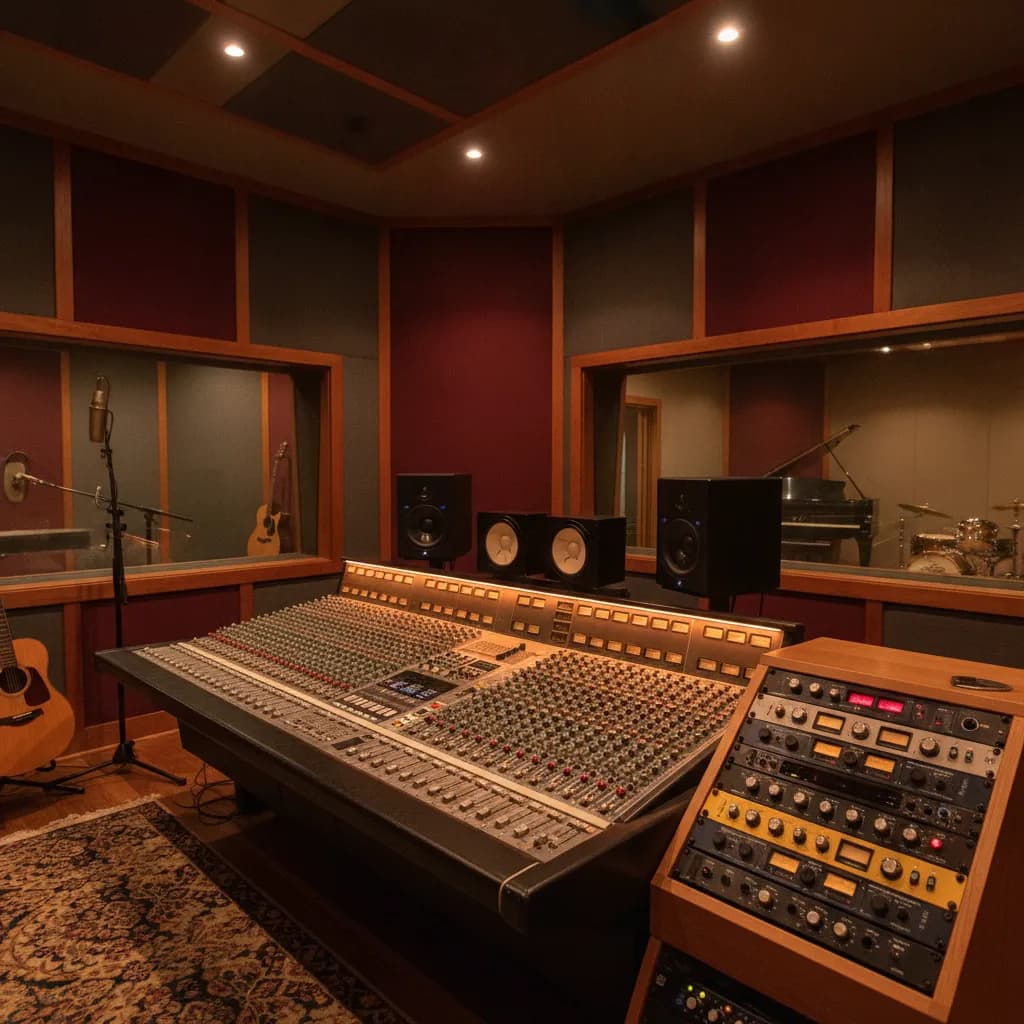
There are two rooms. The Rainforest Room is tuned for vocals, voiceover, and podcast recording — it starts from $200 per 2-hour block and is where you want to be if you're a singer-songwriter, a voice actor, or a podcaster who needs clean, professional audio without the cost of a large tracking facility. The Rock Room is built for bands and full-kit tracking, with a baby grand piano and a full drum kit already in the room, mic'd and ready — starting from $250 per 2-hour block. Both rooms include a Manley Reference microphone, a Tube-Tech CL 1B compressor, API preamps, and Focal Twin6 monitors.
The thing that separates Paradise from most of the options available to Glendale artists: an in-house engineer is included in every single session. You are never left alone with the gear. That matters enormously if you're new to studio recording, if you're tracking a full band and need someone managing the console while you perform, or if you simply want to focus on the music instead of the technical decisions. Pricing is posted on the website — no back-and-forth emails to get a number. The studio is open 9am–2am daily, which means early-morning sessions before Glendale traffic builds, or late-night creative windows after the 10 freeway clears out. Membership options exist for artists who record regularly, and mixing and mastering services are available if you need the full chain handled in one place.
For Glendale artists, the honest pitch is this: the drive earns its keep when the recording has to sound finished. For a quick reference demo or a scratch vocal, staying local may be right. For a release-ready track, an EP, a podcast you're proud to publish, or a band session where the drum sound actually matters — book the session and make the drive.
2. Silent Zoo Studios — Glendale
Silent Zoo Studios is a single-room recording facility at 736 Salem Street in Glendale, catering to bands, artists, film and television scores, and other sound recording needs, with top-tier equipment and comprehensive backline options. It's one of the few genuinely local options in Glendale proper.
Best for: Glendale-based bands and composers who want to stay in the neighborhood. Why it fits: Local access, no cross-town drive, and a focus on full-band and scoring work. What to ask: Current hourly rates, whether an engineer is included or billed separately, and minimum booking requirements.
3. ES Audio Recording Studios — Glendale area
ES Audio is a well-reviewed independent studio operating in the Glendale/Burbank corridor. Reviewers describe the engineers as "phenomenal," note that the facility has housed major talent, and call the equipment "state-of-the-art."
Best for: Independent artists and producers who want a local option with professional gear. Why it fits: Strong community reputation and accessible location for Glendale residents. What to ask: Whether engineering is included, current session minimums, and availability for same-week bookings.
4. Oak House Recording — Glendale area
Oak House Recording is a boutique independent room that turns up consistently in Glendale-area searches. Reviewers note that Oak House has "all of the right elements including a big room for more live" recording work.
Best for: Artists who want a live-room feel at an independent studio without driving to Hollywood. Why it fits: Boutique scale, local access, and a live-room orientation. What to ask: Rates with and without an engineer, availability, and what backline gear is in the room.
5. Sunset Sound — Hollywood
Sunset Sound is one of the most historically significant recording facilities in Los Angeles, with a track record spanning decades of rock, pop, and R&B records. It's a legitimate institution.
Best for: Artists who want a storied room with deep gear history and a large-format console. Why it fits: Studios like Sunset Sound are legitimate institutions with iconic gear and history, and their rates reflect that — you're looking at $75–$200+/hr at those rooms, often with minimum booking requirements and weeks of lead time. What to ask: Current room availability, minimum session length, and whether a staff engineer is included or hired separately.
6. East West Studios — Hollywood
East West Studios occupies a historic Hollywood building with multiple rooms ranging from intimate vocal booths to large orchestral stages. It's a go-to for film scoring, large ensemble recording, and artists who need serious acoustic real estate.
Best for: Large-format sessions, orchestral tracking, or projects that require a genuinely big room. Why it fits: Multiple room configurations, legendary acoustic design, and a location that's closer to Glendale than the Westside. What to ask: Which room fits your project size, current daily and hourly rates, and lead time for booking.
7. EastSide Sound — Echo Park
EastSide Sound is a respected independent room in the Echo Park/Silver Lake corridor — geographically closer to Glendale than most Westside studios, and with a reputation for indie, alternative, and left-of-center projects.
Best for: Indie bands and singer-songwriters who want a creative, non-corporate room without crossing the 405. Why it fits: Closer drive from Glendale than Santa Monica, with a strong independent reputation. What to ask: Current rates, room configuration, and what's included in the session rate.
8. Studio City Sound — Studio City
Studio City Sound is a full-service studio in the Valley with a reputation for world-class session work. Reviewers describe it as having "integrity" and being "first-class," with "world-class equipment, top notch staff and session musicians."
Best for: Artists who want access to professional session players alongside their tracking session. Why it fits: Valley location is convenient from Glendale, and the facility is built for serious commercial work. What to ask: Whether session musicians are available to book, current room rates, and minimum session length.
9. Glenwood Place Recording Studios — Burbank
Glenwood Place Recording Studios is a multi-room facility in Burbank, just a short drive from Glendale. It caters to a broad range of project types and budgets.
Best for: Mid-budget projects where the Burbank/Glendale commute is the priority over Westside access. Why it fits: Geographic proximity to Glendale and a range of room options. What to ask: Current rates per room, what gear is available, and whether engineering is included or separate.
10. Village Studios — West LA
Village Studios (formerly Village Recorder) is a major tracking facility in West LA with a long history of major-label records. It's a significant drive from Glendale but worth mentioning for artists budgeting a serious album project.
Best for: Full-production albums with major-label-grade tracking requirements and a large budget. Why it fits: Legendary rooms, serious gear, and a pedigree that spans genres. What to ask: Current availability, day rates vs. hourly rates, and whether the project scope justifies the cost.
This ranking reflects Paradise Recording's editorial opinion only and is not paid placement. Verify all rates, hours, and availability directly with each studio before booking.
What makes a great LA recording studio (and how to choose)
The gear chain matters — but not in the way most people think
New artists often fixate on the console name or the DAW. What actually matters is the signal chain from microphone to converters: the mic, the preamp, and the monitoring environment. A Manley Reference microphone through API preamps into Focal Twin6 monitors is a genuinely professional chain that will reveal what your performance actually sounds like — and that's the point. Studio quality, engineer experience, preparation, and workflow efficiency all affect the final investment — and a cheaper room with a weaker chain can cost you more in mixing time later.
Room acoustics are not negotiable
A room that sounds bad will make everything you record in it sound bad, regardless of how good your microphone is. Purpose-built rooms — with proper bass trapping, diffusion, and isolation — are the reason professional studios exist. When evaluating a local Glendale option, ask specifically whether the room was acoustically designed or simply treated after the fact. There's a meaningful difference.
The engineer is half the session
Rates usually include a staff engineer at mid-range studios, though some studios charge separately for engineering. At Paradise Recording, the engineer is always included — you never pay a room rate and then discover engineering is an add-on. For Glendale artists evaluating local options, this is the most important question to ask before you book: is the engineer included, or is that a separate line item?
If you want to understand more about what an engineer actually does during your session, see our guide on what a recording engineer does.
Hourly vs. lockout/day rate
The hourly model is the most common for mid-range studios and commercial facilities — you pay for each hour you use the studio, typically with a minimum booking requirement of two to four hours. A lockout or day rate gives you exclusive use of the room for a full day, usually at a discount per hour compared to the hourly rate. For a single vocal session or a podcast episode, hourly is almost always the right call. For a full band tracking a five-song EP over two days, a day rate or block booking will save you money. See our full breakdown at recording studio lockout day rate meaning.
Location and parking — especially from Glendale
From Glendale, the I-5 south to the I-10 west is the most direct route to Santa Monica. Off-peak, that's a 30–35 minute drive. During weekday rush hours — roughly 7–9am westbound and 4–7pm eastbound on the 10 — budget 50–70 minutes and plan accordingly. The 2 Freeway to the 101 to the 10 is an alternative that avoids the downtown interchange, and can be faster depending on where in Glendale you're starting. Santa Monica's downtown parking structures on 4th and 5th Streets are the practical option and start with free hours, so a short session often costs nothing to park.
Vibe and comfort
You will spend hours in this room. The studio should feel comfortable, not clinical. Ask whether you can bring guests, whether there's a lounge or waiting area for bandmates, and what the vibe is like. A good studio engineer will put you at ease — that directly affects the quality of your performance.
What recording studios cost in LA
Recording at an LA studio in 2026 can cost anywhere from $50 to over $300 per hour, and that range is genuinely that wide because it spans everything from a bedroom producer renting their home setup to a legendary Hollywood facility with a vintage Neve console and a full-time staff.
Studio time in Los Angeles typically ranges from $35–$150 per hour, depending on the studio, equipment, and whether an engineer is included. The "whether an engineer is included" part is where many artists get surprised. Some studios post a room rate that looks affordable, then add engineer time on top — the main cost factors are session length (hourly vs. extended blocks) and whether you require a sound engineer. Always ask what's included before you compare prices.
At Paradise Recording, the starting prices are straightforward and posted: the Rainforest Room starts from $200 per 2-hour block, and the Rock Room starts from $250 per 2-hour block — both with an in-house engineer included. There are no hidden add-ons for engineering. For context on how that compares across the broader LA market, see our guide on how much it costs to record a song in Los Angeles.
Recording studios in Los Angeles generally operate on one of three pricing structures, and understanding which model aligns with your needs is the single most important factor in getting good value for your recording budget: hourly booking, day/lockout rates, and membership. If you record regularly — more than once a month — a membership can change the math significantly.
For a full breakdown of mixing and mastering costs on top of your session, see mixing and mastering services: what they cost in 2026.
Which room or setup is right for you
Vocals, voiceover, and podcasts → Rainforest Room
If you're a singer-songwriter tracking a demo, a voice actor doing a commercial session, or a podcaster who wants broadcast-quality audio, the Rainforest Room at Paradise Recording is the right fit. It's purpose-built for exactly this use case: a quiet, acoustically treated vocal environment with a Manley Reference microphone, API preamps, and an engineer who knows how to get a clean, professional vocal take. Glendale has a significant voice-acting and podcasting community given its proximity to Burbank's entertainment industry — this room is built for that work. For more on podcast studio options across LA, see where to record a podcast in Los Angeles.
Full bands and drum tracking → Rock Room
If you're a band that needs to track drums, the Rock Room is the answer. A full drum kit is already in the room, already tuned and mic'd. There's a baby grand piano. The room is designed for the volume and bleed management that live band tracking requires. For Glendale bands — especially the active rock, metal, and indie scenes that use the Valley's rehearsal spaces — this is where a demo becomes a record. For more on what full-band tracking looks like, see our guide on band recording studio Los Angeles.
Quick demo vs. release-ready recording
Be honest with yourself about what the project actually needs. If you're capturing a song idea to send to a collaborator or check an arrangement, a home setup or a budget local room may be entirely appropriate. If the recording is going on streaming platforms, into a pitch, or represents you professionally — that's when the drive to a room with real gear, real acoustics, and a real engineer earns its keep. Our guide on home studio vs. professional recording studio lays out the tradeoffs clearly.
Multi-session projects
For an EP or album, think in blocks rather than individual sessions. Book the same room across multiple dates, come in prepared (charts, demos, tuned instruments), and use the engineer's expertise to build consistency across the project. If you're planning more than four or five sessions, ask about membership options — the economics can shift meaningfully.
The Glendale music scene: what's actually here
Glendale's creative community is real and active, even if the professional recording infrastructure hasn't fully caught up with it. Brand Boulevard and the surrounding streets support a genuine arts scene. The Alex Theatre at 216 North Brand Boulevard has served as a landmark cultural anchor since 1925, seating 1,400 and known for its distinctive 100-foot neon tower. It continues to host concerts, theatrical productions, film screenings, television tapings, and special events, drawing audiences from across Southern California.
The Americana at Brand in Glendale is a one-of-a-kind destination offering a remarkable blend of shopping, restaurants, activities, movies, and entertainment, and it functions as a genuine public gathering space — the kind of place where musicians perform and audiences form. Talented musicians perform live there every Friday, Saturday, and Sunday.
The Glendale Galleria, the Armenian cultural community centered around Central Avenue, and the proximity to Burbank's entertainment industry all contribute to a city that has more working musicians and audio professionals per square mile than its recording-studio count would suggest. The gap isn't talent — it's infrastructure. Recording studios in the Glendale area average around $133 per hour to rent on booking platforms, but that figure reflects a mix of podcast studios, project spaces, and event rooms rather than a deep roster of professional tracking facilities.
The practical reality: if you need a rehearsal room, a podcast space, or a project studio to sketch ideas, you can find something local. If you need a room where the drum sound is right on the first take, the vocal chain is genuinely professional, and an experienced engineer is managing the session — that's when the drive west makes sense.
Making the drive: Glendale to Santa Monica
The driving distance from Glendale to Santa Monica is approximately 24 miles by car, following the I-10 route. The most common path is I-5 south from central or north Glendale, merging onto the I-10 west toward Santa Monica. Alternatively, the 2 Freeway south through Eagle Rock connects to the 101 and then the 10, which can be faster depending on your starting point in Glendale.
Off-peak — before 7am, after 7pm on weekdays, or on weekend mornings — the drive is roughly 32 minutes non-stop. In rush hour, the I-10 westbound can back up significantly between downtown LA and the 405 interchange; budget 50–70 minutes for a morning session during peak commute hours. The practical solution: schedule your session for 10am or later on weekdays, or take a weekend morning slot. By the time you arrive, the 10 is moving, parking in the 4th Street structure is easy, and you're walking into the studio relaxed rather than frazzled.
Parking at Paradise Recording is straightforward: Santa Monica's downtown public parking structures on 4th and 5th Streets are the practical option and start with free hours, so a short session often costs nothing to park. The Metro E Line's Downtown Santa Monica terminus at 4th & Colorado is about a five-minute walk from the studio door — a legitimate option for Glendale artists who'd rather avoid the 10 entirely, though the transit route from Glendale requires a transfer at Union Station.
Frequently asked questions
How much does a recording studio cost in Glendale or LA in 2026?
Recording at an LA studio in 2026 can cost anywhere from $50 to over $300 per hour, depending on the room, gear, and whether an engineer is included. Glendale-area studios and project spaces tend to sit in the lower-to-mid range of that spectrum. Full-service professional rooms with in-house engineers and purpose-built acoustics — like Paradise Recording in Santa Monica — start from $200 per 2-hour block (Rainforest Room) or $250 per 2-hour block (Rock Room), with the engineer included. For a detailed breakdown, see how much does a recording studio cost in Los Angeles.
Do recording studios in Glendale include an engineer?
Not always, and this is one of the most important questions to ask before you book anywhere. Rates usually include a staff engineer at mid-range studios, though some studios charge separately for engineering. At Paradise Recording, an in-house engineer is included in every session — no add-ons, no surprises. For more on this, see do recording studios provide an engineer?
What's the difference between hourly booking and a day rate?
Hourly booking means you pay for the hours you use, typically with a two- to four-hour minimum. A day rate or lockout rate gives you exclusive use of the room for a full day, usually at a lower effective hourly cost. For a single vocal session, hourly is almost always right. For a full band tracking an EP, a day rate often makes more financial sense. See recording studio lockout day rate meaning for a full explanation.
What's the best studio in Glendale for recording vocals?
Glendale's local options are limited for dedicated vocal recording. The most reliable option for Glendale vocalists who need a genuinely professional result is making the drive to Paradise Recording's Rainforest Room in Santa Monica — purpose-built for vocal tracking with a Manley Reference microphone, API preamps, and an included engineer. For a broader look at vocal recording options across LA, see where to record vocals in Los Angeles.
What's the best studio near Glendale for a full band?
For full-band tracking with a live drum kit, the Rock Room at Paradise Recording is the answer for Glendale bands willing to make the drive. It comes with a full drum kit already in the room, a baby grand piano, and an in-house engineer — everything a band needs to track without spending the first hour setting up gear. Locally, Silent Zoo Studios on Salem Street in Glendale is the most credible option for staying in the neighborhood.
How far is it from Glendale to Paradise Recording in Santa Monica?
The driving distance from Glendale to Santa Monica is approximately 24 miles by car, following the I-10 route. Off-peak, that's roughly 30–35 minutes. During rush hour on the I-10, budget 50–70 minutes. The practical solution is to schedule sessions outside peak commute windows — a 10am start on a weekday or a weekend morning slot typically means a smooth drive and easy parking.
Can I record a podcast at a studio near Glendale?
Yes — the Glendale Podcast Studio is a local option for podcast-specific recording. For a more fully equipped session with a professional engineer included, Paradise Recording's Rainforest Room in Santa Monica handles podcast recording as a core use case, with clean acoustics and broadcast-quality gear. See podcast studio rental cost Los Angeles 2026 for pricing context.
How far in advance should I book a studio session?
Same-day booking is genuinely rare at professional studios in LA — most rooms require 24 to 48 hours notice. For weekend sessions, especially Saturdays, book at least a week ahead. For multi-day projects or specific holiday windows, two to three weeks is safer. See how far in advance should you book a recording studio? for more.
What should I bring to my recording session?
Tuned instruments, prepared charts or lyrics, any reference tracks you want the engineer to hear, and a good night's sleep. The studio clock starts when you walk in — preparation is the single biggest variable in how much you accomplish per hour. See our full checklist at what to bring to a recording studio session.
Final verdict
Glendale is a musically active city with a genuine creative community — the Alex Theatre has served as a cultural anchor for the region since 1925 — but its professional recording infrastructure doesn't yet match the talent density. The honest picture is that local options skew toward rehearsal, podcast-specific spaces, and project studios. For a quick demo or a scratch vocal, those may serve you fine.
For recording that has to sound finished — a release, a pitch, a podcast you're publishing, a band session where the drum sound matters — Paradise Recording in Santa Monica earns its place at the top of this list. Two purpose-built rooms, an in-house engineer included in every session, transparent posted pricing, and gear that's genuinely professional. The drive from Glendale is real, but it's manageable, and it's worth it when the work demands it.
Next steps
- Book a session at Paradise Recording
- Explore both studio rooms
- Learn about the Rainforest Room (vocals, voiceover, podcast)
- Learn about the Rock Room (bands, drums, piano)
- View membership options for regular recording
- Mixing and mastering services
- Best Recording Studios in Los Angeles (2026)
- Best Recording Studios in Hollywood (2026)
- How much does a recording studio cost in Los Angeles?