
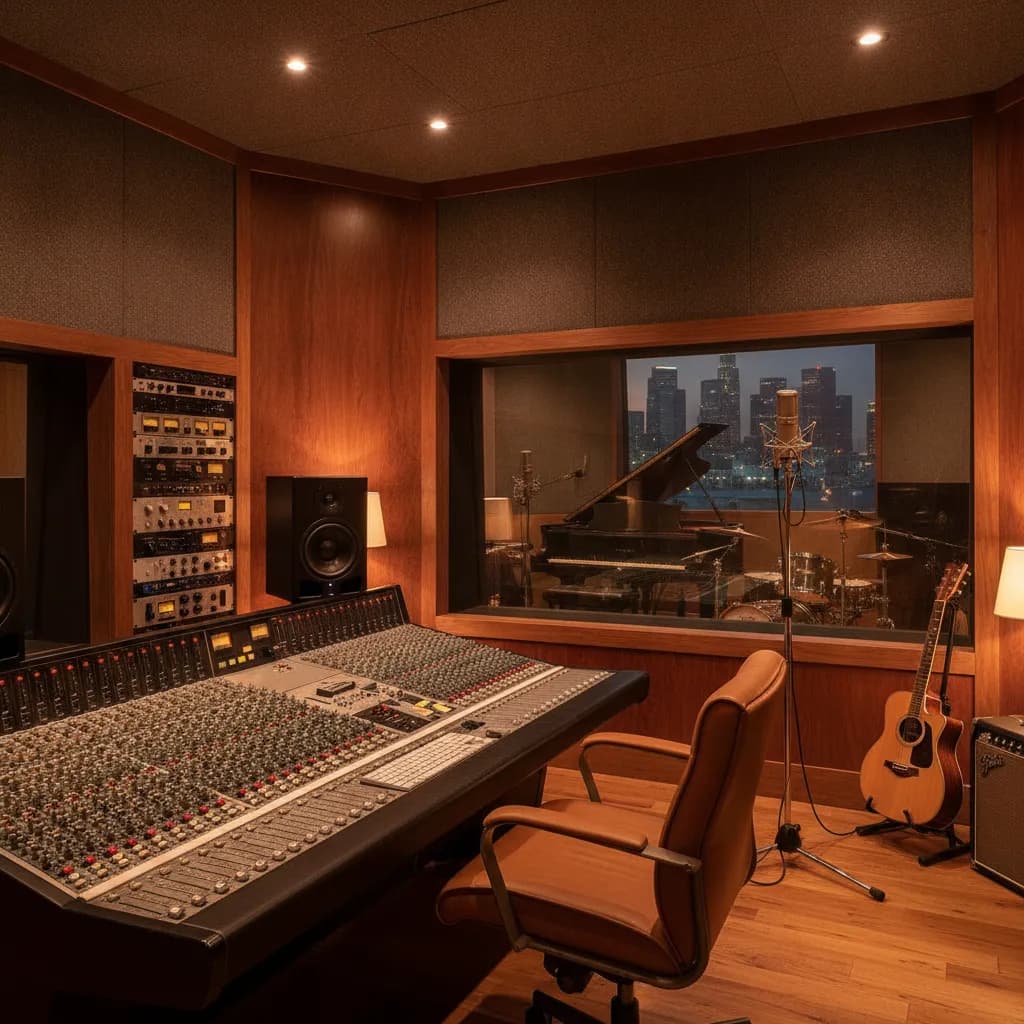
Downtown Los Angeles is one of the most musically charged square miles in the country. On Grand Avenue, Walt Disney Concert Hall seats over 2,200 people and is home to the Los Angeles Philharmonic and the Los Angeles Master Chorale. Several of LA's cultural crown jewels sit within a three-block stretch of Grand Avenue, including the Dorothy Chandler Pavilion, The Broad, MOCA, and Grand Park. A few blocks east, Little Tokyo was declared a National Historic Landmark District in 1995. And south of the 101, the Arts District — a former industrial corridor bounded roughly by the LA River, 1st Street, Alameda, and 7th — has become a genuine creative hub. Musicians live and work in the Arts District, and for years artists found practice spaces in the warehouses here. Broadway's historic theatre corridor, Spring Street's finance-district lofts, and Little Tokyo's Japanese American Cultural and Community Center round out a neighbourhood that thinks seriously about art, sound, and performance.
What DTLA is less flush with is professional, dedicated recording studios. The neighbourhood has rehearsal rooms, multi-use creative spaces, and project-studio lofts — and a handful of boutique rooms have set up shop in the Arts District — but it does not have the density of full-service tracking facilities you find in Hollywood or on the Westside. That is not a slight; it is just the honest lay of the land, and it matters when you are planning a session. This guide covers what genuinely exists in and near Downtown LA, when staying local makes sense, and when making the drive to Santa Monica pays off in sound quality, gear, and the value of an included engineer.
Whether you are a rapper tracking vocals near Skid Row, a band rehearsing in a warehouse off Traction Avenue, a podcaster working out of the Historic Core, or a film composer scoring near the Music Center, read this before you book. You will finish knowing more about your own neighbourhood's recording options than most of the people working in it.
Quick takeaways
- The Arts District has creative energy but limited professional tracking rooms. Rehearsal spaces and project studios exist; full-service rooms with a dedicated engineer and calibrated acoustics are thin on the ground. Verify any DTLA room carefully before you book.
- Transparent pricing is rarer than it should be. Recording studios in Los Angeles generally operate on one of three pricing structures, and understanding which model aligns with your needs is the single most important factor in getting good value for your recording budget. Always ask for a full rate sheet before committing.
- "With an engineer" changes everything. Some LA studios charge the room rate plus a separate engineer fee; others include an engineer in a single posted price. Know which you are booking. At Paradise Recording in Santa Monica, an in-house engineer is included in every session — no add-on fee, no guesswork.
- Typical LA hourly rates span a wide range. Recording a song at an LA recording studio in 2026 can cost anywhere from $50 to over $300 per hour. Budget rooms, project studios, and overnight slots sit at the low end; rooms like Paramount Recording and EastWest Studios command $75–$200+/hr, often with minimum booking requirements and weeks of lead time.
- The drive from DTLA to Santa Monica is real but manageable. Off-peak on the I-10 West, you can be at the studio in 20–25 minutes. Budget 45–60 minutes during morning or evening rush. The Metro E Line runs directly from Downtown LA to the 4th & Colorado terminus, a five-minute walk from Paradise Recording's door.
- Book what the session actually needs. For a quick demo or a scratch vocal, staying local may be the right call. For tracking that has to sound finished — a full band, a polished vocal, a podcast that needs to compete with national shows — the gear and the room matter, and the drive earns its keep.
The 10 best recording studios in Downtown Los Angeles (2026)
At-a-glance ranking
- Paradise Recording — Best for: vocals, bands, podcasts, and voiceover; transparent pricing + included engineer
- EastWest Studios — Best for: major-label tracking, film scoring, orchestral sessions
- Capitol Studios — Best for: prestige sessions, live orchestral recording, historic rooms
- Sunset Sound — Best for: rock, indie, and singer-songwriter tracking in a legendary room
- United Recording Studios — Best for: large-format sessions with vintage console pedigree
- Henson Recording Studios — Best for: full-band live tracking in a storied Hollywood complex
- NRG Recording Studios — Best for: hip-hop, pop, and R&B production in North Hollywood
- The Village Studios — Best for: West LA artists wanting a classic-rock-era room with modern upgrades
- Neon Sound — Best for: budget-conscious artists who want a dedicated Arts District room
- Rock Star Studios — Best for: rehearsal-to-recording workflow in the Arts District
Disclaimer: This ranking reflects Paradise Recording's own editorial opinion and is not paid placement. Verify each studio's current rates, availability, and engineer policies directly before booking.
#1 — Paradise Recording · Santa Monica (recommended for Downtown LA artists)
Paradise Recording is a boutique studio at 1505 4th St, Suite 219, Santa Monica — about 15 miles west of Downtown LA, open 9am–2am daily. It ranks first for this area not because it is the biggest room in Los Angeles (it is not), but because it solves the three problems DTLA artists run into most often: opaque pricing, no engineer included, and rooms that were not purpose-built for the task.
Two dedicated rooms cover the full range of what most independent artists need. The Rainforest Room is purpose-tuned for vocals, voiceover, and podcast recording — starting from $200 per 2-hour block. The Rock Room is built for full-band tracking, with a baby grand piano and a full drum kit that is pre-tuned and pre-mic'd before you walk in — starting from $250 per 2-hour block. Every session in either room includes an in-house engineer; you are never left alone with the gear, and you never pay a separate engineer surcharge on top of the room rate.
The gear list is honest and specific: a Manley Reference microphone, a Tube-Tech CL 1B compressor, API preamps, and Focal Twin6 monitors. That is a signal chain most project studios in the Arts District cannot match. Pricing is posted publicly — no email back-and-forth to get a number. Mixing and mastering options are available at /mix-master, and a membership program at /membership suits artists who record regularly. Book a session here.
#2 — EastWest Studios · Hollywood
EastWest Studios is located at 6000 West Sunset Boulevard in Hollywood. The studios have given rise to some of the most celebrated music of the last sixty years, from Frank Sinatra to The Rolling Stones, and have produced more Grammy-winning albums than any other studio in the world.
Best for: Major-label tracking, film scoring, and sessions that require a very large live room. Why it fits: The rooms have genuine acoustic pedigree and the gear list is exceptional. What to ask: Minimum booking requirements, whether an engineer is included or billed separately, and current day-rate structures — these rooms are not budget-friendly and lead times can be significant.
#3 — Capitol Studios · Hollywood
No existing recording studio in Hollywood is more famous than Capitol Studios in the distinctive, circular Capitol Records tower, now a historic city landmark. The studio launched in 1956 and has witnessed sessions from Frank Sinatra, Dean Martin, Peggy Lee, Lou Rawls, and the Beach Boys, among many others.
Best for: Prestige sessions, orchestral recording, and projects where the room's provenance matters to the artist or label. Why it fits: The acoustics and equipment are world-class; the address carries genuine weight. What to ask: Current availability (the rooms book out significantly in advance), engineer inclusion, and whether your project's scale matches the facility's typical session size.
#4 — Sunset Sound · Hollywood
Sunset Sound Recorders is a recording studio in Hollywood, California, located at 6650 West Sunset Boulevard. Sunset Sound has been a favorite of rock legends since the 1960s.
Best for: Rock, indie, and singer-songwriter projects that want a room with deep musical history and a warm, analogue-leaning sound. Why it fits: Multiple rooms at different price points give artists more flexibility than a single large-format facility. What to ask: Which room suits your project, current hourly vs. lockout rates, and whether house engineers are available on your preferred dates.
#5 — United Recording Studios · Hollywood
United Recording Studios is among the most historic studio locations in Hollywood, cited by music preservation professionals for its deep catalogue. The buildings produced famous recordings by The Beach Boys, Beyoncé, Prince, Frank Sinatra, U2, and other major acts.
Best for: Large-format sessions, vintage console work, and projects that benefit from the Sunset Boulevard studio corridor's engineering community. Why it fits: The rooms are large enough for live band tracking and have a pedigree that attracts experienced session engineers. What to ask: Current room availability, engineer rates, and minimum session lengths.
#6 — Henson Recording Studios · Hollywood
The front gates at Henson Recording Studios, at 1416 N. La Brea Ave., are hard to miss. Artists say that when the gates open, they immediately feel removed from Hollywood and in a different location — no other facility has that feel.
Best for: Full-band live tracking, film and TV scoring, and artists who want a campus-style facility with multiple rooms. Why it fits: The compound layout and room variety suit multi-day projects and larger productions. What to ask: Which room fits your band size and budget, and whether the studio's in-house engineers are available on your dates.
#7 — NRG Recording Studios · North Hollywood
NRG is located in North Hollywood, a neighborhood in the San Fernando Valley region of Los Angeles. It is a well-regarded mid-to-large facility with a strong track record in hip-hop, pop, and R&B production.
Best for: Urban and contemporary production, artists working with producers who are already familiar with the room. Why it fits: North Hollywood's studio density means engineering talent and session musicians are nearby. What to ask: Current room rates, engineer availability, and parking — the Valley can be a significant drive from Downtown LA, especially in afternoon traffic.
#8 — The Village Studios · West Los Angeles
The Village Studios has been a mainstay in the Los Angeles music scene since the 1960s and has hosted iconic recording sessions, including Fleetwood Mac's Rumours and Bob Dylan's Blood on the Tracks.
Best for: Artists who want a classic-era room with modern upgrades, particularly for live-band tracking or piano-centred sessions. Why it fits: The rooms are large, well-maintained, and carry genuine acoustic character. What to ask: Current rates, engineer inclusion, and whether the room's scale matches your project — this is not a budget facility.
#9 — Neon Sound · Arts District, Downtown LA
Neon Sound is a recording studio in the Arts District / Downtown LA. It is one of the few dedicated recording rooms that actually sits inside the DTLA footprint, making it a practical option for artists who want to stay local.
Best for: Budget-conscious artists who want a proper recording room without leaving the neighbourhood. Why it fits: The Arts District location is walkable for many DTLA residents, and the studio focuses on music recording and production. What to ask: What engineer support is included, what the signal chain looks like, and what the minimum booking is — verify current rates directly with the studio.
#10 — Rock Star Studios · Arts District, Downtown LA
Rock Star Studios is among the recording and rehearsal studios in the Arts District, Los Angeles. It serves artists who want to move from rehearsal to recording without switching buildings.
Best for: Bands who want to rehearse and track in the same neighbourhood, and artists who need affordable block time close to DTLA. Why it fits: The Arts District location and rehearsal-room infrastructure make it practical for bands that live and work in the eastern part of the city. What to ask: Whether the recording setup is fully professional or more of a project-studio level, what engineer support is available, and current rates.
This ranking is Paradise Recording's own editorial opinion, not paid placement. Always verify each studio's current rates, room availability, and engineer policies before booking.
What makes a great LA recording studio (and how to choose)
Gear that matches your project
The microphone, preamp, and monitor chain determine how your recording sounds before any mixing happens. A Manley Reference mic into API preamps and Focal monitors is a meaningfully different starting point than a budget condenser into a USB interface. Ask any studio for a specific gear list — not a category list ("professional microphones") but actual model names. If they will not tell you, that tells you something.
Room acoustics: the invisible ingredient
A well-designed vocal booth eliminates the room from the equation. A purpose-built live room shapes the sound of a drum kit before the engineer touches a fader. Multi-use loft spaces and converted warehouses — common in the Arts District — can sound great for some applications and problematic for others. Ask whether the room was acoustically designed or acoustically treated after the fact, and ideally listen to a reference recording made in that room.
The engineer: your most important collaborator
Rates usually include a staff engineer, though some studios charge separately for engineering. That distinction can add $50–$100+ per hour to your effective cost at studios where the room and the engineer are billed separately. Beyond cost, the engineer's experience with your genre matters. Ask who will be running your session, whether that person is a staff engineer or a freelancer, and whether you can hear examples of their work.
Hourly vs. lockout/day rates
The most common model for mid-range studios is hourly billing, typically with a minimum booking requirement of two to four hours. The advantage of hourly billing is flexibility: you only pay for what you use, and you can book short sessions for specific tasks like vocal overdubs or quick mix revisions. A lockout or day rate reserves the entire facility for a full day — useful for bands tracking live, or for projects where you need to leave gear set up between sessions. See our guide on what a lockout day rate means for a full breakdown.
Location, parking, and load-in
For DTLA artists, this is not a trivial consideration. If you are carrying a guitar, a laptop, and a bag of cables, most studios are manageable. If you are moving a full band's backline, the logistics of parking, loading docks, and elevator access matter enormously. Ask specifically: where does gear go in, is there a freight elevator, and where do bandmates park?
Vibe and comfort
A session that runs four to six hours is a long time to be uncomfortable. Good studios have a lounge or waiting area, reliable Wi-Fi, and a control room that does not feel like a server closet. These are not luxuries — they affect whether you make good creative decisions at hour five.
What recording studios cost in LA
Recording a song at an LA recording studio in 2026 can cost anywhere from $50 to over $300 per hour. Studio time in Los Angeles typically ranges from $35–$150 per hour, depending on the studio, equipment, and whether an engineer is included. The spread is that wide because the market is that fragmented — a project studio in a converted Arts District loft and a major Hollywood facility with a vintage Neve console are both called "recording studios," but they are not the same product.
What "with an engineer" actually means: At some studios, the hourly rate covers the room only; engineering time is a separate line item, often $50–$100+ per hour on top of the room rate. At others — including Paradise Recording — an in-house engineer is included in every posted session price. When you are comparing rates, always confirm whether the number you are seeing includes engineering or not. The all-in cost can look very different from the headline rate.
Hourly vs. lockout/day rates: Hourly booking suits single artists, vocal sessions, podcast recordings, and short overdub sessions where you know roughly how long you need. A lockout or day rate reserves the studio for an extended block — typically eight to twelve hours — and usually works out to a lower effective hourly cost for bands tracking live or for multi-song projects. Minimum booking requirements are typically two to four hours for hourly sessions.
At Paradise Recording, posted starting rates are transparent: the Rainforest Room starts from $200 per 2-hour block (vocals, voiceover, podcast), and the Rock Room starts from $250 per 2-hour block (full band, drum tracking, piano sessions). Both rates include an in-house engineer. There are no hidden add-on fees to discover after you book. For a full breakdown of what drives the total bill, see our guide on how much it costs to record a song in Los Angeles.
Which room or setup is right for you
You are a solo vocalist, rapper, or voiceover artist
You need a quiet, well-treated booth, a high-quality microphone, and an engineer who knows how to get a performance out of a single artist. You do not need a live room or a drum kit. The Rainforest Room at Paradise Recording was built exactly for this use case. For DTLA-based artists, this is also the session type where the drive to Santa Monica is easiest to justify: the gear difference between a purpose-built vocal room and a treated loft is audible on every take.
If you are recording vocals specifically, see our dedicated guide on where to record vocals in Los Angeles. For rap vocals in particular, we cover the specific signal chain and room considerations in our guide on the best recording studio for rap vocals in Los Angeles.
You are a band tracking live
This is where the scarcity of purpose-built rooms in DTLA is most acute. A full drum kit needs a live room with real acoustic treatment, a pre-tuned and pre-mic'd kit, and enough space to separate instruments. The Rock Room at Paradise Recording has all of that — baby grand piano, full drum kit, and an engineer who sets the room up before you arrive. For DTLA bands, the drive is worth it. See our guide on band recording studio options in Los Angeles for more on what to look for.
You are a podcaster or content creator
DTLA has podcast-capable spaces, including multi-use production studios that can handle a two-host setup. That said, if your show needs to sound competitive with professionally produced podcasts, the microphone and room treatment matter. The Rainforest Room handles podcast sessions well, and the included engineer takes the technical load off the host. See our guide on podcast studio rental costs in Los Angeles for pricing context across the market.
You are a singer-songwriter doing a demo
A short session — two to four hours — is often enough for a singer-songwriter to track a polished demo of one or two songs. The Rainforest Room suits acoustic and vocal-forward work; the Rock Room adds the option of live piano. For DTLA artists, this is also the session where staying local might genuinely be the right call for a very rough scratch demo, but where the drive earns its keep if the demo is going to labels, sync supervisors, or streaming platforms. See our guide on singer-songwriter demo recording in Los Angeles for a practical walkthrough.
Making the drive from Downtown LA to Santa Monica
Let's be direct: Paradise Recording is in Santa Monica, not Downtown LA. For a DTLA-based artist, that is a real consideration — and worth thinking through honestly rather than glossing over.
The route
The fastest route is via I-10 West (the Santa Monica Freeway), but local surface streets like Santa Monica Boulevard offer a more scenic, stop-friendly drive. From Downtown LA, you pick up the I-10 West near the 4th Street / 6th Street on-ramps and ride it straight to the 4th Street exit in Santa Monica. The studio is less than a mile from the freeway terminus.
Realistic drive times
Driving time is typically 20–40 minutes without traffic, but can be an hour during peak hours. Avoid 7–10 AM and 4–7 PM on weekdays. If you are booking a morning session, aim for a 10am or later start to clear the worst of the westbound commute. Late-night sessions — Paradise is open until 2am — sidestep traffic entirely; the I-10 at midnight is a different road than the I-10 at 5:30pm.
Going car-free: the Metro E Line
The Metro E Line runs daily from Downtown LA directly to Downtown Santa Monica, with a travel time of approximately 46 minutes. The Downtown Santa Monica terminus is at 4th Street and Colorado — a five-minute walk from the studio door at 1505 4th St, Suite 219. For artists carrying a guitar or a laptop bag, this is a genuinely practical option. For a full band with gear, you will want to drive or arrange a vehicle.
Parking at the studio
Santa Monica's downtown public parking structures on 4th and 5th Streets are the practical option for drivers. They start with free hours, so a shorter session often costs nothing to park — a meaningful difference from the paid structures at most Hollywood studios. Load-in is straightforward from the street-level garage.
Why the drive earns its keep
The honest case for making the trip: a Manley Reference microphone, a Tube-Tech CL 1B compressor, API preamps, and Focal Twin6 monitors are not what you find in most DTLA project studios. Neither is a pre-tuned drum kit in a purpose-built live room, or an in-house engineer included in a transparent posted rate. For a quick scratch demo, staying local may be right. For tracking that has to sound finished, the gear and the room are worth 30–45 minutes on the 10.
Frequently asked questions
How much does a recording studio cost in Downtown LA in 2026?
LA studio rates in 2026 range from $50 to over $300 per hour, and the DTLA market reflects that full spread. Dedicated professional rooms in the Arts District tend to sit in the $50–$150/hr range; major Hollywood facilities command more. Always confirm whether engineering is included in the quoted rate. At Paradise Recording in Santa Monica, the Rainforest Room starts from $200 per 2-hour block and the Rock Room from $250 per 2-hour block, both with an in-house engineer included.
Do recording studios provide an engineer?
It depends on the studio. Rates usually include a staff engineer, though some studios charge separately for engineering. At Paradise Recording, an engineer is included in every session — there is no separate add-on fee. At other studios, you may pay the room rate plus an hourly engineering rate on top. Always clarify this before you book. Our guide on whether recording studios provide an engineer covers what to ask and what to expect.
What is the difference between hourly booking and a lockout/day rate?
Hourly booking means you pay for the hours you use, typically with a two-to-four-hour minimum. A lockout or day rate reserves the entire studio for a full day — usually eight to twelve hours — and typically works out to a lower effective hourly cost. Lockouts make sense for full-band tracking or multi-song projects where you need to leave gear set up. Our guide on what a lockout day rate means explains the structure in detail.
What is the best studio in Downtown LA for recording vocals?
Purpose-built vocal rooms are scarce inside the DTLA footprint. For a session that needs to sound finished, the Rainforest Room at Paradise Recording in Santa Monica is the closest professional vocal room to Downtown LA with a transparent posted rate and an included engineer. The Metro E Line makes the trip car-free if needed. For a full comparison of vocal recording options across LA, see our guide on where to record vocals in Los Angeles.
What is the best studio near Downtown LA for a full band?
Full-band tracking requires a live room with real acoustic treatment, a purpose-built drum kit, and enough space to separate instruments — none of which are common in DTLA's current studio landscape. The Rock Room at Paradise Recording has a pre-tuned drum kit, a baby grand piano, and an in-house engineer, starting from $250 per 2-hour block. For larger productions with orchestral requirements, EastWest Studios or Capitol Studios in Hollywood are the established options, though at significantly higher rates and with longer lead times.
How far in advance should I book a recording studio?
For most independent artists, booking two to seven days in advance is typical for mid-tier studios. Same-day booking is genuinely rare at professional studios in LA — most rooms require 24 to 48 hours' notice. For major Hollywood facilities, lead times of several weeks are common. Our guide on how far in advance to book a recording studio covers the full range.
Is there a recording studio open late near Downtown LA?
Paradise Recording is open 9am–2am daily, which covers late-night sessions for DTLA artists who want to avoid rush-hour traffic on the I-10. The late-night window is also one of the most productive times to record — the city quiets down, phones stop buzzing, and the creative pressure lifts. Our guide on recording studios open late in Los Angeles covers what late-night access actually means at different facilities.
What should I bring to my first recording session?
Beyond your instrument and any charts or lyrics, bring reference tracks (songs that represent the sound you are going for), a charged phone, and a clear sense of what you want to accomplish in the session. Our guide on how to prepare for your first recording session has a full checklist. If it is your first time in a professional studio, our guide on what to expect as a first-time studio client in Los Angeles walks through the whole process.
Final verdict
Downtown Los Angeles is a genuinely exciting place to be a musician in 2026. Bunker Hill is home to Frank Gehry's Walt Disney Concert Hall, a renowned venue for live music and home to the LA Philharmonic. Musicians live and work in the Arts District, and for years artists found practice spaces in its warehouses. The neighbourhood has energy, creative community, and serious performance infrastructure.
What it does not have — yet — is a deep bench of full-service professional recording studios. The rooms that exist in DTLA tend toward the rehearsal-and-project-studio end of the spectrum. For a quick scratch demo or a rough reference recording, staying local is often the right call. For tracking that has to sound finished — a single that is going to streaming platforms, a podcast that needs to compete with national shows, a band recording that a label will actually hear — the gear, the room, and the engineer matter, and the drive to Santa Monica earns its keep.
Paradise Recording ranks first for Downtown LA artists because it solves the three real problems this market presents: it has purpose-built rooms (not converted lofts), it includes an in-house engineer in every posted rate (no surprise add-ons), and its pricing is publicly listed so you can plan a budget before you pick up the phone. It is a boutique studio, not the biggest tracking facility in Los Angeles — but for the vast majority of independent artists, bands, podcasters, and voiceover clients working out of DTLA, it is the most practical, honest, and well-equipped option within a 30-minute drive.
Next steps
- Book a session at Paradise Recording
- Explore both studio rooms
- Learn about the Rainforest Room (vocals, podcast, voiceover)
- Learn about the Rock Room (bands, drums, piano)
- View mixing and mastering services
- Explore membership options
- Read our full LA recording studio guide
- Compare studios across the broader LA market
- Understand what mixing and mastering costs in 2026