
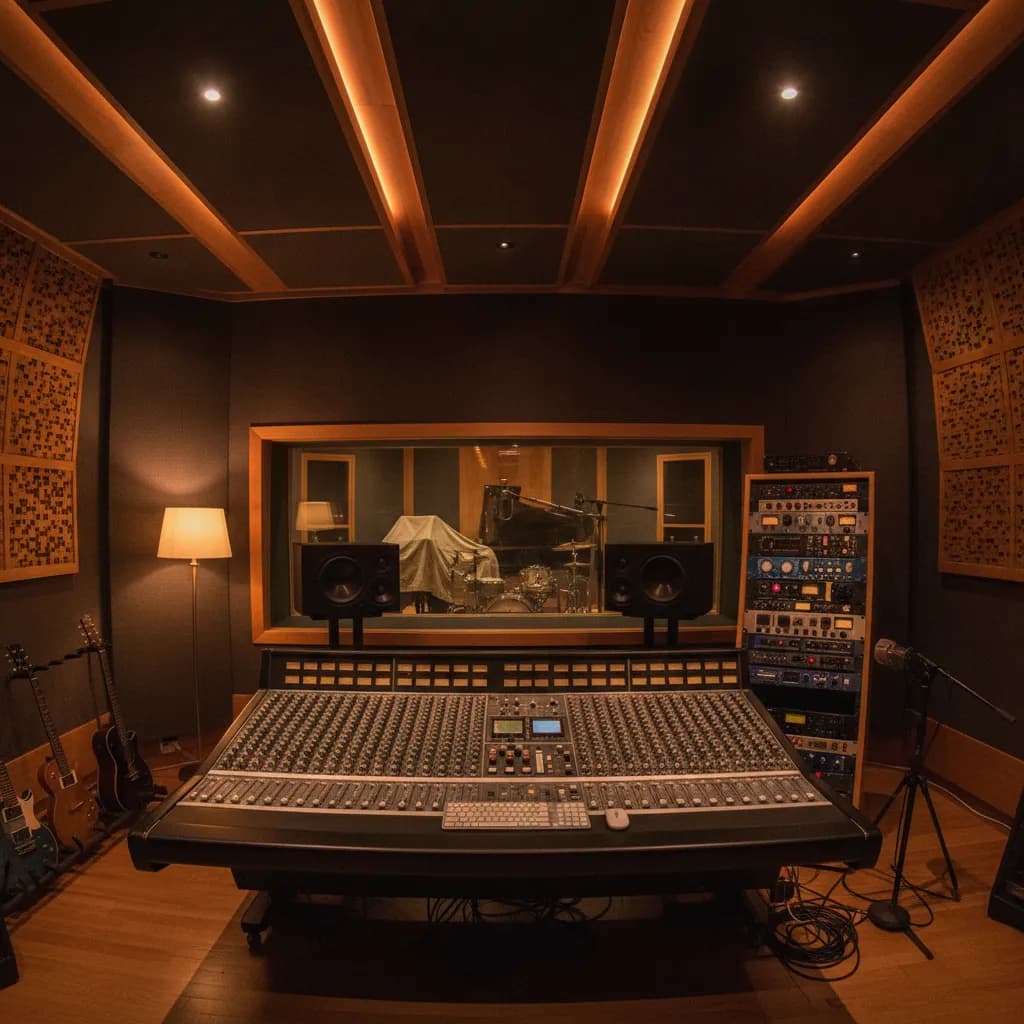
Mixing takes your individual recorded tracks — drums, bass, guitars, vocals, everything — and balances them into a single stereo file. Mastering takes that finished stereo file and gives it the final polish, loudness, and format prep it needs before it hits Spotify, vinyl, or anywhere else. They are sequential, not interchangeable: you cannot master a song that hasn't been mixed, and mastering cannot undo a bad mix.
What mixing actually does
Mixing is the stage where all the individual tracks of a composition come together to form a cohesive whole. A mixing engineer balances individual instruments, adjusts volume levels, shapes the frequency range, and adds effects such as reverb.
It involves blending individual tracks together to create a cohesive whole — adjusting levels, panning instruments within the stereo field, applying EQ and effects, and balancing frequencies to ensure clarity. The goal is for every element to have its own space without stepping on something else.
Lower-tier mixes often include balance, basic EQ, compression, and limited revisions. Higher-tier mixes include detailed automation, creative effects, vocal tuning, mix bus processing, and collaborative feedback rounds.
The output of mixing is a stereo bounce (sometimes called a "two-track") — the file you hand to a mastering engineer.
What mastering actually does
Mastering is the final stage of post-production before a song is released to the public. Mastering uses subtle broad strokes, usually applying changes to a single stereo file.
In practice, a mastering engineer will:
- Balance tone — small EQ moves, often just 1 dB or so, to fix anything that doesn't translate across speakers
- Control dynamics — apply light compression to add cohesion and limiting to ensure the track reaches an industry-standard loudness level without distorting
- Set loudness — use a limiter to bring loudness levels to market standards; a song doesn't have to be the loudest thing around, but it should be within the ballpark of similar music, and mastering engineers often use brickwall limiters to hit these targets without causing too much distortion
- Prepare deliverables — prepare the song for distribution, ensuring the file meets technical requirements for streaming platforms, CDs, or vinyl, including managing peak levels, maintaining dynamic range, and achieving consistent tonal balance
- Sequence albums — for albums or EPs, mastering also involves sequencing tracks, ensuring smooth transitions between songs, and setting appropriate gaps
One thing mastering cannot do: mastering cannot fix a bad mix. It can improve clarity, balance, and translation — but it cannot replace decisions that belong in the session. If the mix has a real problem, the right move is to go back and fix it before mastering begins.
Mixing vs. mastering at a glance
| Stage | Input | Output | Typical LA-market cost* | Typical turnaround |
|---|---|---|---|---|
| Mixing | Multitrack session files (stems) | Stereo WAV/AIFF | $100–$800 per song | 4–7 business days |
| Mastering | Finished stereo mix file | Release-ready masters (all formats) | $40–$200 per song | 2–5 business days |
| Both together | Multitrack session files | Release-ready masters | $230–$900+ per song | 7–14 business days |
| Paradise mix + master | Your session files or stereo mix | Release-ready masters | Contact for quote | Contact for timeline |
*Typical LA-market ranges based on independent mid-tier engineers in 2026. AI mastering services run $5–$40 per track. Grammy-level engineers charge significantly more. Paradise's rates are available at /mix-master.
Together, expect $230–$2,500 to take a single from raw stems to a release-ready master in 2026. Mid-tier engineers with verifiable credits cluster at $400–$800 for mixing and $75–$200 for mastering.
Why separate engineers is usually the right call
One of the key benefits of working with a separate mastering engineer is the fresh set of ears they bring to your project. After hours or even days of working on a mix, mix engineers can become too close to the material, potentially overlooking subtleties or issues that a fresh listener would catch.
Mastering engineers typically work in studios designed for critical listening, equipped with high-end gear and software tailored specifically for mastering tasks. This environment allows them to hear nuances and details that might not be as apparent in a typical mixing setup.
There is also a specialization argument. Mastering and mixing engineers utilize different playback environments, and not every audio engineer is qualified for both processes. A great mix engineer and a great mastering engineer are trained to listen for completely different things.
When one engineer doing both is fine
Honest answer: sometimes it works perfectly well. If you're recording a demo, a podcast episode, a quick single for social media, or a low-stakes release, having your session engineer mix and master in the same workflow saves time and money. Many engineers are genuinely skilled at both.
The caution is ear fatigue and familiarity bias. If you can't be a different pair of ears, you can at least be a fresh pair of ears — save the mastering stage for another day. The longer the gap you can leave between mixing and mastering, the less chance your mastering decisions will be coloured by your memories of mixing.
For anything you're releasing commercially — especially an EP or album — budget for separate engineers. The cost difference is modest; the quality difference can be significant.
How long does each stage take?
A typical timeframe for mixing a single song is around 4–5 business days, and mastering usually takes 2–3 business days. Those are calendar turnarounds, not hands-on hours. The actual hands-on mastering time will usually be 30 minutes to 2 hours, but engineers stack sessions across the day and often need fresh ears between revisions.
Rush fees are common. If you need a 24–48 hour turnaround, expect the price to jump by 1.5× or 2×. If your release date is fixed, build the post-production timeline backwards from it.
Getting the most from both stages
A great recording makes everything downstream easier and cheaper. That starts in the studio. At Paradise, every session in the Rainforest Room (vocals, podcasts, acoustic work) and the Rock Room (full bands, drum kit, baby grand) includes an in-house engineer — someone whose job is to capture the cleanest possible signal so your mix engineer has real material to work with, not a rescue job.
Mastering ensures your music translates across Spotify, club systems, car stereos, and headphones. Evaluate your release strategy, invest heavily in getting the mix right first, and select the mastering tier that directly aligns with your current budget.
If you're still figuring out how much the whole recording-to-release pipeline costs, the guides on how much mixing and mastering costs and how long mixing and mastering takes are good next reads. For a full picture of the LA market, see our honest 2026 guide to recording studio costs in Los Angeles.
Frequently asked questions
Can I skip mastering and just release my mix?
You can, and for internal demos or reference tracks it's fine. For any commercial release, skipping mastering means your track will likely sound quieter and less polished than everything around it on a playlist. Streaming platforms apply loudness normalization, but that is not the same as proper mastering — it won't fix tonal imbalances or prepare format-specific deliverables.
Do I need to send stems to a mastering engineer, or just the stereo mix?
Standard mastering only needs your finished stereo mix — a 24-bit WAV or AIFF with a few dB of headroom (don't peak-limit the mix bus before sending). Stem mastering, where the engineer works with grouped stems like drums, bass, and vocals separately, is a separate service that costs more but gives the mastering engineer more flexibility.
What file format should I export from my mix session before mastering?
Export a 24-bit (or 32-bit float) WAV or AIFF at your session's native sample rate — 44.1 kHz or 48 kHz is standard. Leave 3–6 dB of headroom; do not apply a limiter to the mix bus before bouncing. Your mastering engineer will handle the final loudness and dithering to 16-bit if needed for CD.
Is AI mastering good enough to release professionally?
A human engineer can hear the intent in your song and master it accordingly. AI treats every mix the same way — that works for around 70% of songs, but fails visibly on the other 30%. For demos, social content, and quick singles, AI mastering is a legitimate option. For an album you care about, a human mastering engineer is worth the investment.
Should I book mixing and mastering together or separately?
Booking them as a bundle from the same engineer is usually cheaper — most engineers offer a 10–20% discount if you book the mix and master together. The tradeoff is that you lose the fresh-ears benefit of a separate mastering engineer. For a debut album or a major release, separate engineers are worth the full price.
Does Paradise Recording offer mixing and mastering?
Yes. Visit /mix-master for current rates and turnaround times. If you've already recorded elsewhere and just need post-production, you can send files remotely — you don't need to book studio time.
Next steps
- Book a session
- Explore mixing and mastering services
- See the Rainforest Room — vocals, podcasts, acoustic sessions
- See the Rock Room — full bands, drum kit, baby grand
- How much does mixing and mastering cost? (2026)
- How long does mixing and mastering take?
- Mixing and mastering services: what they cost in 2026
Facts and prices on this page last verified 2026-08-03 by the Paradise Recording team.