
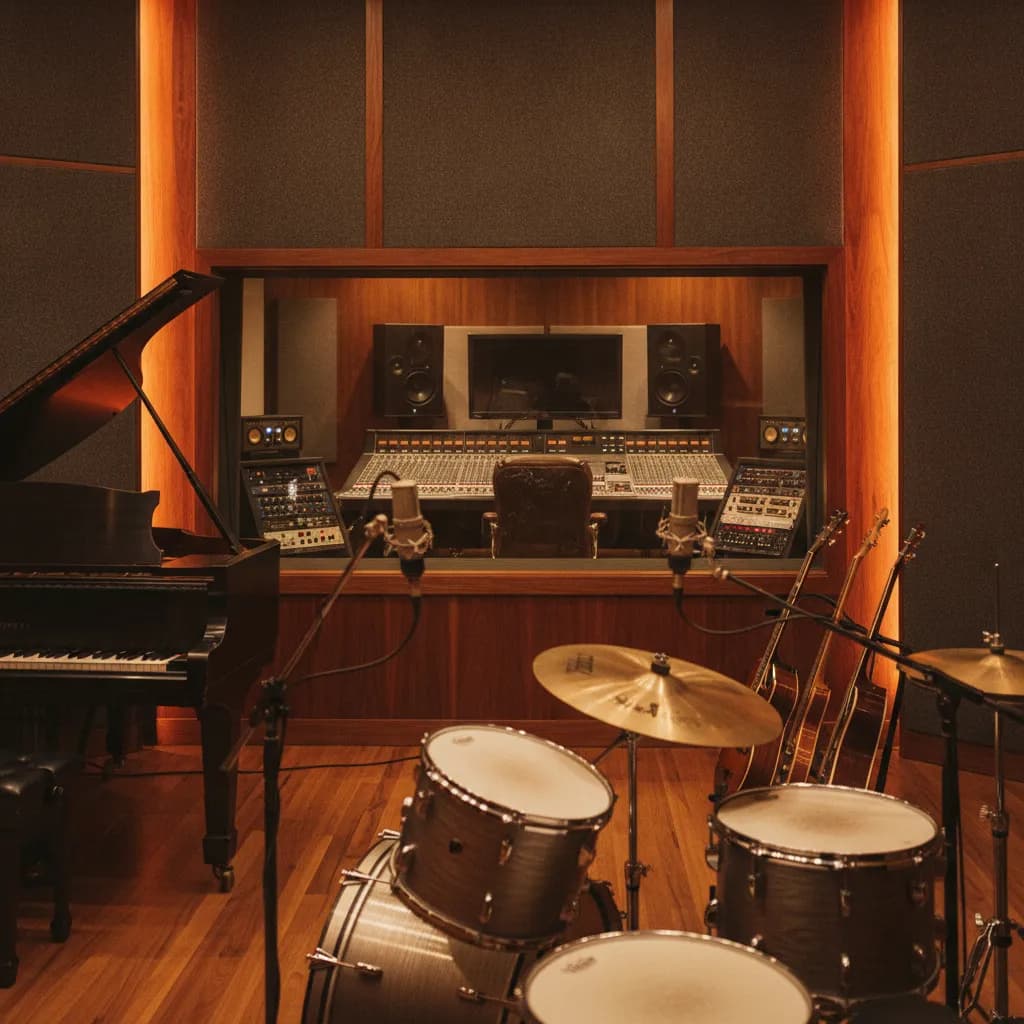
The short answer
For voice actors, narrators, and agencies working in Los Angeles, Paradise Recording's Rainforest Room in Santa Monica delivers a purpose-built voiceover environment — low noise floor, Manley Reference Cardioid into Tube-Tech CL 1B signal chain, an included in-house engineer, and remote directing via Source Connect or Zoom — at rates that start at $200 for two hours, well below the typical LA voiceover studio range of $200–$500 per hour. Files ship the same day, formatted to 48 kHz/24-bit WAV for video and broadcast work, with MP3 references for auditions and approvals.
Why the Rainforest Room works for voiceover
The Rainforest Room was designed for exactly this use case: vocals, narration, and podcasts in a quiet, controlled space. A few things matter more than gear lists when you're choosing a voiceover room:
Room tone. An untreated room is the single biggest reason files get rejected by ACX, broadcast QC, or a client's post house. The Rainforest Room's acoustic treatment keeps the noise floor low enough for audiobook work, where the platform standard is unforgiving on HVAC bleed and room ring.
The signal chain. The Manley Reference Cardioid into the Tube-Tech CL 1B gives you a warm, controlled capture that translates cleanly to video timelines and broadcast delivery — without the harshness that cheaper chains introduce when a client's engineer pushes the gain in post.
An engineer in the room. Every Paradise session includes an in-house engineer at no extra charge. For voiceover, that means someone is monitoring levels, catching mouth noise between takes, and managing the session file — so you're performing, not troubleshooting.
Delivery formats: what to ask for and why
Music traditionally lives at 44.1 kHz, while video and broadcast live at 48 kHz. Since most voiceover ends up attached to video, 48 kHz has become the working standard for voice over. Paradise sessions are recorded at 48 kHz/24-bit by default.
Deliver WAV unless the client specifically asks for MP3. A WAV file is uncompressed audio — it contains everything the microphone captured, which is exactly what a client's audio engineer wants. They may be mixing your voice under music, running it through processing, or cutting it into a video timeline, and every one of those steps benefits from starting with full-quality audio.
48 kHz/24-bit BWF is the broadcast standard. If files arrive as 44.1 kHz MP3s without a specific brief instruction to do so, the supplier is not delivering to broadcast spec.
For auditions and client approvals, the engineer exports a 320 kbps MP3 reference alongside the master WAV — fast to email, easy to play back on any device, and clearly labeled so nobody accidentally submits the compressed version.
Mono is normally right for voiceover. Stereo yields larger files and more opportunities for something to go wrong in the chain. Exceptions exist — for example, if you explicitly want a stereo file with room or effect — but the default is mono.
Remote directing: how it works here
In a typical remote directed session, the voice actor connects to the client or studio through a platform such as Source Connect, Cleanfeed, or Zoom while recording locally in their studio. Remote voiceover sessions allow producers, directors, and voice actors to collaborate in real time without being in the same studio.
At Paradise, the engineer handles all the routing. Your agency or producer joins via Zoom or Source Connect; they hear the take in real time and direct just as they would in the room. Most commercial sessions deliver same day. The master WAV — clean and unaffected by any internet compression — is what gets recorded locally and delivered.
In industry surveys, voice actors report using Zoom as the main tool for connecting remotely with their clients. Both Zoom and Source Connect are supported here. If your agency specifies a different platform, ask when you book your session.
What you can realistically cover in each block
The table below uses industry benchmarks for how much finished content a prepared narrator can capture per studio hour, alongside Paradise's posted rates for the Rainforest Room. Competitor figures are honest typical LA ranges — not specific studio quotes.
| Block | Paradise Rainforest Room | Typical LA voiceover studio range | Audiobook (finished audio) | Commercial/promo | E-learning modules |
|---|---|---|---|---|---|
| 2 hours | $200 | $200–$500/hr (per-session) | ~1–1.5 finished hrs | 3–6 :30 spots with selects | 4–8 short modules |
| 4 hours | $295 | — | ~2.5–3 finished hrs | Full campaign (10–15 spots) | Half-day e-learning chapter |
| 6 hours (half day) | $450 | — | ~4–5 finished hrs | Full broadcast package + pickups | Full e-learning module set |
| 8 hours | $595 | — | ~6–7 finished hrs | Large campaign with agency direction | Full course chapter with retakes |
| 12 hours | $850 | — | ~9–10 finished hrs | Full series or long-form narration | Complete course unit |
Notes on the audiobook column: A common industry benchmark is 1.5–2 finished hours of audio per recording hour in the studio. That means for every hour of finished audiobook, plan on 1.5–2 hours of studio time. A prepared narrator with a marked script moves toward the faster end of that range. Narrators who are just starting out will take about five hours to record one finished hour; more experienced performers can knock that down to two or three hours.
The location: why Santa Monica makes sense for voiceover work
Paradise Recording is at 1505 4th St, Ste 219, Santa Monica CA 90401, open 9 am–2 am daily. That late closing time matters for voiceover: agencies in New York or overseas can schedule afternoon sessions on their clock that land in evening LA time, and the room is still available.
The Metro E Line's Downtown Santa Monica terminus at 4th & Colorado is about a five-minute walk — no car required for talent coming from the Westside or Mid-City. Driving in from Venice takes roughly 10 minutes via Lincoln; Culver City is around 15 minutes via Washington; Hollywood is 25–35 minutes on the 10. Santa Monica's public parking structures on 4th and 5th Streets start with free hours, so a two-hour session often costs nothing to park.
If you need strings replaced or a capo before an acoustic session in the adjoining Rock Room, McCabe's Guitar Shop on Pico Blvd is a short drive away. For a pre-session meal or a walk to clear your head, the Third Street Promenade is two blocks west and the Santa Monica Pier is about ten minutes on foot.
Home studio vs. professional studio for voiceover
This is worth being honest about. ACX and other platforms reject a significant proportion of first-time submissions. The most common technical rejection reasons are a noise floor that is too high — HVAC, room noise, or computer fan noise is audible — and an RMS level that is out of range. If your home setup passes those thresholds consistently, a home studio is a perfectly legitimate option for self-directed work.
Where a professional room earns its cost:
- Agency-directed sessions. Clients expect to hear broadcast-quality audio on the monitor feed in real time. A professional room and engineer remove the technical variables from the performance conversation.
- Audiobook chapters. Long-form narration requires consistent room tone across many sessions. A treated booth with the same microphone position every time eliminates the patchwork sound that home setups produce when recording conditions change.
- Auditions that need to stand out. The Manley/Tube-Tech chain produces a capture that is noticeably cleaner than most home rigs at any price point.
For a broader comparison, see our guide to home studio vs. professional recording studio.
Rates at a glance
Paradise's Rainforest Room is the right room for voiceover, narration, and podcasting. All rates include an in-house engineer.
- 2 hours — $200
- 4 hours — $295
- 6 hours — $450
- 8 hours — $595
- 12 hours — $850
If you're recording regularly — multiple audiobook chapters, a long e-learning series, or ongoing commercial work — the Paradise membership is worth a look. Mixing and mastering for finished voiceover deliverables is available at /mix-master.
For context on where these rates sit in the broader LA market: studio time in Los Angeles typically ranges from $35–$150 per hour, depending on the studio, equipment, and whether an engineer is included. The standard hourly rate for voiceover sessions at dedicated professional facilities often ranges from $200 to $500 per hour. Paradise's block pricing keeps the effective hourly rate well below that ceiling, even with an engineer included.
Frequently asked questions
What microphone and preamp does Paradise use for voiceover?
The Rainforest Room runs a Manley Reference Cardioid microphone into a Tube-Tech CL 1B compressor. This chain is well suited to broadcast and audiobook work: it captures detail without harshness and controls dynamics gently enough that the engineer doesn't need to over-compress at the source. If you have a preferred microphone or outboard piece, ask when you book.
Does Paradise support remote directing for agency sessions?
Yes. The in-house engineer routes your session for remote direction via Source Connect or Zoom. The voice actor connects to the client or studio through a platform such as Source Connect, Cleanfeed, or Zoom while recording locally. The director provides feedback live, guiding the performance just as they would in a traditional recording booth. Your agency attends remotely; the master WAV is recorded cleanly at the studio end regardless of connection quality.
What file formats does Paradise deliver?
The default deliverable for video and broadcast work is a 48 kHz/24-bit WAV, mono. MP3 references (320 kbps) are exported for auditions and client approvals. If your project requires a different sample rate, bit depth, or channel format, specify it when you book and the engineer will configure the session accordingly before you arrive.
How much time should I book for an audiobook chapter?
A common industry benchmark is 1.5–2 finished hours of audio per recording hour in the studio. That means for every hour of finished audiobook, plan on 1.5–2 hours of studio time. A prepared narrator with a marked manuscript and a clear retake protocol moves toward the faster end. For a first chapter or a new project, the four-hour block ($295) gives you enough time to settle in, establish room tone, and capture two to three finished hours without feeling rushed.
Can I get same-day file delivery?
Yes. For commercial and short-form sessions, files are typically ready the same day. Audiobook chapters and longer narration sessions may require a brief edit pass before delivery, but the engineer will give you a realistic timeline at the end of your session. Mixing and mastering for finished deliverables is a separate service with its own turnaround — ask for a quote when you book.
Is there parking near the studio?
Santa Monica's public parking structures on 4th and 5th Streets are the practical option and start with free hours, so a short session often costs nothing to park. The Metro E Line's Downtown Santa Monica terminus at 4th & Colorado is about a five-minute walk for talent coming by transit.
Next steps
- Book a session
- Explore the Rainforest Room
- View mixing and mastering services
- See membership options
- Best Recording Studios in Santa Monica (2026 Guide)
- Best Recording Studios in Los Angeles (2026): Top 10 + How to Choose
- Home Studio vs. Professional Recording Studio: An Honest 2026 Comparison
Facts and prices on this page last verified 2026-07-31 by the Paradise Recording team.