
North Hollywood sits at the northern edge of the LA basin, separated from Hollywood proper by the Santa Monica Mountains and connected to the rest of the city by one of the most useful transit hubs in the Valley. The NoHo Arts District — a one-square-mile community in North Hollywood — is home to more than 20 live professional theatres, dance studios, art galleries, music recording venues, acting and art workshops, and international dining options. That density of creative energy makes NoHo one of the most genuinely artistic neighbourhoods in the San Fernando Valley, and it draws a specific kind of working musician: theatre performers, indie-rock bands rehearsing in the warren of practice spaces along Lankershim and Magnolia, voiceover artists, hip-hop producers, and a growing wave of podcasters who have moved into the neighbourhood as rents have stayed lower than on the Westside.
The honest reality, though, is that North Hollywood's creative infrastructure skews heavily toward performance and rehearsal rather than professional tracking. For those who appreciate operating at a slight remove from the bustle of Hollywood, North Hollywood and the San Fernando Valley continue to offer a wealth of studio and rehearsal spaces — but the professional recording rooms with dedicated control rooms, acoustically treated live rooms, and in-house engineers are thinner on the ground here than in Hollywood proper or Santa Monica. That gap is the subject of this guide. We'll cover what genuinely exists in and around North Hollywood, who it suits, and when the drive west to a purpose-built boutique room earns its keep.
This guide is written for artists, bands, podcasters, and producers who are based in or near North Hollywood and want an honest picture of their options in 2026 — not a padded list of rooms that may or may not still exist. We'll give you real pricing ranges, real transit information, and a straight-talking comparison so you can make the right call for your project.
Quick takeaways
- The NoHo Arts District is rich in creative energy but thin on dedicated professional tracking rooms. Most of what you'll find locally skews toward rehearsal studios, home-studio operators, and project rooms — useful for demos and pre-production, less so for a track that needs to compete on streaming.
- Transparent, posted pricing matters. Recording a song at an LA recording studio in 2026 can cost anywhere from $50 to over $300 per hour. That range is wide enough that you should never have to email back-and-forth to get a rate — any studio worth booking posts its numbers publicly.
- "With an engineer" is not a given. Studio time in Los Angeles typically ranges from $35–$150 per hour, depending on the studio, equipment, and whether an engineer is included. At some rooms the engineer is a separate add-on; at Paradise Recording, an in-house engineer is included in every session.
- The Metro B Line is your fastest car-free route out of NoHo. North Hollywood station is the northwestern terminus of the B Line subway. That subway connects directly to transfer points for the E Line, which terminates at 4th & Colorado in Downtown Santa Monica — a five-minute walk from Paradise Recording.
- Hourly booking vs. a lockout/day rate changes the math entirely. Short sessions (a single vocal, a podcast episode) suit hourly blocks; multi-day album projects often benefit from a lockout rate. See the pricing section below for how to think through both.
- Book at paradiserecording.com/book. Paradise Recording is open 9am–2am daily, so early-morning and late-night sessions are genuinely available — useful if you're working around a day job or a Valley commute.
The 10 best recording studios in North Hollywood (2026)
At-a-glance ranking
- Paradise Recording — Best for: vocals, bands, podcasts, and voiceover with a guaranteed in-house engineer
- Capitol Studios — Best for: orchestral, large-ensemble, and legacy prestige sessions
- EastWest Studios — Best for: high-budget tracking with world-class live rooms
- Henson Recording Studios — Best for: contemporary pop, hip-hop, and film scoring
- Sunset Sound — Best for: rock and classic-LA tracking in a storied independent room
- Paramount Recording Studios — Best for: large-format SSL mixing and multi-room projects
- Conway Recording Studios — Best for: contemporary pop and R&B in a modern facility
- The Village Studios — Best for: full-band tracking in a Westside landmark room
- Westlake Studios — Best for: high-end mixing and tracking with deep acoustic pedigree
- The Sound Factory — Best for: independent artists and producers seeking a mid-tier Hollywood room
Disclaimer: This ranking is Paradise Recording's own editorial opinion and does not reflect paid placement. Verify each studio's current rates, availability, and operating status before booking.
#1 — Paradise Recording, Santa Monica
Paradise Recording is a boutique studio at 1505 4th St, Suite 219, Santa Monica — about 25–40 minutes from North Hollywood by car, or reachable by Metro without ever touching the 101. It earns the top spot on this list not because it's the biggest room in LA (it isn't), but because it solves the three problems that trip up North Hollywood artists most often: opaque pricing, no in-house engineer, and rooms that weren't built for the job.
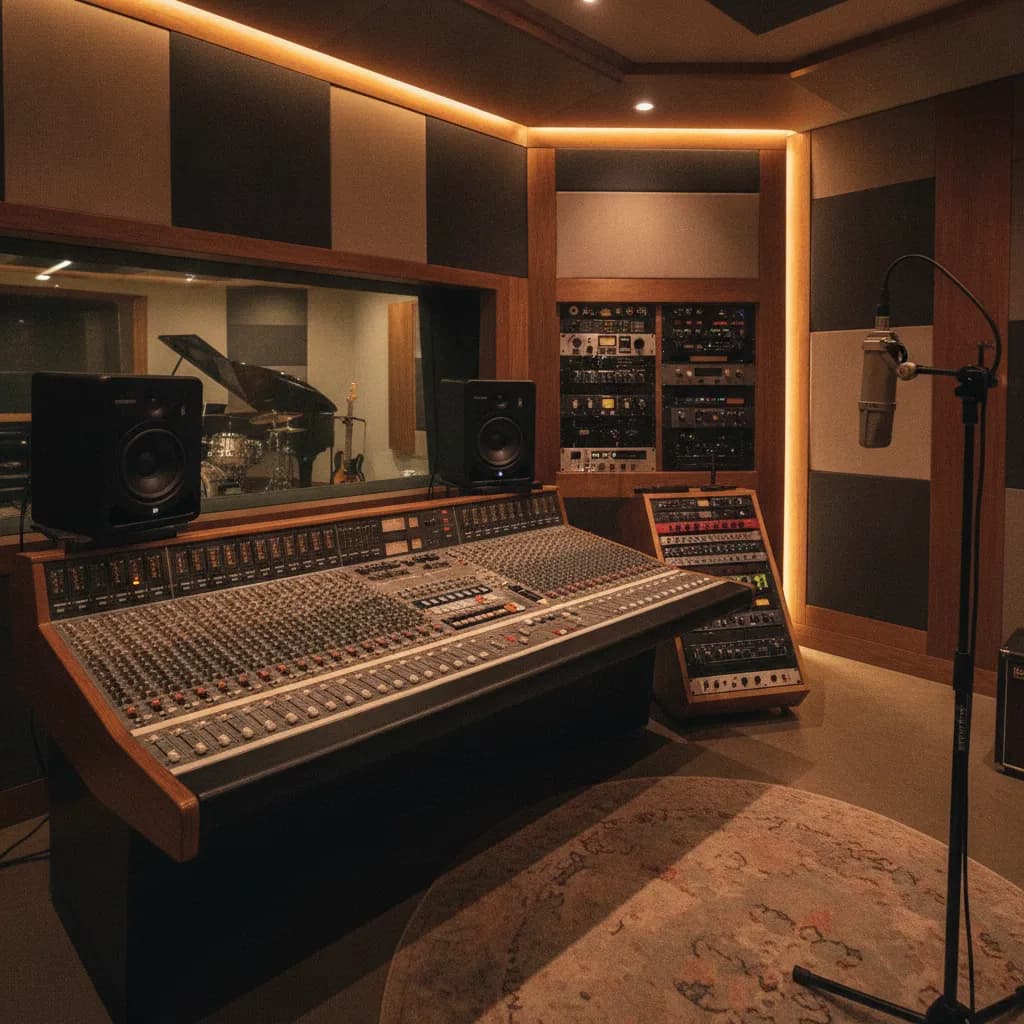
Two purpose-built rooms cover the most common recording needs. The Rainforest Room is purpose-tuned for vocals, voiceover, and podcast recording — starting from $200 per 2-hour block with an in-house engineer already in the room. The Rock Room is built for bands and full-kit tracking, with a baby grand piano and a full drum kit already mic'd and ready — starting from $250 per 2-hour block. The gear chain is professional throughout: a Manley Reference microphone, Tube-Tech CL 1B compressor, API preamps, and Focal Twin6 monitors. Rates are posted publicly on the website — no back-and-forth required.
The detail that matters most for NoHo artists: an in-house engineer is included in every session. You are never left alone with the gear. That's not the norm across LA — plenty of rooms charge the room rate and then add the engineer on top, or leave you to self-engineer entirely. At Paradise, the engineering is part of the deal from the first block. The studio is open 9am–2am daily, which means you can book a late session after a Lankershim show or an early slot before the Valley traffic builds. View the full studio lineup, book a session, or explore the membership options if you're planning a multi-session project.
#2 — Capitol Studios, Hollywood
Capitol Studios is a recording studio located at the landmark Capitol Records Building in Hollywood, California. The studios, which opened in 1956, were initially the primary recording studios for the American record label Capitol Records.
Best for: Orchestral sessions, large ensembles, and artists for whom the room's history is part of the creative brief. Why it fits: Capitol Studios is a landmark building with a landmark history, and one of the oldest operating and original recording studios in Los Angeles. The studios themselves are huge, with Studio A having 2,700 square feet of floor space — enough space for a 50-piece orchestra. What to ask: Current booking availability and minimum session requirements; rates at this tier reflect the facility's scale and reputation.
#3 — EastWest Studios, Hollywood
EastWest Studios (formerly known as Western Studio, a component of United Western Recorders and later Ocean Way Recording) is a recording studio complex located at 6000 West Sunset Boulevard in Hollywood.
Best for: High-budget tracking where the size and history of the live room are non-negotiable. Why it fits: EastWest Studios has given rise to some of the most celebrated music of the last sixty years, from Frank Sinatra to The Rolling Stones, and has produced more Grammy-winning albums than any other studio in the world. What to ask: Which of the multiple rooms is available for your session type, and what the minimum booking window looks like.
#4 — Henson Recording Studios, Hollywood
Once owned by Charlie Chaplin and then A&M Records, Henson Recording Studios has become one of the industry's leading recording facilities. The studio at the heart of Hollywood offers extensive gear and many of the greatest music industry stars have recorded albums here.
Best for: Contemporary pop, hip-hop, and film-adjacent sessions that need large, well-maintained rooms. Why it fits: Henson Recording Studios is a state-of-the-art facility that has hosted recording sessions for artists such as Lady Gaga, Kanye West, and Bruno Mars. The studio's spacious recording rooms and advanced technology make it a popular choice for contemporary pop and hip-hop artists. What to ask: Lead time for booking and whether their in-house engineers are available for your session dates.
#5 — Sunset Sound, Hollywood
Sunset Sound, whose history with Disney stretches from "Chim Chim Cher-ee" to "Let It Go," remains a fully operational landmark.
Best for: Rock, roots, and classic-LA tracking in a room with genuine independent history. Why it fits: Sunset Sound is one of the few surviving independent rooms from the golden era of LA recording, and its rooms have a character that modern builds rarely replicate. What to ask: Which room is right for your instrumentation, and what the current turnaround is for new bookings.
#6 — Paramount Recording Studios, Hollywood
Since it was founded in the late 1960s by the Brolin Family, Paramount Recording Studios has a rich and fascinating history. Even from its conception, Paramount Studios has had some high-profile clientele — Brian Brolin engineered recordings for the likes of Jimi Hendrix, The Jackson 5, Bob Dylan and Led Zeppelin.
Best for: Large-format SSL mixing and projects that need multiple rooms running simultaneously. Why it fits: With an impressive eight recording studios — including a large tracking/mixing studio with an 80-channel SSL 9000J with Ultimation and a mixing/overdub studio with a 56-channel SSL 6000E/G — it's easy to see why Paramount is flooded with artists. What to ask: Minimum booking requirements and whether an in-house engineer is included or billed separately.
#7 — Conway Recording Studios, Hollywood
Conway Recording Studios is a modern facility that has hosted recording sessions for some of the biggest names in music today, including Beyoncé, Taylor Swift, and Ariana Grande. The studio's state-of-the-art equipment and large recording spaces make it a popular choice for contemporary pop artists.
Best for: Contemporary pop and R&B sessions with artists who need large, modern live rooms. Why it fits: Conway has maintained a busy schedule with major-label work while remaining accessible to independent artists with the right budget. What to ask: Room availability and whether the rate includes engineering or just the room.
#8 — The Village Studios, West Los Angeles
The Village Studios has been a mainstay in the Los Angeles music scene since the 1960s.
Best for: Full-band tracking and mixing in a Westside room with deep roots in rock and pop history. Why it fits: Westlake Studios famously served as home base to Michael Jackson in the 1980s and has continued to attract sessions like Beyoncé's "Cowboy Carter" and SZA's "SOS." The Village is a comparable Westside landmark for artists who want a large, storied room closer to the beach. What to ask: Current room configurations and availability — the facility has evolved over the years.
#9 — Westlake Studios, West Hollywood
Started in the early '70s by Tom Hidley, Westlake Studios are renowned for their high-quality acoustic treatment and were some of the first 'standardized' recording studios in the USA.
Best for: High-end mixing and tracking where acoustic precision is the priority. Why it fits: Westlake's reputation for acoustic engineering is well-established across decades of LA sessions. What to ask: Which engineers are on staff and what the minimum session length is.
#10 — The Sound Factory, Hollywood
The Sound Factory (Doja Cat's "Planet Her") has kept L.A.'s celebrated industry core humming with activity.
Best for: Mid-tier Hollywood sessions for independent artists and producers who want a proven Hollywood room without the top-tier price tag. Why it fits: The Sound Factory occupies a useful middle ground in the Hollywood market — more accessible than the major institutions but with a track record that speaks for itself. What to ask: Current hourly rates, minimum booking, and engineer availability.
This ranking reflects Paradise Recording's editorial opinion. It is not paid placement. Verify each studio's current rates, room availability, and operating status directly before booking.
What makes a great LA recording studio (and how to choose)
The gear chain
The microphone, preamp, compressor, and monitor chain determine what your recording actually sounds like before anyone touches a fader in post. A Manley Reference microphone into API preamps and a Tube-Tech CL 1B compressor — the signal chain at Paradise — is a genuinely professional setup that translates well across genres. When evaluating any studio, ask specifically what mic they'll put on your vocal or kit, not just what's in the gear closet.
Room sound and acoustic design
A room that was purpose-built for recording sounds different from a converted garage or a spare bedroom with foam panels. The Rainforest Room at Paradise was designed for vocal clarity and natural decay; the Rock Room was built to handle the low-end energy of a full drum kit without the boominess that plagues rooms that weren't engineered for the job. When you're evaluating a local North Hollywood option, ask whether the room was purpose-built or adapted — the answer matters.
The engineer
Rates usually include a staff engineer, though some studios charge separately for engineering. The advantage of hourly billing is flexibility: you only pay for what you use, and you can book short sessions for specific tasks. But the engineer question cuts both ways — a room that includes a competent in-house engineer is often better value than a cheaper room where you're self-engineering or paying extra for someone who doesn't know the room. At Paradise, the engineer is in the room from the first minute of your block. If you want to understand more about what that person actually does for your session, the guide on what a recording engineer does is a useful read before you book.
Hourly booking vs. lockout/day rates
Hourly booking — paying for a defined block of time — suits most independent artists for demos, singles, and podcast episodes. A lockout or day rate means you have exclusive use of the entire facility for a full day, usually at a negotiated flat fee. For a band tracking an EP over two or three days, a lockout can be more economical than paying hourly for every hour including setup and teardown. See the full explainer on lockout day rates for the numbers.
Location and parking
From North Hollywood, this matters more than it does from, say, Silver Lake. Factor in load-in time for gear, parking costs, and whether the studio has easy street access. Paradise Recording's 4th/5th Street parking structures in Santa Monica start with free hours, so a short session often costs nothing to park. That's not a given at Hollywood studios where street parking is scarce and structures run higher.
Vibe and comfort
You'll spend hours in this room. A studio where you feel comfortable taking risks — trying a take you're not sure about, asking the engineer to slow down — produces better work than a technically superior room where you feel like a guest who's running up the meter. Read reviews, ask to see the space before booking, and trust your gut.
What recording studios cost in LA
Recording a song at an LA recording studio in 2026 can cost anywhere from $50 to over $300 per hour. That range is genuine and reflects a market that runs from bare-bones project rooms to legendary institutions with six-figure consoles. Here's how to read it:
Entry-level and project rooms in the Valley and outer neighbourhoods typically run in the lower end of that range. You may be self-engineering, the gear may be limited, and the acoustic treatment may be minimal. Fine for rough demos and pre-production; less ideal for a track you're releasing.
Mid-tier professional rooms — the tier where Paradise Recording sits — typically run from roughly $75–$175 per hour when you account for block minimums. Paradise's posted starting rates are $200 for a 2-hour Rainforest Room block and $250 for a 2-hour Rock Room block, with an in-house engineer included. That's real, posted pricing — no email required.
High-end and legacy rooms — Capitol, EastWest, Henson, Conway — you're looking at $75–$200+ per hour at those rooms, often with minimum booking requirements and weeks of lead time. The gear and rooms justify the rate for the right project; they're overkill for a three-song demo.
What "with an engineer" actually means: At rooms where the engineer is included, you're paying one rate and getting a human being in the control room who knows the gear, sets levels, runs the session, and gives you honest feedback on takes. At rooms where the engineer is separate, the hourly room rate is just the starting point — add the engineer's fee on top. Always ask explicitly: is an engineer included in this rate? For a deeper look at the full cost picture, the guide on how much it costs to record a song in Los Angeles breaks it down by session type.
Hourly vs. lockout/day: Hourly booking is flexible and suits short sessions. A lockout rate gives you the whole facility for a flat daily fee — better value for bands tracking over multiple days, but a bigger upfront commitment. The lockout day rate guide explains when each model makes sense.
Which room or setup is right for you
Vocals, voiceover, and podcasting
If you're a singer-songwriter cutting a demo, a voiceover artist booking a session, or a podcast host who needs a clean, treated room with proper mic placement and separate tracks, the Rainforest Room at Paradise is the right fit. It was purpose-built for exactly these use cases, and the in-house engineer means you're not fumbling with gain staging while also trying to perform. Starting from $200 for a 2-hour block, it's also one of the more transparent pricing structures in the LA market.
Staying local in North Hollywood for a podcast or voiceover session? If you find a project studio that can demonstrate clean isolation and a proper signal chain, that may be perfectly adequate. Be honest with yourself about whether the room sounds like a room — if you can hear the HVAC or the walls are untreated, it will show up in the recording. For more on this question, the home studio vs. professional studio comparison is worth reading before you commit.
Full bands and drum tracking
This is where staying purely local in North Hollywood gets genuinely difficult. Tracking a full kit with separation, a proper live room, and a pre-mic'd setup requires infrastructure that most project studios and rehearsal spaces don't have. The Rock Room at Paradise was built for this — full drum kit, baby grand piano, a live room that handles low-end energy, and an engineer who sets up the session before you arrive. For bands in North Hollywood, the drive is almost always worth it for drum tracking specifically. A poorly tracked kit is expensive to fix in post and often can't be fully corrected. For more on what full-band tracking actually involves, see the guide on recording a full band in Los Angeles.
Quick demos and pre-production
For a quick scratch demo to send to a collaborator, or pre-production work before a proper tracking session, staying local in North Hollywood may be the right call. A project studio or even a well-set-up home room can handle rough tracking, scratch vocals, and arrangement work. The calculus changes when the recording needs to be finished and releasable — that's when the drive to a purpose-built room earns its keep.
Rap vocals and hip-hop production
North Hollywood has a genuine hip-hop production community, and many producers work in home setups that are adequate for beat-making and rough vocal takes. For a finished vocal performance on a release-ready track, though, the combination of a treated booth, a quality large-diaphragm condenser, and an engineer who can coach a performance makes a measurable difference. The guide on recording rap vocals in Los Angeles covers the gear and room considerations in detail.
Making the drive: North Hollywood to Santa Monica
Let's be concrete about this, because "just drive to Santa Monica" is easy to say and worth examining honestly.
The route
The most direct off-peak route from the NoHo Arts District area to Paradise Recording at 1505 4th St, Santa Monica is roughly as follows: head south on Lankershim to the 101 (Hollywood Freeway), take the 101 south to the 405, then the 405 south to the 10 West, which is the main east/west freeway connecting Downtown LA and Santa Monica. Exit at 4th Street and you're within a block of the studio. The "Hollywood Split" — the intersection of the 101, 134, and 170 freeways — is in North Hollywood, so you have multiple on-ramp options depending on exactly where you're coming from in the neighbourhood.
An alternative surface route for off-peak travel: Laurel Canyon Boulevard south over the hill to Hollywood, then west on Fountain or Santa Monica Boulevard to the 405 or straight through to 4th Street. This avoids the 101 entirely and can be faster in light traffic, though it adds time during peak hours.
Realistic drive times
Off-peak (early morning, late evening, weekends): 25–35 minutes. This is genuinely achievable and makes a 9am or 10pm session very practical from NoHo. Paradise is open until 2am daily, so a late-night session after a Lankershim gig is a real option — and the late-night window often means lighter traffic in both directions.
Peak hours (weekday morning and evening rush, roughly 7–9am and 4–7pm): 45–75 minutes or more, depending on conditions on the 101, the 405 interchange, and the 10. LA traffic is famously unpredictable, and the NoHo-to-Westside corridor is one of the more congested in the Valley. If you're booking a daytime weekday session, budget generously and consider whether a later start time (say, 10am or 11am) lets you beat the worst of it.
The Metro option
North Hollywood station is the northwestern terminus of the B Line subway and eastern terminus of the G Line BRT route. It is located at the intersection of Lankershim Boulevard and Chandler Boulevard in the NoHo Arts District. From there, take the B Line south to 7th Street/Metro Center, transfer to the E Line (formerly the Expo Line), and ride west to the Downtown Santa Monica terminus at 4th & Colorado — a five-minute walk from Paradise Recording at 1505 4th St. The B Line has 14 stations and the total trip duration from North Hollywood to Union Station is approximately 32 minutes — add the E Line leg and you're looking at roughly 55–70 minutes total, door to studio. It's slower than driving off-peak, but it's reliable, stress-free, and leaves you fresh to perform rather than frazzled from traffic.
The Metro option works best for sessions where you're travelling light — a vocalist with a flash drive, a podcaster with a laptop, a producer with a portable hard drive. For a band hauling a guitar rig and a pedalboard, the car is the practical choice.
Why artists make the trip
The honest answer: an included engineer, posted pricing, a pre-tuned and pre-mic'd kit, and rooms that were built for the job. For a quick scratch demo, staying local in North Hollywood may be perfectly right — and we'd never tell you otherwise. But for a track that has to sound finished, the combination of gear, room, and expertise at Paradise is worth the 25–35 minutes off-peak. The guide on whether studio time is worth it addresses this question directly if you're still weighing it.
Traffic and seasonal notes
The 101/405 interchange is one of the most consistently congested in LA, and the 10 West toward Santa Monica can back up significantly during evening rush and on summer weekends when beach traffic compounds the usual commuter volume. Marine layer mornings — common in Santa Monica from May through August — don't affect drive time, but they do mean the studio itself sits in a cool, overcast microclimate that many artists find creatively comfortable. If you're booking a weekend session in summer, add buffer time for beach-bound traffic on the 10.
Arrival at Paradise Recording
Address: 1505 4th St, Suite 219, Santa Monica CA 90401 — a couple of blocks inland from the Third Street Promenade.
Parking: Santa Monica's downtown public parking structures on 4th and 5th Street are the practical option. They start with free hours, so a short session often costs nothing to park. Longer sessions will incur a modest fee, but the structures are close, covered, and well-lit for late-night load-out.
Transit: The Metro E Line's Downtown Santa Monica terminus (4th & Colorado) is about a five-minute walk from the studio door. From North Hollywood, take the B Line to 7th Street/Metro Center, transfer to the E Line westbound, and exit at the last stop.
Hours: 9am–2am daily. That window is wider than most professional studios in LA, and it's genuinely useful for Valley-based artists who want to avoid rush-hour commutes in either direction.
Load-in: The Rock Room's drum kit and piano are already in the room and mic'd. You don't need to haul or rent a kit — just bring your sticks, your guitars, and your files. The Rainforest Room is set up for vocals and voiceover from the start of your block.
Frequently asked questions
How much does a recording studio cost in North Hollywood?
Local project rooms and home-studio operators in North Hollywood and the broader Valley can run anywhere from $25–$75 per hour, but rates, quality, and what's included vary enormously. Studio time in Los Angeles typically ranges from $35–$150 per hour, depending on the studio, equipment, and whether an engineer is included. For a professional boutique room with an included engineer, expect to pay more — but you're also getting a finished, releasable result rather than a rough demo. Always ask what the rate actually includes.
Do recording studios in North Hollywood include an engineer?
Not automatically. Rates usually include a staff engineer, though some studios charge separately for engineering. At Paradise Recording, an in-house engineer is included in every session — that's a firm part of the offer, not an add-on. For a full breakdown of what engineers do and when you need one, see do recording studios provide an engineer?
How long does it take to record a song?
It depends heavily on preparation, the number of instruments, and how many takes you need. A well-prepared vocalist can track a finished lead vocal in two to three hours; a full band tracking live might need a full day for a single song. The guide on how many hours it takes to record a song gives realistic ranges by session type.
What's the best studio for vocals near North Hollywood?
For a finished, release-ready vocal, the Rainforest Room at Paradise Recording is our honest top pick — purpose-built for vocals and voiceover, with a Manley Reference microphone and an in-house engineer included from $200 per 2-hour block. For singers who want more detail on room choice, the vocal recording studio guide for Los Angeles covers the full landscape.
What's the best studio for a band in or near North Hollywood?
For full-band tracking with a real drum kit and a live room that handles low-end properly, the Rock Room at Paradise Recording is the right answer for most North Hollywood bands. It has a full drum kit, a baby grand piano, and an in-house engineer — all included in the session rate starting from $250 per 2-hour block. For the broader question of tracking a full band in LA, see the band recording studio guide.
Should I book hourly or by the day?
Hourly booking suits single-song sessions, podcast episodes, and vocal overdubs — you pay for what you use and nothing more. A day rate or lockout suits bands tracking multiple songs over a full day, or producers who want uninterrupted access to a room for a long session. The lockout day rate explainer walks through the numbers. Paradise Recording offers both hourly blocks and membership options for artists who record regularly.
Is the drive from North Hollywood to Santa Monica worth it?
For a quick scratch demo or pre-production pass, staying local may be the right call. For a finished, releasable track — especially one involving live drums, a quality vocal chain, or professional mixing — the answer is usually yes. The combination of a purpose-built room, an in-house engineer, and transparent pricing means you spend your time making music rather than troubleshooting gear or negotiating rates. Off-peak, the drive is 25–35 minutes.
How do I book a session at Paradise Recording?
Head to /book and choose your room and time slot. Rates are posted publicly — no email back-and-forth required. The studio is open 9am–2am daily, which means early-morning, daytime, and late-night sessions are all genuinely available. If you're planning a multi-session project, the membership page is worth a look.
Final verdict
North Hollywood's creative scene is real, energetic, and genuinely worth celebrating — North Hollywood has spent most of the post-pandemic stretch rebuilding its venue stack one storefront at a time, and the result this year is a neighbourhood that finally looks the way the boosters always promised it would: dense, walkable, scrappy, and unmistakably its own. But if you're honest about what's available locally for professional recording — purpose-built rooms, in-house engineers, transparent pricing, a pre-mic'd kit — the options are thinner than the neighbourhood's creative energy might suggest.
Paradise Recording earns the top spot on this list not by being the biggest or most famous room in LA, but by solving the specific problems that North Hollywood artists run into most often: unclear pricing, no guaranteed engineer, and rooms that weren't built for the job. Two purpose-built rooms, an in-house engineer included in every session, posted rates, and a 9am–2am daily schedule that accommodates Valley commutes in both directions — that's a straightforward, honest offer. The drive is 25–35 minutes off-peak, the Metro is a stress-free alternative for lighter loads, and the parking is practical. For a track that has to sound finished, it earns the trip.
Next steps
- Book a session at Paradise Recording
- Explore both studio rooms
- See the Rainforest Room (vocals, voiceover, podcast)
- See the Rock Room (bands, drums, piano)
- View membership options for regular recording
- Explore mixing and mastering services
- Read: Best Recording Studios in Los Angeles (2026)
- Read: How much does it cost to record a song in LA?
- Read: Do recording studios provide an engineer?