
Not legal advice. This page explains how copyright ownership typically works in plain English. For your specific situation — especially before signing anything — talk to a music attorney.
When you pay for studio time as a service, you own the master recording. The studio is renting you a room and a skill set; it is not acquiring any rights to what you create inside it. Under copyright law, when a person creates something with at least a minimal amount of originality, they own it unless and until they transfer ownership to someone else, in writing. That principle is your baseline. Where things get complicated — and where artists lose rights without realizing it — is when a producer funds the session, a label deal is in place, or collaborators leave without a signed split sheet.
The two copyrights in every recording
Every recorded song creates two copyrights. The composition — the song as written: melody, lyrics, arrangement — is owned by the songwriter(s). The master recording — the specific recorded audio file, the version that came out of your session, got mixed, got mastered, and was delivered to your distributor — is owned by whoever funded and controlled the recording.
The master recording does not cover the composition of recorded material, which is a separate copyright that belongs to the songwriter unless ownership of the copyright is transferred or sold to a separate entity. In other words, you can own 100% of the master and still owe publishing royalties to a co-writer — or vice versa. Keep the two buckets separate in every conversation and every contract.
Whoever owns the master controls how that specific recording is distributed, licensed, and monetized. For independent artists, owning your masters means keeping the majority of your streaming revenue and full control over licensing decisions.
Who typically owns what: a plain-English table
| Arrangement | Who usually owns the master | Notes |
|---|---|---|
| Artist pays for studio time (service model) | Artist | Standard situation; studio retains no rights |
| Artist + producer split session costs | Negotiated | Needs a written agreement before tracking |
| Producer funds the entire session | Producer (absent other agreement) | Artist should get ownership in writing upfront |
| Label deal — label pays for recording | Label | Explicitly stated in most recording agreements |
| Work-for-hire — artist hired by a brand/label | Hiring party | Must be in writing; creator waives all future royalties |
| Co-written song, no split sheet signed | Unclear / disputed | Every co-writer may claim full rights under US law |
| Beat licensed (non-exclusive lease) | Producer retains master | Artist licenses the recording, not the beat itself |
Typical LA studio hourly rates for context: LA recording studio rates typically range from $30–$100/hour for project studios to $500/hour for world-class facilities. Paradise Recording's posted rates start at $160 for a 2-hr block ($80/hr, whole studio, engineer included) — see every rate for full pricing.
The studio-as-service rule
A recording studio that charges by the hour is selling you a service: the room, the gear, the engineer's time. Most artists think that because they've paid these other people for their services, their ownership rights are covered. However, paying for something doesn't always mean ownership of it, especially under copyright law. Section 202 of Copyright Law says that ownership of a copyright is distinct from ownership of any material object in which the work is embodied.
Translation: walking out with the hard drive does not automatically mean you own the copyright. What matters is who created the work and whether any written agreement changed that default.
Sound recordings made after January 1, 1978, are automatically protected by copyright. A sound recording is considered created when it is "fixed" in a phonorecord for the first time. Neither registration in the Copyright Office nor publication is required for protection under the present law. Protection is automatic. Registration — available through the U.S. Copyright Office for $45–$65 per claim — is what makes that protection enforceable if someone infringes your work.
When ownership gets complicated
Producer points and co-ownership
Hired producers on artist projects may work under work for hire (no ownership) or negotiate points — a percentage of royalties on the sound recording. The agreement determines the arrangement. "Producer points" typically run 2–5% of the master royalty. That is not an ownership stake by default, but a poorly worded contract can blur the line. Get it in writing before the session starts.
People other than the artist who were involved in the recording of the masters can make the argument that their contribution to the recording counts as a copyrightable contribution, and thus makes them joint owners. Producers and engineers can influence the sound through musical contribution or other direction, recording techniques, and microphone placement. This is rare in practice, but it is a real legal risk when no written agreement exists.
Work-for-hire
Work-for-hire flips the default: the hiring party owns the copyright from the moment of creation. Work for hire is a legal designation where the hiring party owns the copyright from the moment of creation. The creator has no ownership rights, no ongoing royalties unless separately negotiated, and no ability to reclaim the work later.
If you sign a work-for-hire agreement as a producer, you give up your ownership stake in the master recording, your publishing stake if you contributed to the composition, your SoundExchange royalties, and your right to reclaim the copyright after 35 years. A flat fee payment for producing a track does not automatically make it work for hire. The work-for-hire designation requires a written agreement. If you produce a track for a flat fee but don't sign anything, you still own the copyright in your production.
Beat licenses
If you recorded over a leased beat, re-read the license. Most non-exclusive leases let you release the recording but do not transfer ownership of the underlying production. The producer retains the master of their beat. This matters enormously for sync licensing and distribution exclusivity.
The split sheet: your simplest protection
A split sheet is a written record of who contributed to a song and what percentage each party owns. Songwriting and sound recording split sheets are easy-to-use templated agreements that help get everyone working on the music on the same page. These forms track who is doing what and document, in writing, the percentage of income owed to each writer if it generates revenue. This makes it easy to register songs for royalties and can prevent nasty legal disputes in the future should the song or sound recording take off or get licensed.
The absence of a split sheet creates a dangerous default under U.S. copyright law. Without written documentation, every collaborator automatically owns 100% of the song. Each person involved has full control to license, distribute, and profit from the work without consulting others.
Getting splits confirmed in writing before you record is the professional standard for a reason. It protects the relationship as much as it protects the money. Music supervisors placing songs in film, TV, or advertising need to clear rights quickly. Any uncertainty about ownership will disqualify a track from consideration — not because the music isn't good enough, but because the paperwork isn't clean.
Sign the split sheet before you leave the room. Free templates are available from Disc Makers, Symphonic, and others — a quick search will surface them.
Does it matter whether you record in LA or anywhere else?
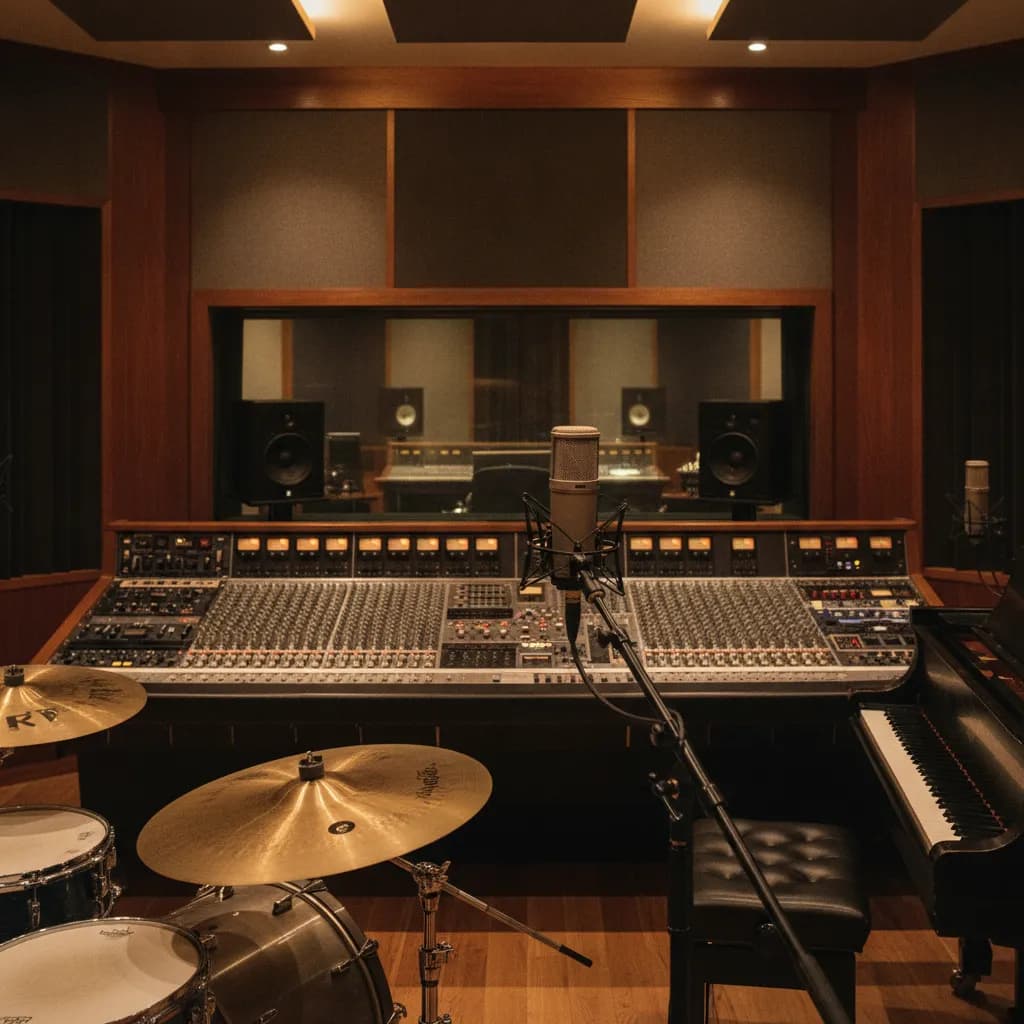
US copyright law applies uniformly across states, so the rules above are the same whether you track in Santa Monica, Nashville, or New York. What changes is the local market context. Recording a song at an LA recording studio in 2026 can cost anywhere from $50 to over $300 per hour. At Paradise, sessions start at $160 for 2 hours and take the whole studio — the Rainforest Room (vocals, podcasts) and the Rock Room (full band, baby grand, drum kit) — with the engineer included in every session. You are paying for a service. Your masters stay yours.
If you are comparing studios across the Westside, our guides to recording studios in Santa Monica and recording studios in Venice cover the local landscape honestly.
Frequently asked questions
Does the recording studio own my music if I don't sign anything?
No. A studio that charges for time as a service acquires no copyright in what you record. Under copyright law, a creator owns their work unless and until they transfer ownership to someone else, in writing. If a studio ever claims rights to your recordings without a signed agreement, that claim has no legal basis.
Does my producer automatically own part of my master?
Not automatically — but they can have a legitimate claim if they funded the session or if no written agreement exists. If a producer funded the recording session — paid for studio time, engineering, etc. — they may have a claim to master ownership unless a written agreement states otherwise. Settle this in writing before you hit record.
What is a "work-for-hire" clause and should I sign one?
It is a contract provision that transfers copyright to the hiring party from the moment of creation. One way the work-for-hire agreement is used in the music business is to transfer rights from people who make contributions to recordings. People who contribute to the recording own their contributions to the master as independent contractors, unless they transfer ownership in writing to the employer. There will ordinarily be a work-for-hire provision in the contracts for the producer, musicians, and singers who contribute to the master. Whether to sign one depends entirely on the deal — get a music attorney's opinion before you do.
Should I register my recording with the Copyright Office?
Yes, if you plan to distribute or license it. Copyright exists the moment your music is fixed in a tangible form. But copyright registration is what turns that baseline protection into an enforcement-ready asset, especially for labels, publishers, and artist teams trying to stop unauthorized commercial uses. Copyright registration costs between $45–$65 through the U.S. Copyright Office and typically takes 3–6 months to process.
When exactly should I sign a split sheet?
If there is an in-person recording session, ideally everyone will sign a split sheet for the songs created during that session before leaving the room. If a recording comes together online, try to get a split sheet signed as quickly as possible after the song is finished. Even if the recording is just a demo, the split sheet will serve to prevent any future dispute over ownership percentages if the demo ends up being officially released.
Does owning the master mean I own the song too?
No. Most music releases involve two separate copyrights: the musical work (composition) — melody, harmony, lyrics, and underlying arrangement — and the sound recording (master) — the specific recorded performance. You can own one without the other. A full rights picture requires both.
Next steps
- Book a session — engineer included, masters stay yours
- The studio — Rainforest Room (vocals, podcasts, voice-over) and Rock Room (full band, baby grand, drum kit) come with every booking, from $160/2 hrs
- Mixing & mastering — post-session services to finish your record
- Membership — regular studio time at reduced rates
- How to prepare for your first recording session — practical checklist
- How much does it cost to record a song in Los Angeles?
Facts and prices on this page last verified 2026-08-26 by the Paradise Recording team.