
Hollywood Hills sits at the geographic and spiritual center of Los Angeles music mythology. In the late 1960s and early '70s, a collection of musicians from around the U.S. flocked to the woodsy Laurel Canyon — a neighborhood that became home to Joni Mitchell, Neil Young, Crosby, Stills and Nash, The Beach Boys, the Mamas and the Papas, the Byrds, and many more. That legacy still shapes the way artists think about the Hills today: as a place to write, to live inside the music, to find your sound before you commit it to tape. What it has never been, honestly, is a dense commercial recording hub. The canyons — Laurel, Coldwater, Benedict, the Cahuenga Pass corridor — are residential and winding. Professional tracking rooms are thin on the ground, and the ones that do exist tend to be private project studios or small boutique setups rather than full-service commercial facilities with staffed engineers and posted pricing.
This guide is written for artists who live in or around Hollywood Hills and need to make a real recording decision in 2026. We'll tell you what's genuinely available locally, who it suits, and when the drive to a fully staffed commercial studio earns its keep. We'll also give you a ranked list of the best recording studios serving Hollywood Hills artists — led by Paradise Recording in Santa Monica, which offers two purpose-built rooms, a posted rate card, and an in-house engineer included in every session. The goal is to help you spend your studio budget on sound, not on surprises.
The Los Angeles recording studio market is wide and varied. Recording in LA in 2026 can cost anywhere from $50 to over $300 per hour. That range tells the whole story: a home-studio-adjacent room in a residential neighborhood and a legendary facility like EastWest or Capitol Studios live in the same city but occupy completely different tiers. For Hollywood Hills artists, understanding where you actually need to be — and when — is the most useful thing this guide can give you.
Quick takeaways
- The Hills are a writing neighborhood, not a tracking hub. Laurel Canyon and the surrounding canyons have produced some of the most celebrated songs in American music. What they've never had in abundance is commercial recording infrastructure. If you need a professional room with an engineer, posted pricing, and pro gear, plan to drive.
- "With an engineer" is not automatic. Studio time in Los Angeles typically ranges from $35–$150 per hour, depending on the studio, equipment, and whether an engineer is included. Some studios charge the engineer's time separately on top of the room rate; at Paradise Recording, an in-house engineer is included in every session at no extra charge.
- Hourly vs. lockout/day rates matter for your budget. Booking by the hour gives you flexibility for short vocal sessions or podcast recordings. A lockout or day rate reserves the entire room for a full day — useful for bands tracking multiple songs. Both structures exist in the LA market; know which fits your project before you call.
- Paradise Recording is the closest fully-staffed boutique studio with transparent pricing. Located in Santa Monica at 1505 4th St, Ste 219, it's roughly 25–45 minutes from Hollywood Hills depending on traffic and route. The Rainforest Room starts at $200 per 2-hour block; the Rock Room (full drum kit, baby grand piano) starts at $250 per 2-hour block.
- The Metro E Line is a real option. The line's Downtown Santa Monica terminus at 4th & Colorado is about a five-minute walk from Paradise Recording — a genuine alternative to driving the 10 or Sunset during peak hours.
- For a quick rough demo, staying local may be right. If you need a scratch vocal to send a collaborator, a well-set-up home studio or a small neighborhood room makes sense. The drive to a professional facility earns its keep when you're tracking something that has to sound finished.
The 10 best recording studios in Hollywood Hills (2026)
At-a-glance ranking
- Paradise Recording — Santa Monica — Best for: vocals, podcasts, full-band tracking, and any project that needs an included engineer and transparent pricing
- EastWest Studios — Hollywood — Best for: major-label and high-budget sessions in a legendary room
- Sunset Sound — Hollywood — Best for: rock, pop, and film score work in a classic LA facility
- The Village Studios — West LA — Best for: artists who want historic atmosphere and large live rooms
- Henson Recording Studios — Hollywood — Best for: orchestral, film, and high-end commercial sessions
- Conway Recording Studios — Hollywood — Best for: pop and hip-hop tracking in a well-equipped modern facility
- Sound Factory — Hollywood — Best for: contemporary pop and urban sessions
- Westlake Studios — West Hollywood — Best for: pop, R&B, and artists who want a storied Westside room
- NRG Recording Studios — North Hollywood — Best for: rock and pop in a large, multi-room complex
- The Record Plant — Hollywood — Best for: artists who want deep LA studio history and a full-service experience
This ranking reflects Paradise Recording's own editorial opinion. It is not paid placement. Verify each studio's current rates, availability, and engineer policies before booking.
1. Paradise Recording — Santa Monica (our pick)
Paradise Recording is a boutique studio, not the biggest tracking facility in LA — and that's precisely the point. What it offers that larger, pricier rooms often don't is transparency and consistency: two purpose-built rooms, an in-house engineer included in every session, and a rate card posted publicly at /studios so you know what you're spending before you pick up the phone.
The Rainforest Room is optimized for vocals, voiceover, and podcasting. The room is acoustically treated for intimate, close-mic work, and the gear chain — Manley Reference microphone, Tube-Tech CL 1B compressor, API preamps, Focal Twin6 monitors — is the kind of signal path that makes a well-prepared vocalist sound like a record. Sessions start from $200 per 2-hour block.
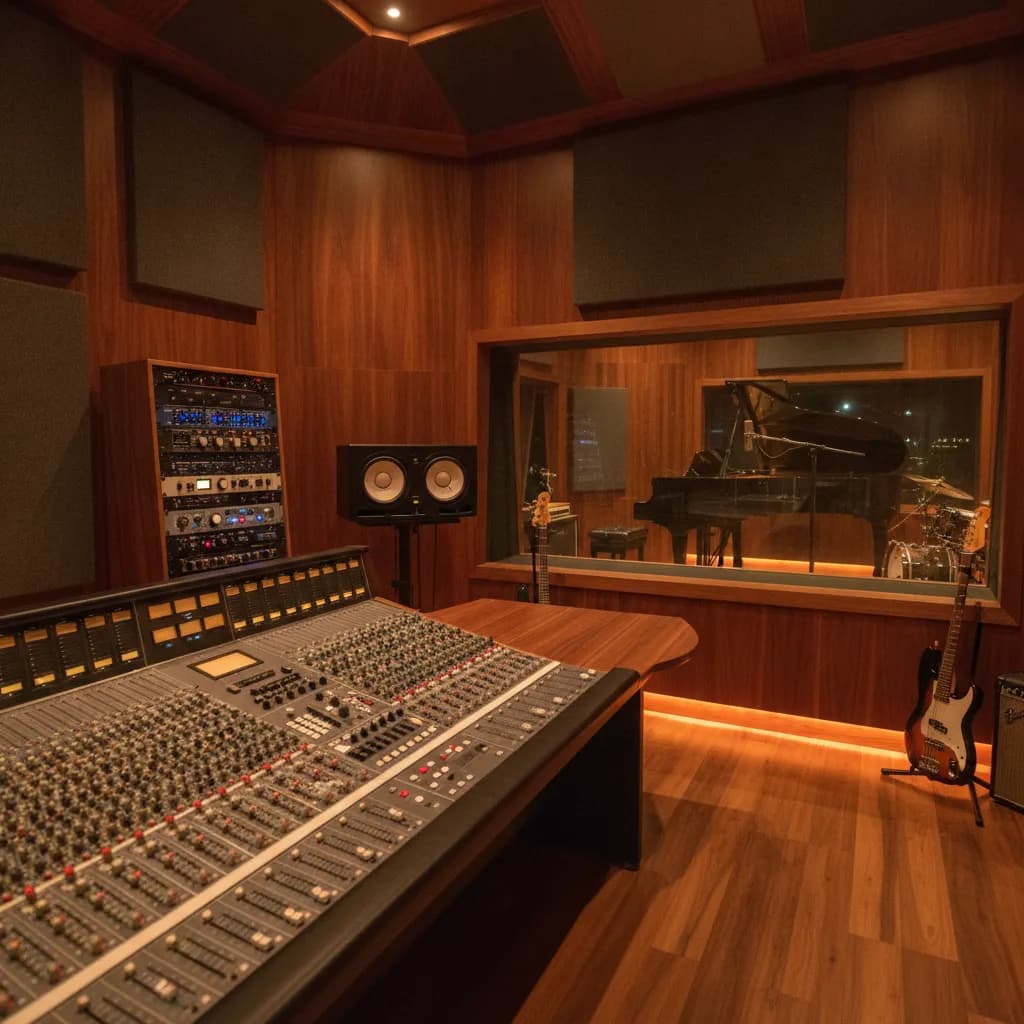
The Rock Room is built for bands and full-kit tracking. It houses a baby grand piano and a full drum kit that's already tuned and mic'd — you walk in, you play, you record. No rental fees for the kit, no setup surcharge. Sessions start from $250 per 2-hour block. For a Hollywood Hills songwriter who has been demoing at home and is ready to hear what their songs sound like with a real room and a real engineer, this is the practical next step.
The studio is at 1505 4th St, Ste 219, Santa Monica CA 90401 — a couple of blocks inland from the Third Street Promenade, open 9am–2am daily. The late closing time matters: if you're a canyon-dweller who writes at night, you can book an evening session without racing a 10pm curfew. Membership options are available for artists who record regularly, and mixing and mastering can be handled in-house so your files don't have to leave the building.
Book a session at Paradise Recording →
2. EastWest Studios — Hollywood
EastWest Studios is a recording studio complex located at 6000 West Sunset Boulevard in Hollywood. The studios have given rise to some of the most celebrated music of the last sixty years and have produced more Grammy-winning albums than any other studio in the world.
Best for: Major-label sessions, artists with larger budgets, and anyone who wants access to one of the most storied signal chains in the business. Why it fits: Multiple rooms, deep vintage-to-modern gear, and a location just down Sunset from the Hollywood Hills corridor. What to ask: Minimum booking requirements, whether an engineer is included in the room rate or billed separately, and current availability — rooms at this tier often require significant lead time.
3. Sunset Sound — Hollywood
Sunset Sound has been a favorite of recording artists since the 1950s and has produced over 300 gold albums during its tenure. Sunset Sound has played a crucial role in the evolution of music, recording albums for artists such as Prince, The Rolling Stones, and Led Zeppelin.
Best for: Rock, pop, and film score productions that benefit from genuine acoustic history and vintage gear. Why it fits: Located in Hollywood proper, making it a reasonable drive from the Hills via Cahuenga or Highland. What to ask: Which room fits your project's size and budget, what the minimum booking window is, and whether the room rate includes a house engineer.
4. The Village Studios — West LA
The Village Studios has been a mainstay in the Los Angeles music scene since the 1960s and has hosted countless iconic recording sessions, including Fleetwood Mac's Rumours and Bob Dylan's Blood on the Tracks.
Best for: Artists seeking large live rooms, a creative atmosphere, and a Westside location that's accessible from the Hills via the 405 or surface streets. Why it fits: The room's history and acoustic character are well-documented; it's a credible step up from a boutique setup for artists ready to scale. What to ask: Room availability, whether your project needs the full live room or a smaller overdub suite, and current day-rate vs. hourly options.
5. Henson Recording Studios — Hollywood
Henson Studios hosted the Rolling Stones' Hackney Diamonds and has kept LA's celebrated industry core active.
Best for: Orchestral work, film scoring, high-end commercial sessions, and any project that requires a very large live room with serious acoustic engineering. Why it fits: Hollywood location, established relationships with top engineers and producers, and multiple rooms for different session sizes. What to ask: Whether your project justifies the room size and rate tier, minimum session length, and engineer inclusion policy.
6. Conway Recording Studios — Hollywood
Conway Studios has hosted Taylor Swift's The Tortured Poets Department and remains a busy, well-regarded Hollywood facility.
Best for: Pop and hip-hop tracking, overdub sessions, and artists who need a reliable mid-to-high-tier Hollywood room. Why it fits: Multiple rooms at different price points, central Hollywood location, and a track record across contemporary genres. What to ask: Which room tier fits your budget, whether an in-house engineer is available, and current booking lead times.
7. Sound Factory — Hollywood
The Sound Factory has hosted sessions including Doja Cat's Planet Her and remains one of Hollywood's active contemporary facilities.
Best for: Contemporary pop, urban, and R&B sessions in a modern Hollywood environment. Why it fits: Well-positioned in the Hollywood corridor, with a reputation for contemporary genre work. What to ask: Room availability, engineer options, and whether the rate structure suits a shorter session or requires a day-rate minimum.
8. Westlake Studios — West Hollywood
Westlake Studios famously served as home base to Michael Jackson in the 1980s and has continued to attract sessions like Beyoncé's Cowboy Carter and SZA's SOS.
Best for: Pop, R&B, and artists who want a Westside location with a genuinely historic pedigree. Why it fits: West Hollywood placement makes it a reasonable drive from Hollywood Hills via Sunset or Laurel Canyon Boulevard. What to ask: Current room availability, rate structure, and whether an in-house engineer is part of the booking.
9. NRG Recording Studios — North Hollywood
NRG Recording Studios has a reputation for rock and pop recordings and offers a creative environment with top-notch facilities.
Best for: Rock, pop, and artists who want a multi-room complex in the Valley — a shorter drive from the north side of Hollywood Hills via the Cahuenga Pass and the 101. Why it fits: North Hollywood is a practical option for Hills residents who want to avoid westbound freeway traffic entirely. What to ask: Which room suits your session size, whether an engineer is included, and current pricing tiers.
10. The Record Plant — Hollywood
The Record Plant is one of LA's longest-running commercial recording facilities, with a history spanning decades of rock, pop, and film work in Hollywood.
Best for: Artists who want deep studio heritage, multiple room options, and a full-service Hollywood experience. Why it fits: Central Hollywood location and a broad range of room sizes for different session types and budgets. What to ask: Current room rates, minimum booking requirements, engineer availability, and turnaround for mix deliverables.
This ranking is Paradise Recording's own editorial opinion and is not paid placement. Rates, availability, and engineer policies at all studios listed above can change — verify directly before booking.
What makes a great LA recording studio (and how to choose)
The gear actually in the room
The microphone, preamp, and monitor chain determine what your recording sounds like before anyone touches a fader. A Manley Reference mic through a Tube-Tech compressor and API preamps is a fundamentally different result than a budget condenser through a USB interface — not because of brand prestige, but because of how each component handles transients, headroom, and harmonic character. Ask any studio for a specific gear list, not a marketing summary. If they can't tell you what microphone is in the vocal booth, that's information.
Room sound and acoustic treatment
A well-treated room controls reflections and gives your recordings a clean, neutral starting point. A purpose-built room — like the Rainforest Room at Paradise, designed specifically for vocal and voiceover work — will behave predictably across sessions. A repurposed space with minimal treatment will fight you. Ask whether the room was acoustically designed or acoustically treated after the fact, and whether the drum room (if you need one) has variable absorption.
The engineer: included or extra?
This is the single most important pricing question to ask any LA studio. Rates usually include a staff engineer, though some studios charge separately for engineering. When an engineer is billed separately, you may be looking at an additional $50–$100+ per hour on top of the room rate. At Paradise Recording, an in-house engineer is included in every session — the rate you see is the rate you pay. See our guide to do recording studios provide an engineer? for a full breakdown of how this varies across the LA market.
Hourly booking vs. lockout/day rates
Hourly booking is flexible: you pay for what you use, and you can book a two-hour block for a single vocal overdub without committing to a full day. A lockout or day rate reserves the entire studio for a set period — typically 10–12 hours — and usually works out to a lower effective hourly cost for longer projects. For a Hollywood Hills band tracking a full EP, a day rate may make more sense than multiple short bookings. For a singer-songwriter doing a demo vocal, an hourly block is the right tool. Read more in our guide on recording studio lockout day rates.
Location, parking, and load-in
For a solo vocalist, location is mostly about travel time. For a band with a van full of gear, load-in logistics matter significantly. Paradise Recording is in a downtown Santa Monica office building with public parking structures on 4th and 5th Street that start with free hours — a short session often costs nothing to park. The Metro E Line's Downtown Santa Monica terminus is about a five-minute walk from the door, which is a genuine option if you're traveling light.
Vibe and comfort
You will make better decisions in a room where you feel comfortable. A studio that is clean, well-lit, and staffed by someone who communicates clearly before you arrive is not a luxury — it's a functional requirement for good work. Ask whether the engineer will set up a rough mix in your headphones before you start, whether there's a lounge or waiting area for bandmates, and what the cancellation policy looks like. Our guide on recording studio deposit and cancellation policies covers what's normal in the LA market.
What recording studios cost in LA
Recording in LA in 2026 can cost anywhere from $50 to over $300 per hour, and that range is real — it reflects the genuine spread between a small neighborhood vocal booth and a multi-room facility with a legendary console. Studio time in Los Angeles typically ranges from $35–$150 per hour, depending on the studio, equipment, and whether an engineer is included. For the major historic rooms — Capitol Studios, EastWest, Sunset Sound — you're looking at $75–$200+ per hour, often with minimum booking requirements and weeks of lead time.
What "with an engineer" means in practice: Some studios post a room rate and then add the engineer's hourly fee on top — meaning the number you see on the website is not the number on your invoice. Others include the engineer in the room rate. Paradise Recording takes the second approach: the posted block rate covers the room and the engineer. No math required.
Hourly vs. day/lockout rates: The most common model for mid-range studios is hourly billing, typically with a minimum booking requirement of two to four hours. The advantage of hourly billing is flexibility: you only pay for what you use, and you can book short sessions for specific tasks like vocal overdubs or quick mix revisions. A lockout or day rate is a flat fee for exclusive use of the room for a full day — useful for bands who need uninterrupted time without the clock pressure of hourly billing.
At Paradise Recording, the Rainforest Room starts at $200 per 2-hour block and the Rock Room starts at $250 per 2-hour block — both with an engineer included. Membership options exist for artists who record regularly and want a more predictable monthly cost. For a full breakdown of what recording costs across the LA market, see our guide on how much it costs to record a song in Los Angeles.
Which room or setup is right for you?
Vocals, voiceover, and podcasting
If your session is a lead vocal, a voiceover, or a podcast episode, you need a well-treated room, a great microphone, and an engineer who knows how to get a clean signal fast. You do not need a live room or a drum kit. The Rainforest Room at Paradise is built for exactly this — the Manley Reference mic and Tube-Tech compressor chain is optimized for voice, and the 2-hour block format means you're not paying for time you don't need. For podcasters specifically, our guide on podcast studio rental costs in Los Angeles covers what to expect across the market.
Singer-songwriters and solo artists
A singer-songwriter doing a demo or a finished single typically needs a vocal booth, a way to record a reference guitar or piano, and an engineer who can deliver a rough mix before you leave. Both rooms at Paradise can handle this — the Rock Room adds the baby grand piano if your songs are piano-driven. If you're weighing a professional session against staying home, our guide on home studio vs. professional recording studio lays out the honest trade-offs.
Bands and full-kit tracking
A full band tracking live — or even overdubbing one instrument at a time — needs a room that can handle the physical and acoustic reality of a drum kit. The Rock Room at Paradise is built for this: full kit, pre-tuned and pre-mic'd, baby grand piano, and enough space for the session to breathe. For a Hollywood Hills band that's been rehearsing in a Cahuenga Pass rehearsal space and is ready to make a proper recording, this is the practical first step. For more on what full-band tracking involves, see our guide on band recording studio Los Angeles.
Multi-day projects and EP/album sessions
If you're tracking an EP or a full album, the economics of day rates and membership options start to matter. Multiple short hourly bookings across several weeks will almost always cost more than a planned block of sessions with a consistent engineer who knows your project. Ask about multi-session packages before you book your first hour.
Making the drive from Hollywood Hills to Santa Monica
This is worth its own section, because it's the practical reality for most Hollywood Hills artists who want a professional room.
The route: The most direct option is to take Laurel Canyon Boulevard south to Sunset Boulevard, then head west on Sunset through West Hollywood and Beverly Hills to the Pacific Coast Highway, turning south briefly to the 4th Street approach into Santa Monica. Alternatively, drop down to Santa Monica Boulevard or the 10 Freeway via Highland or La Brea for a more freeway-oriented route. Both paths land you at 4th Street in downtown Santa Monica.
Realistic drive times: Off-peak — say, mid-morning on a weekday or a weekend afternoon — the drive runs roughly 25–35 minutes. During westbound rush hour (roughly 4pm–7pm on weekdays), the 10 Freeway and Sunset both slow significantly, and the same trip can take 45–60 minutes or more. If you're booking a late session, the drive back east late at night is typically 20–25 minutes with light traffic. Paradise Recording is open until 2am daily, so a 9pm or 10pm session start is entirely workable — and the return drive will be the easiest one you make all day.
Friday afternoons are the exception. Westbound traffic into Santa Monica on Friday afternoons is notoriously heavy. If your session is on a Friday, book a morning slot or plan to arrive by 2pm. The studio's 9am–2am window gives you that flexibility.
The Metro E Line option: If you're traveling without gear — a vocalist coming in for a single session, a podcaster with a laptop and a hard drive — the Metro E Line is genuinely practical. The line runs from East LA through downtown and terminates at 4th & Colorado in Santa Monica, about a five-minute walk from the studio. It removes the parking and traffic variable entirely.
Parking on arrival: Santa Monica's public parking structures on 4th and 5th Street are the practical option. Both offer free initial hours, meaning a two-hour session often costs nothing to park. The structures are a short walk from 1505 4th St.
Why the drive earns its keep: A home studio or a small neighborhood room is the right call for a rough demo or a scratch vocal. But when you need a recording that has to sound finished — a single for release, a podcast with a real client, a band tracking that will go to a mixer — the combination of a purpose-built room, a staffed engineer, a professional signal chain, and transparent pricing is worth the 30-minute drive. You don't have to negotiate a rate or wonder whether the engineer is included. You show up, you record, you leave with files that are ready for the next step.
The Hollywood Hills music scene: what it actually is in 2026
It's worth being honest about what Hollywood Hills is and isn't as a recording location, because the mythology around Laurel Canyon can create unrealistic expectations.
In the late sixties and early seventies, an impromptu collection of musicians colonized a eucalyptus-scented canyon deep in the Hollywood Hills and melded folk, rock, and savvy American pop into a sound that conquered the world. Members of The Mamas and the Papas, Love, The Byrds, The Doors, Crosby, Stills, Nash & Young, The Monkees, and The Eagles — at one point or another they all called the canyon home, as did Jackson Browne, Joni Mitchell, Frank Zappa, Linda Ronstadt, and other emerging greats. Fleetwood Mac's Mick Fleetwood took up residence in Laurel Canyon in 1974, where he met Stevie Nicks and Lindsey Buckingham, who agreed to join the band, forming the Rumours era of the group.
That era's recording infrastructure, however, was largely located off the hill — at studios on Sunset Boulevard, in Hollywood proper, and eventually at facilities that spread across the Westside. The music was constantly flowing, artists were always playing and rehearsing together in each other's cottage-esque homes. The canyon was where songs were written and arrangements were worked out — not where they were tracked to tape. The actual recording happened elsewhere.
That dynamic hasn't changed much. Today, Hollywood Hills is home to working musicians, producers with home setups, and songwriters who use the physical remove from the city as a creative advantage. The Cahuenga Pass corridor — where Cahuenga Boulevard West runs through the hills between Hollywood and the Valley — has a handful of rehearsal and small recording spaces, but nothing that constitutes a professional commercial studio ecosystem. The Hotel Café, located off Cahuenga Boulevard in Hollywood, has become known for helping to establish the careers of new singer-songwriters — it's a performance venue, not a recording facility, but it's representative of the live-music energy that still runs through the corridor.
The Sunset Strip, just south of the hills via Laurel Canyon Boulevard, puts you within reach of West Hollywood's studio cluster. And the 10 Freeway, accessible from most canyon entrances, connects you to Santa Monica in under 30 minutes off-peak. For Hollywood Hills artists, the professional recording infrastructure of the Westside is genuinely close — it just requires leaving the canyon.
Frequently asked questions
How much does a recording studio cost in Hollywood Hills?
There are very few commercial recording studios operating in Hollywood Hills proper. For professional sessions, most artists in the area drive to facilities in Hollywood, West Hollywood, or Santa Monica. Studio time in Los Angeles typically ranges from $35–$150 per hour, depending on the studio, equipment, and whether an engineer is included — with major historic rooms running higher. Paradise Recording in Santa Monica starts at $200 per 2-hour block with an engineer included.
Do recording studios in LA include an engineer?
It varies significantly by studio. Rates usually include a staff engineer, though some studios charge separately for engineering. Always ask explicitly whether the posted rate includes an engineer or whether that's billed on top. At Paradise Recording, an in-house engineer is included in every session — you are never left alone with the gear. See do recording studios provide an engineer? for a full market overview.
What's the difference between hourly booking and a lockout/day rate?
Hourly booking means you pay for each hour you use, typically with a 2–4 hour minimum. A lockout or day rate gives you exclusive use of the room for a full day — usually 10–12 hours — at a flat fee that works out to a lower effective hourly cost. Hourly booking suits short sessions and individual overdubs; day rates suit bands or artists tracking multiple songs in one go. Our guide on lockout day rates explains the trade-offs in detail.
What's the best studio for vocals near Hollywood Hills?
The Rainforest Room at Paradise Recording in Santa Monica is purpose-built for vocal recording, with a Manley Reference microphone, Tube-Tech CL 1B compressor, API preamps, and an in-house engineer included. It's roughly 25–45 minutes from Hollywood Hills depending on traffic. For a full singer's guide to the LA market, see where to record vocals in Los Angeles.
What's the best studio for a full band near Hollywood Hills?
The Rock Room at Paradise Recording is built for full-band and kit tracking, with a baby grand piano and a full drum kit that's pre-tuned and pre-mic'd. You walk in and play — no rental fees for the kit. For a broader look at what full-band tracking involves, see band recording studio Los Angeles.
Can I record a podcast near Hollywood Hills?
The closest professional podcast studio with posted pricing, a staffed engineer, and purpose-built acoustic treatment is the Rainforest Room at Paradise Recording in Santa Monica. Sessions start at $200 per 2-hour block. For a full breakdown of podcast studio options and costs across LA, see our guide on podcast studio rental costs in Los Angeles.
How far in advance should I book a recording studio?
Same-day booking is available at some studios, though it is genuinely rare at professional facilities in LA. Most rooms require 24 to 48 hours notice. For major historic rooms, lead times can stretch to weeks. For Paradise Recording, check current availability at /book. Our guide on how far in advance to book a recording studio covers what's realistic across the market.
Is it worth driving from Hollywood Hills to Santa Monica to record?
For a rough demo or a scratch vocal, staying local or using a home setup is often the right call. For a recording that needs to sound finished — a releasable single, a professional podcast, a band session going to a mixer — the combination of a purpose-built room, an included engineer, professional gear, and transparent pricing makes the 25–45 minute drive worthwhile. You'll spend less time on logistics and more time actually recording.
Final verdict
Hollywood Hills is one of the great creative neighborhoods in American music history. No single musical style characterized the Laurel Canyon scene — the cross-pollination helped bands and solo artists alike plumb greater depths. That spirit is still alive in the canyon today. What the Hills has never offered is a dense professional recording infrastructure, and pretending otherwise wouldn't serve you.
For Hollywood Hills artists who need a proper session — a room that sounds like a record, an engineer who shows up knowing the gear, and a rate you can verify before you leave the house — Paradise Recording in Santa Monica is the honest first call. Two purpose-built rooms. An in-house engineer in every session. Posted pricing at /studios. Open 9am–2am daily. The drive is real, but so is the result.
Next steps
- Book a session at Paradise Recording
- Explore our rooms: Rainforest Room and Rock Room
- See Rainforest Room details (vocals, voiceover, podcast)
- See Rock Room details (bands, full kit, baby grand)
- Explore membership options for regular recording
- Add mixing and mastering to your session
- How much does it cost to record a song in Los Angeles?
- Do recording studios provide an engineer?
- The 10 best recording studios in Hollywood (2026)
- The 10 best recording studios in West Hollywood (2026)
- Singer-songwriter demo recording in Los Angeles